
The fall of prompt engineering
Holmes starts by splitting a software engineer's work into three steps: planning, implementation and code review. Before agents, implementation was the bulk of the deep work: writing the code took up almost all of the time, and whatever was left went to architecture discussions and code review.
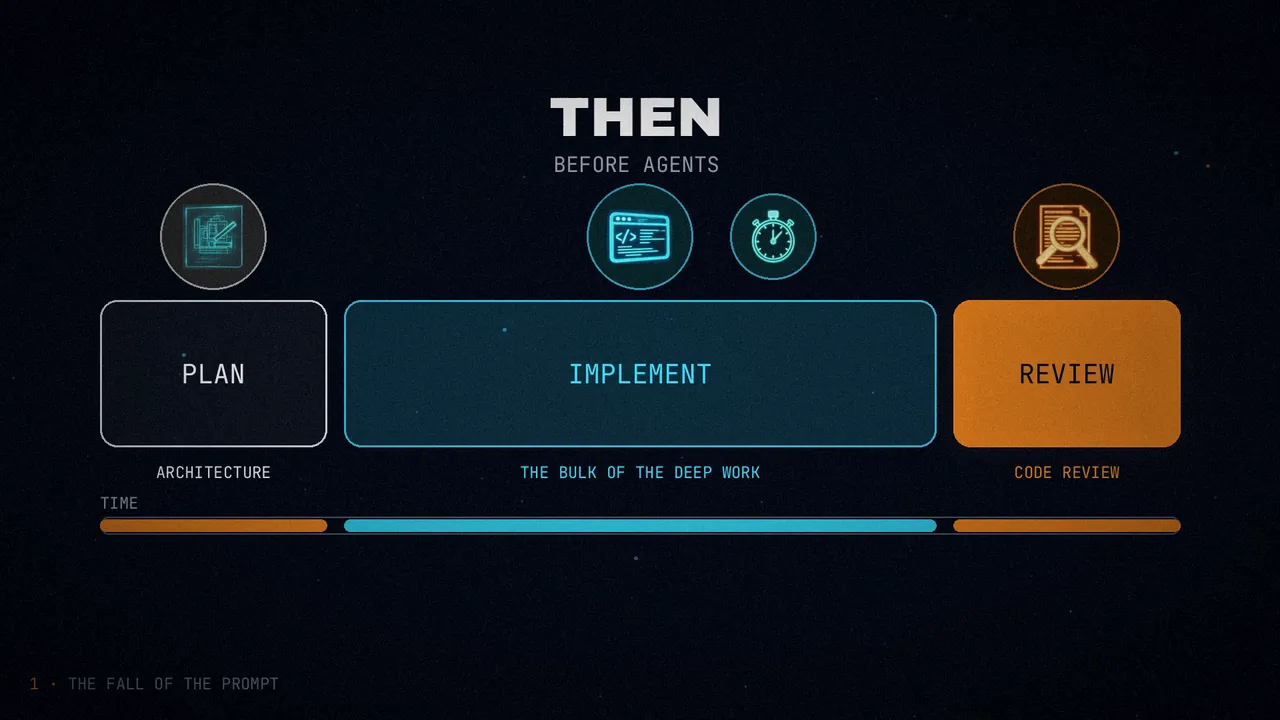
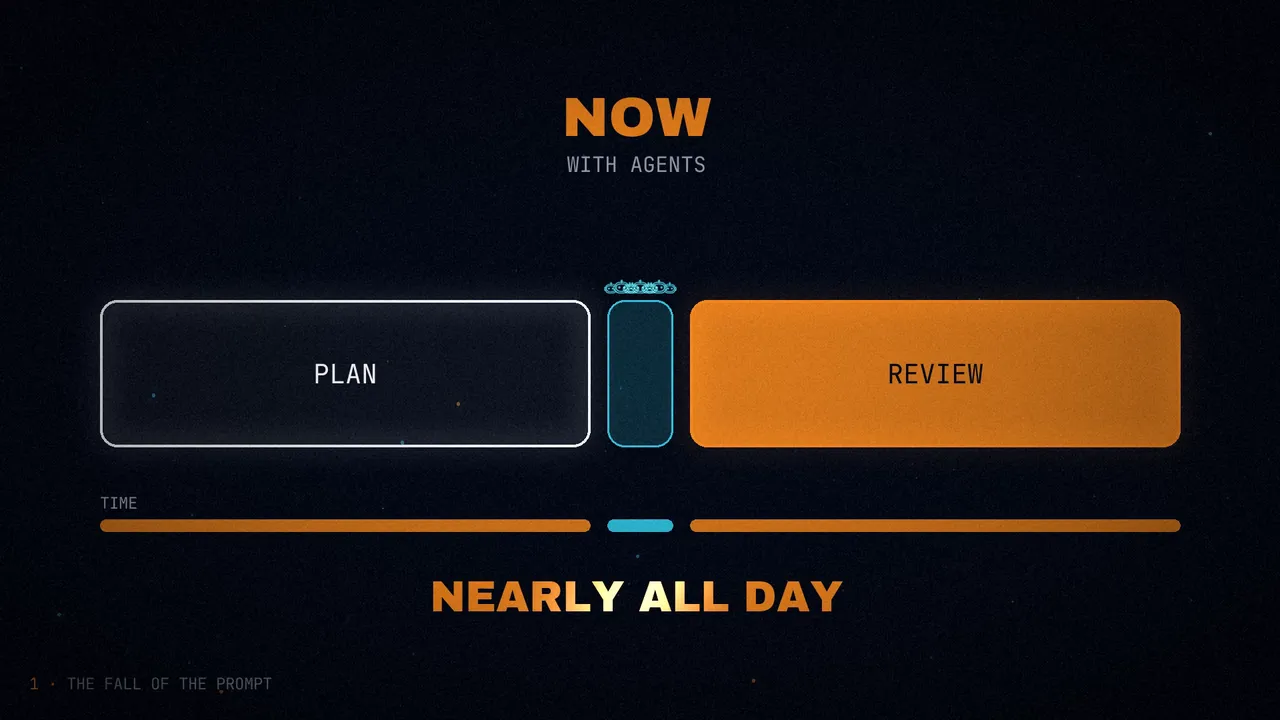
But now agents do most of the implementation, and the balance has flipped. Implementation shrinks until it almost disappears, and planning and review take up nearly the whole day.
And if you've sped up to fill that gap, it looks more like this: one plan, a tiny implementation, and then review, review, review and more review.
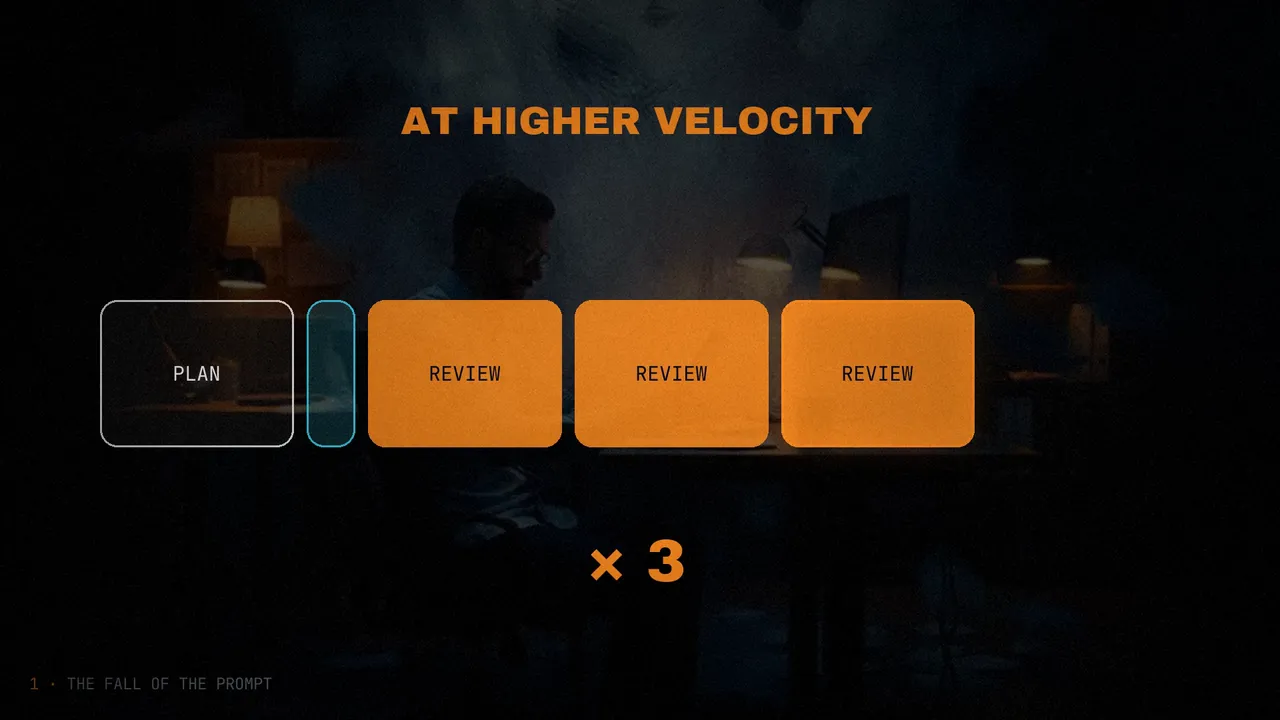
If you stop there, Holmes says, it feels like engineering was replaced with 20% meetings and 80% drudgery. Careful: that's not a measured number, it's how it feels. And if you pause for a moment, some really interesting engineering problems show up, one in each step:
- Plan: when should the agent bring in a human to draft a plan, and when should it go ahead with implementation? What questions should it ask? What goes into a good product or technical spec?
- Implement: now that agents write the code, how do we optimize its cost and quality? And what can they access: secrets, MCP servers, skills?
- Review: how do we give agents the tools to verify their own work end to end before tagging us? How can an agent assess the risk of a pull request and write that assessment into it, to save us time?
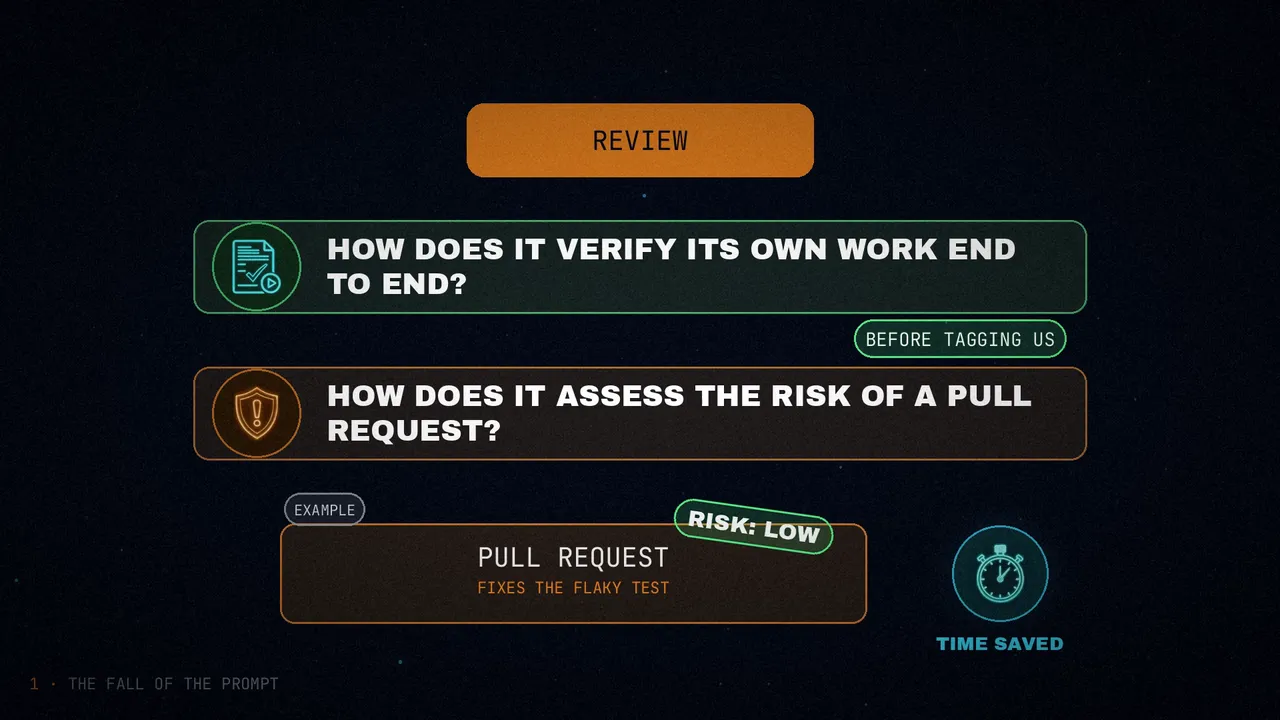
These are the same systems design questions engineers used to solve with syntax and abstractions. Only now they're solved one level higher.
What is factory engineering?
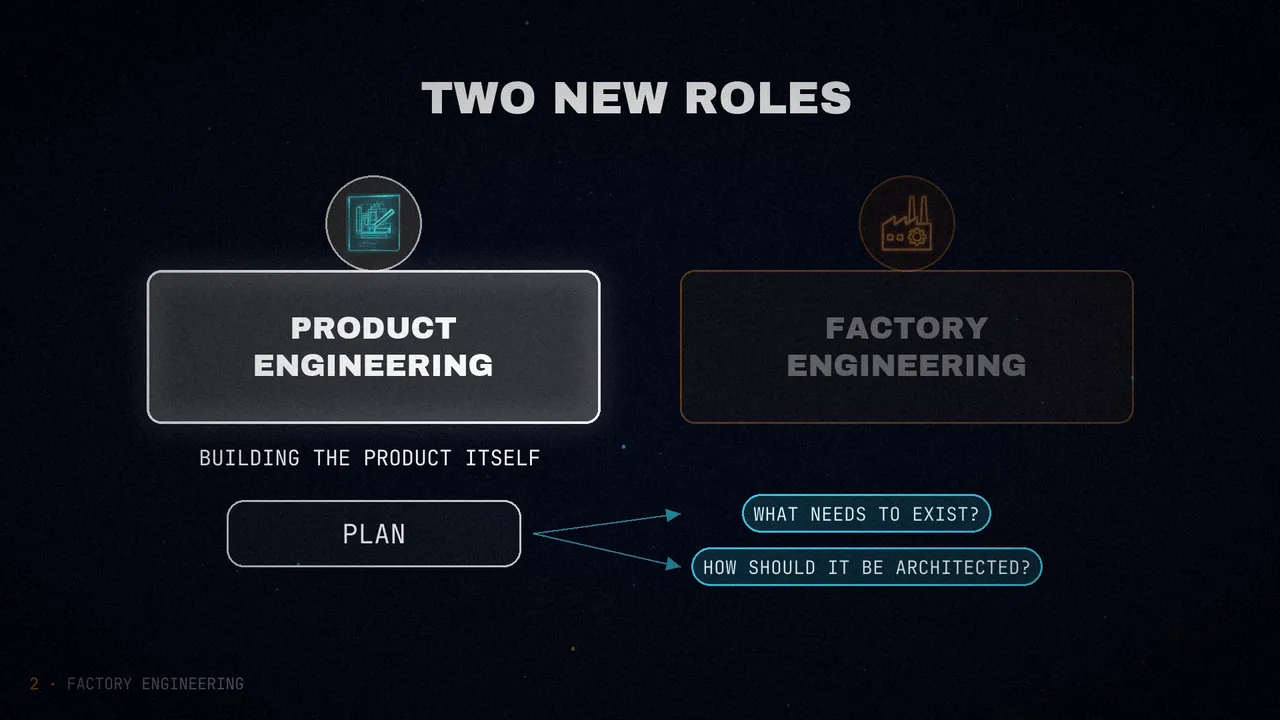
According to Holmes, these stages of development turn into two new roles:
- Product engineering: building the product itself. That's the planning part: deciding what needs to exist and how it should be architected.
- Factory engineering: building the system of agents that builds the product. That system is called a software factory, hence the name. Its job is to optimize implementation and review by automating them.
And here's the nuance I like most in the article: that does not mean automating everything. It means automating the low-risk work, and only asking for a human's attention when it's truly necessary.
What kind of requests does a factory engineer get? Holmes gives three examples:
- "Our agent keeps adding test cases and code comments that it really shouldn't. Could someone make the agent write better code?"
- "I keep copy/pasting these error monitor reports into an agent when I'm on-call. Could we automate this?"
- "Our API bill skyrocketed after the latest model release. Could we be moving some workflows to cheaper models without sacrificing code quality?"
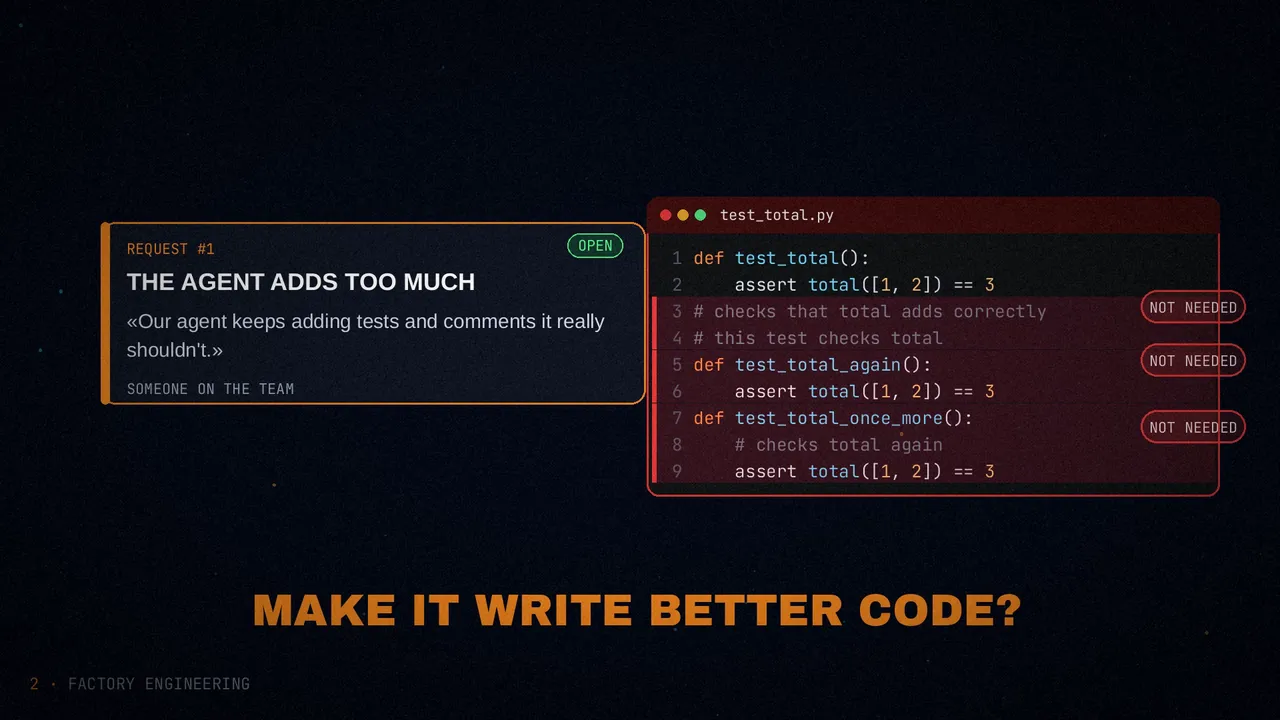
The larger your product gets, and the more agents you deploy to build it, the more valuable factory engineering becomes.
What a software factory looks like
A software factory is an automation loop around agents, designed to build better and better software over time. In its idealized form, you set the requirements and the factory builds and optimizes the product with no human involved. But agents aren't at that level yet: you can't hand them "build a product and make money" and let them run forever.
That's what factory engineers are for: to build a factory around today's agents that automates as much of the software development process as possible. Holmes asks for two things to start:
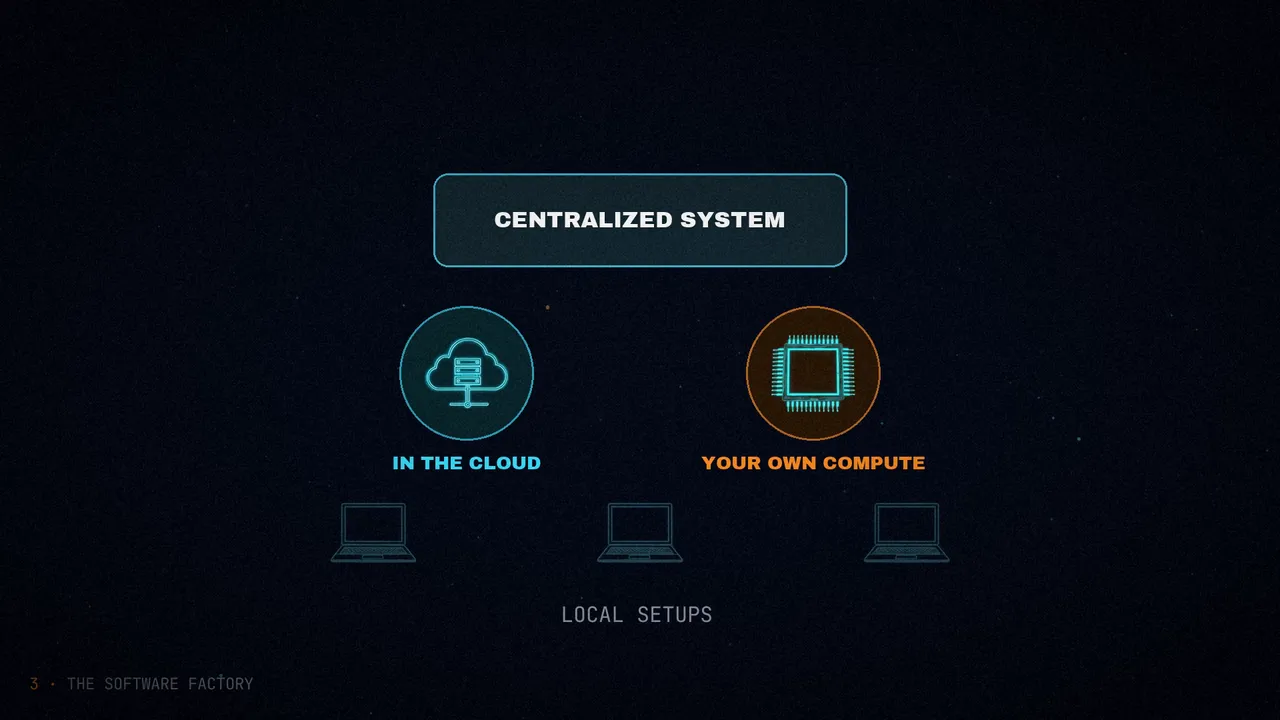
- A shared setup that both agents and the engineering team can access. Usually that means moving away from local setups towards a centralized system, in the cloud or on your own compute.
- Configurable by humans and agents: the environment where the agent runs, its access levels and the pipeline of steps it follows to produce work. That pipeline has its own parts, including the points where a human steps in.
Holmes shows an example factory (one you might build, not the only one). A task comes in: fix a flaky test. An agent triages it and decides whether a spec is needed; if it is, it writes it, and this is where the first human comes in to review it. Then the agent implements and a review step checks the change; if it finds problems, it goes back to implementation. Once it passes, a pull request is opened, and that's where the second human is. If they ask for changes, the work goes back to implementation.
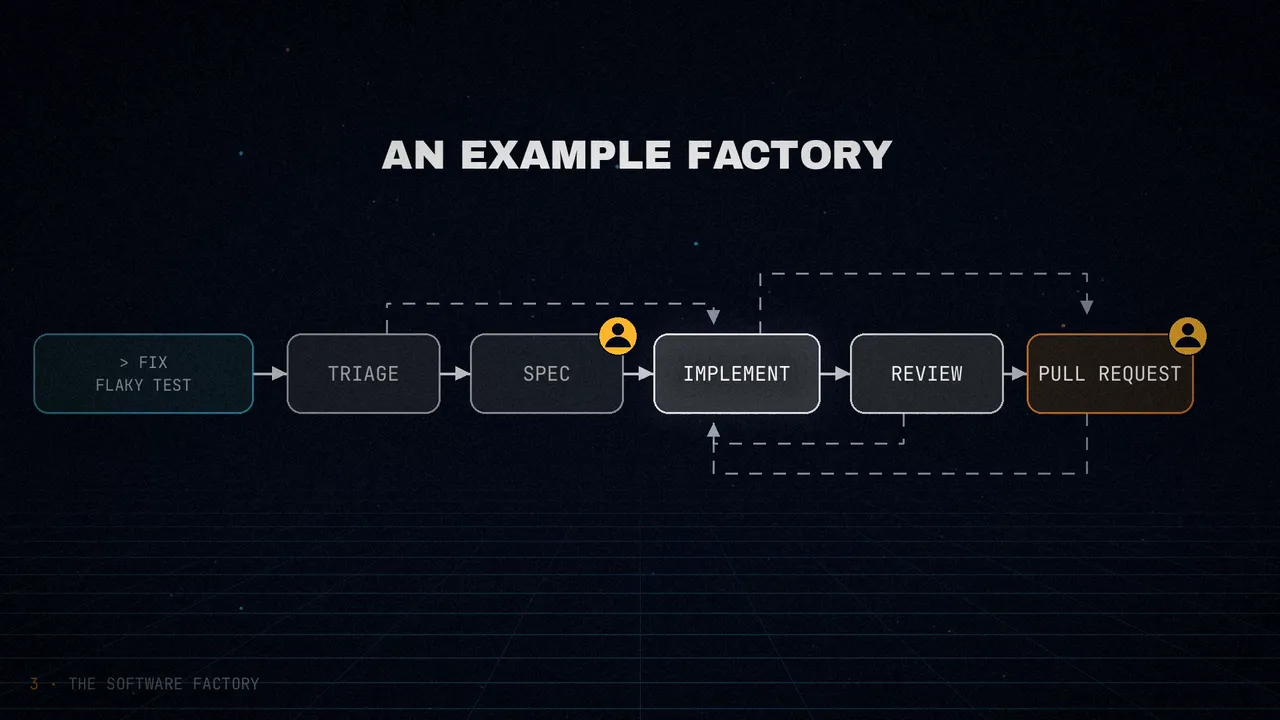
Look at the dashed arrows: there are shortcuts (a simple task can skip the spec) and loops back (review or the pull request send the work back to implementation). Humans only show up at two points.
Measuring and improving the factory
Alongside the development loop you need tools to monitor and improve the factory itself. Holmes proposes four:
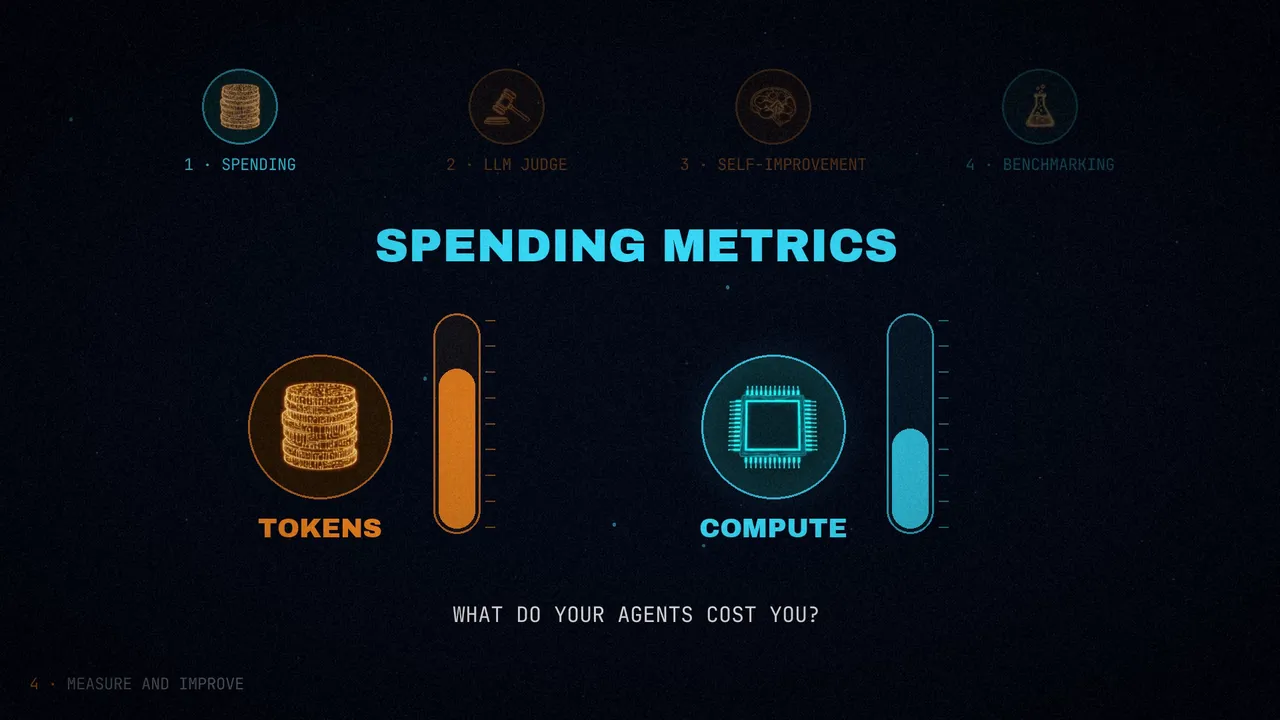
- Spending metrics. What your agents cost you, in tokens and compute. For those numbers to be useful you translate them into real value: cost per pull request, or cycle time, from the initial prompt to release.
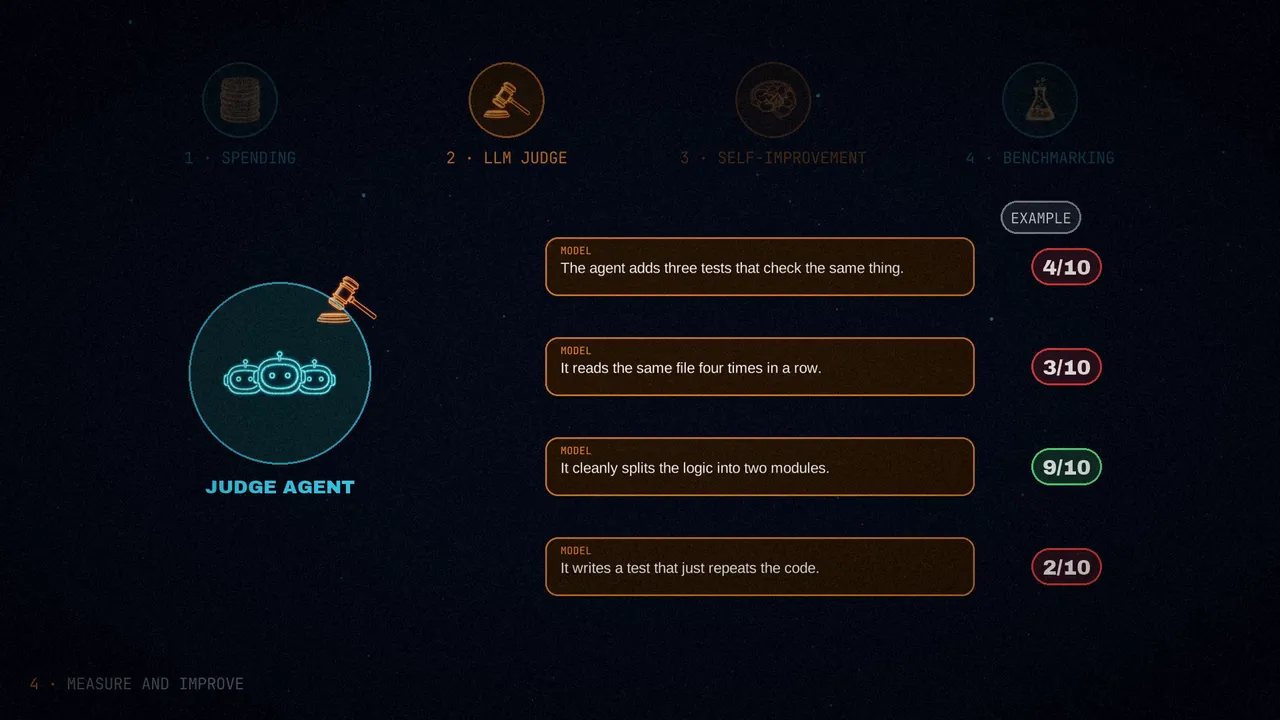
- LLM-as-a-judge scoring. Some things can't be checked statically: architecture quality, how many tests are redundant or tautological, how efficient the agent's tool calls are. To measure them, another agent goes through past agent conversations and scores them.
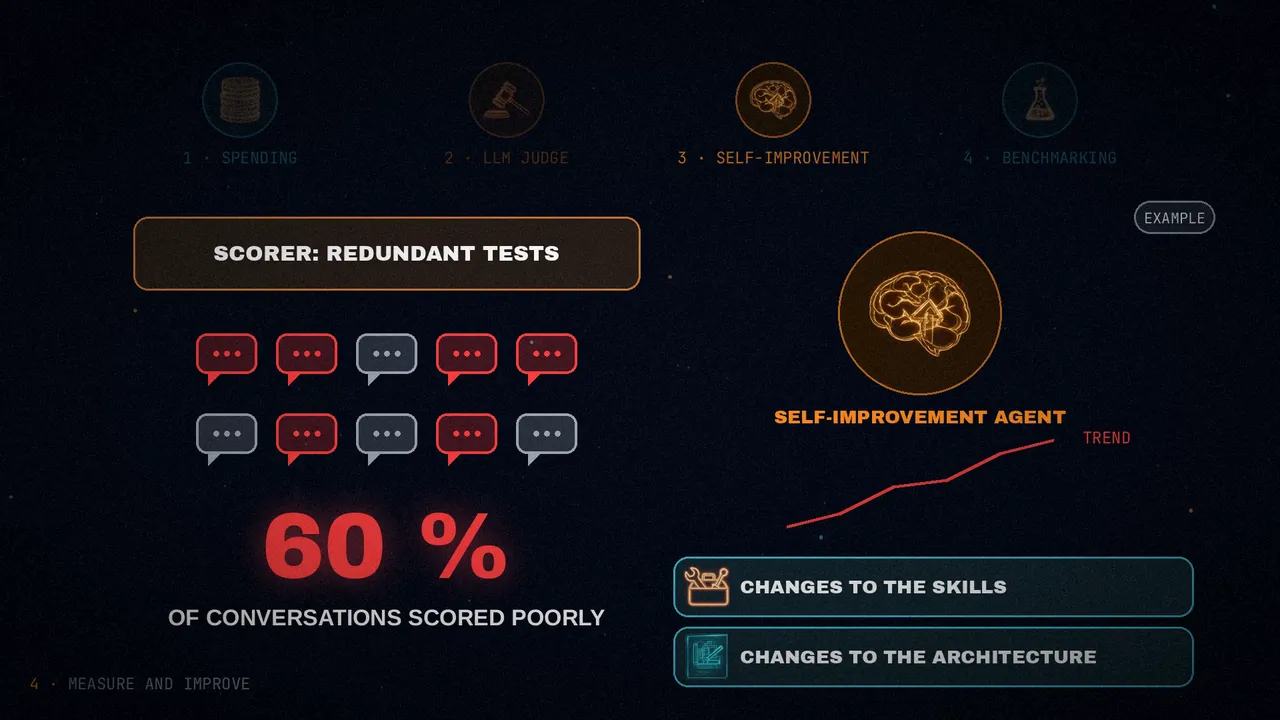
- Self-improvement. Once you track all that, make those metrics accessible to agents so they can improve their own performance.
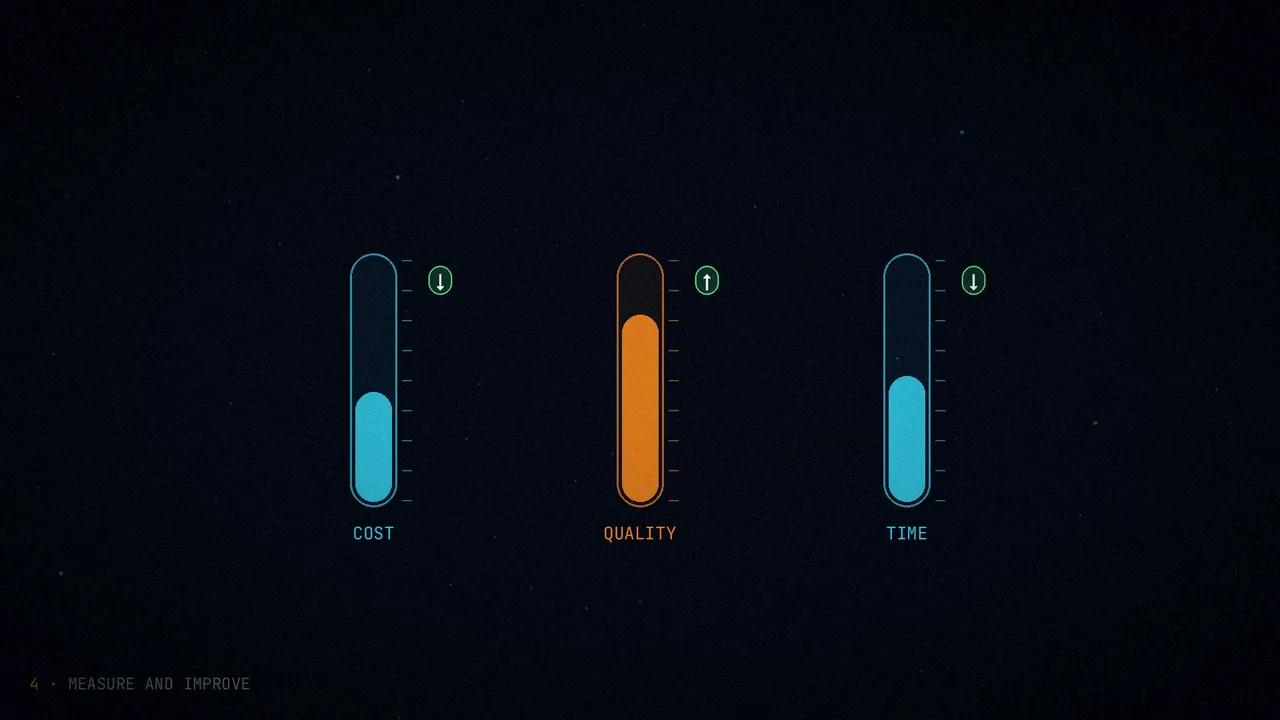
- Benchmarking. To test which factory configuration improves cost and quality. The biggest lever, according to Holmes, is model selection; but you can also remove stages from your factory, or add and remove subagents.
The article's self-improvement example: imagine a redundant tests scorer that performs poorly on 60% of conversations (a hypothetical example, not Warp data). A self-improvement agent would notice that trend and suggest changes to your skills and code architecture to reduce those failures.
And the key to benchmarking is to treat it as an experiment: each idea is a hypothesis. You change one single variable in your factory and watch how the metrics move.
To sum up
Agents already write most of the code, and engineering moves up one level. It's no longer about writing the code or the prompt, but about designing the factory that produces it, deciding where a human steps in, and measuring it so it improves by itself.
If you want to start, Holmes links at the end to a free Warp course on building software factories with their product (Warp Factories), though he says the ideas work for any setup.
Your job is no longer writing the code or the prompt: it's designing, monitoring and improving the agent factory that writes it.
What part of your work with agents would you automate first?
Sources
- "Becoming a factory engineer", by Ben Holmes (@BHolmesDev, Warp), article on X, November 19, 2026.
- Using LLM-as-a-judge scoring to measure your software factory and Engineering self-improving software factories, from the Warp blog, linked in the article.
- The video, on my channels: English and Spanish.