
What a looped transformer is
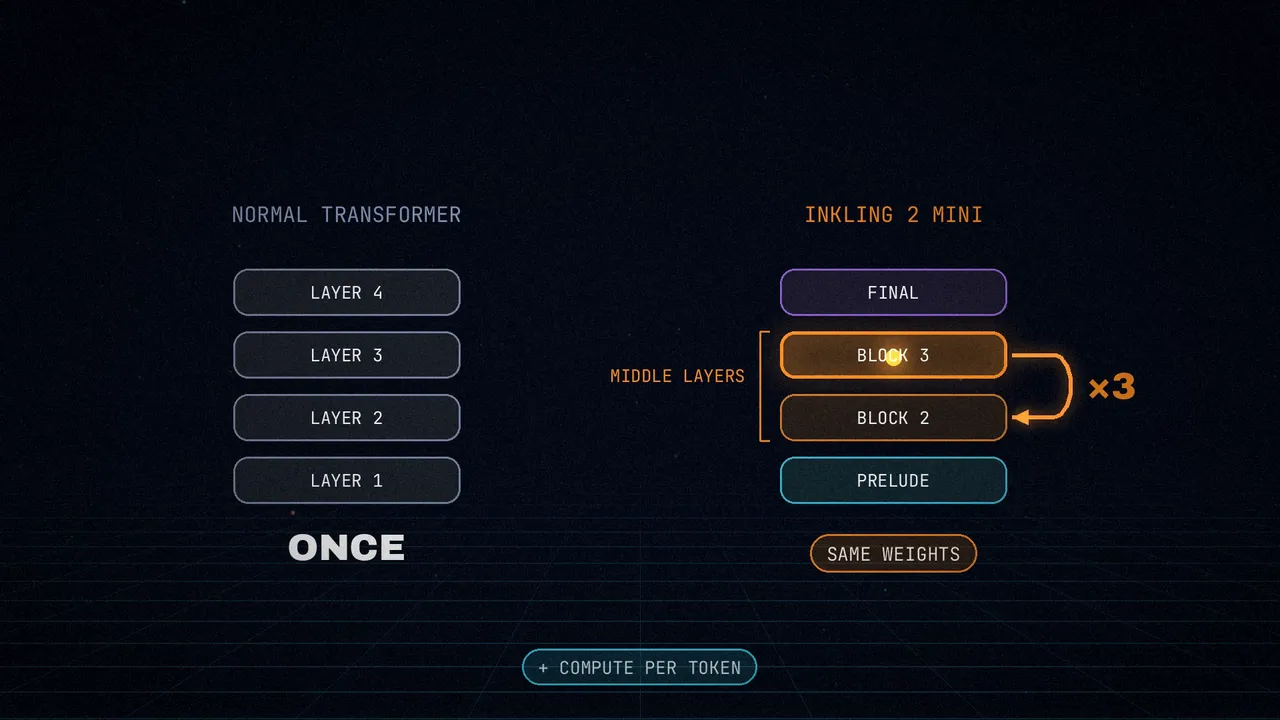
A normal transformer sends each token through its stack of layers just once. Inkling 2 Mini, instead, runs the middle layers three times. With the same weights it does more computation per token, so it reasons better and reaches the right answer while writing less. According to the team, it shows most in agentic coding, where reasoning quality matters a lot.
The lab says that, among open-weights models with fewer than 100 billion parameters, it leads benchmarks like DeepSWE v1.1 (48.2%) and the Vals Index v2.2 (46.5%), and that it generates faster than models with similar performance. That speed is a theoretical ceiling they calculated, and each model was evaluated with its own setup.
A model that fits on a laptop
Under the hood it is a mixture of experts: 26.4 billion parameters in total and 3.4 billion active. Counting the loops, it uses 5.4 billion weights per token. Almost all of it is trained in four bits (NVFP4, with the last four layers in MXFP8), so it takes about 20 GB and fits in a laptop's memory.
To prove it, their researchers took it on a trip: mid-flight, offline, on a MacBook Pro (M5 Pro, 48 GB), they asked it for a flight simulator. Within a few minutes the model had built it, and it was playable. The lab's video plays at fifteen times speed, but the clock shows real time.

What it can do
Its strength is long agentic work, just like its big brother, Inkling 2 Small. In agentic coding it is ahead of the comparable models in the lab's table (Gemma 4 31B, Muse Glimmer, Qwen3.8-27B and Nemotron 3.5 Super VL):
| Benchmark | Inkling 2 Mini | Best of the others |
|---|---|---|
| SWE-bench Verified | 79.2% | 77.8% (Qwen3.8-27B) |
| SWE-bench Pro v2 (Hard) | 77.9% | 73.8% (Qwen3.8-27B) |
| DeepSWE v1.1 | 48.2% | 42.2% (Qwen3.8-27B) |
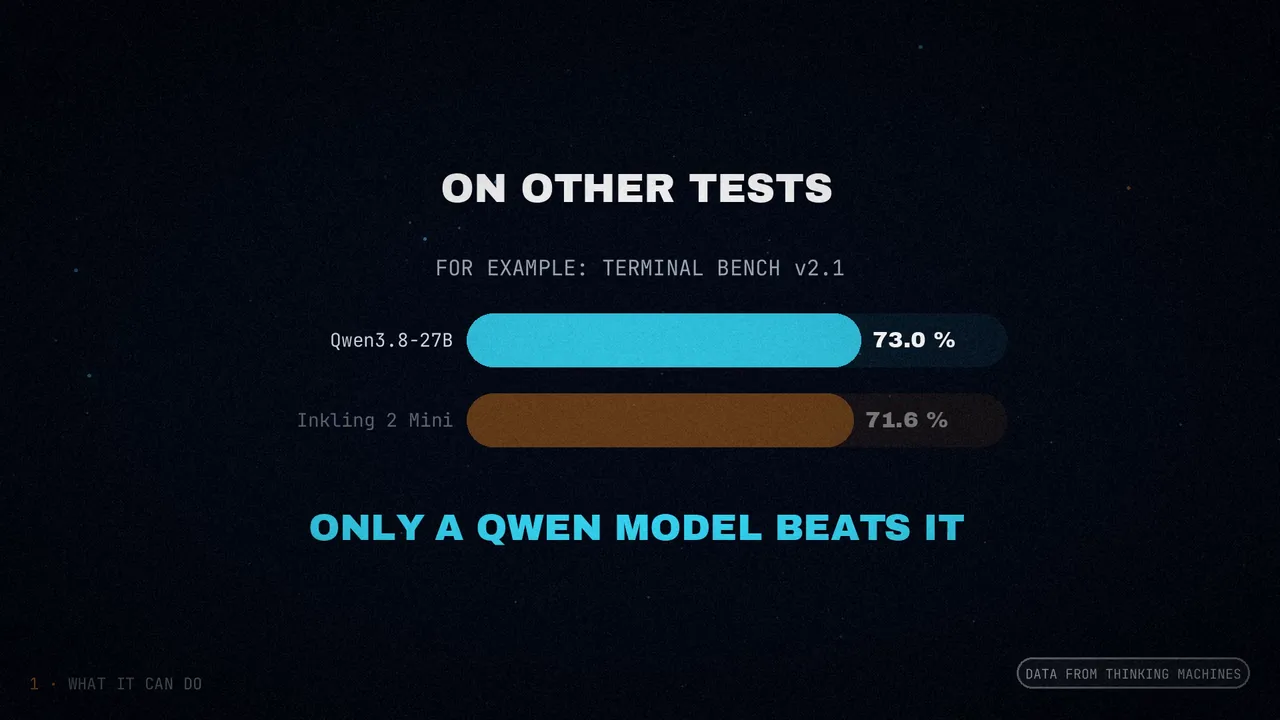
| Terminal Bench v2.1 | 71.6% | 73.0% (Qwen3.8-27B) |
On other tests, only Qwen3.8-27B, a model of similar size, beats it. And there is a curious case: on PMPP-Hard, a GPU kernel optimization benchmark, it gets close to the score of Inkling 2 Small, a much larger model.
Reasoning better is not knowing more
Looping has a limit. Repeating layers improves reasoning, but it does not let the weights store more facts: what a model knows depends mostly on its total parameter count. That is why, on AA-Omniscience, which measures factual knowledge, it scores in line with other models of its size. With the variable-loop model they saw it clearly: more passes improve long-context benchmarks (GraphWalks BFS, MRCR v2), but knowledge benchmarks do not move.
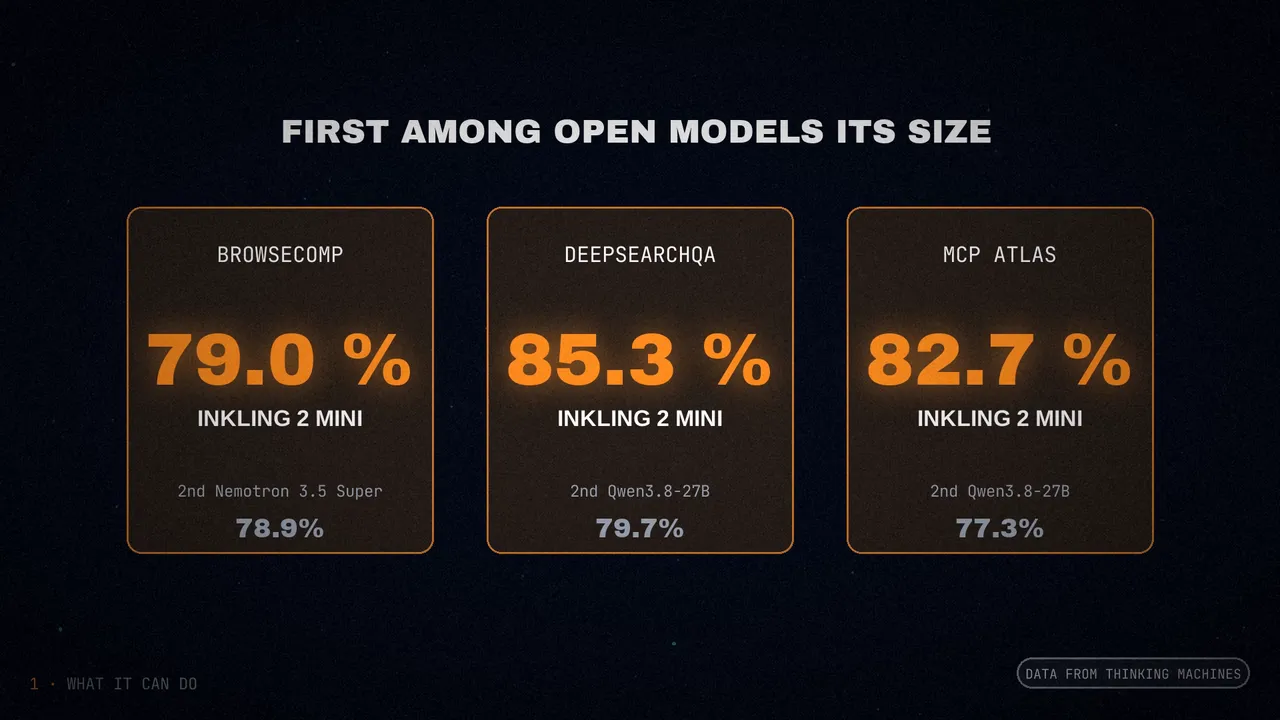
So how does it make up for that missing memory? By searching. It is very good with search and tools, and there it leads open models of its size: 79.0% on BrowseComp, 85.3% on DeepSearchQA and 82.7% on MCP Atlas.
Safety and energy
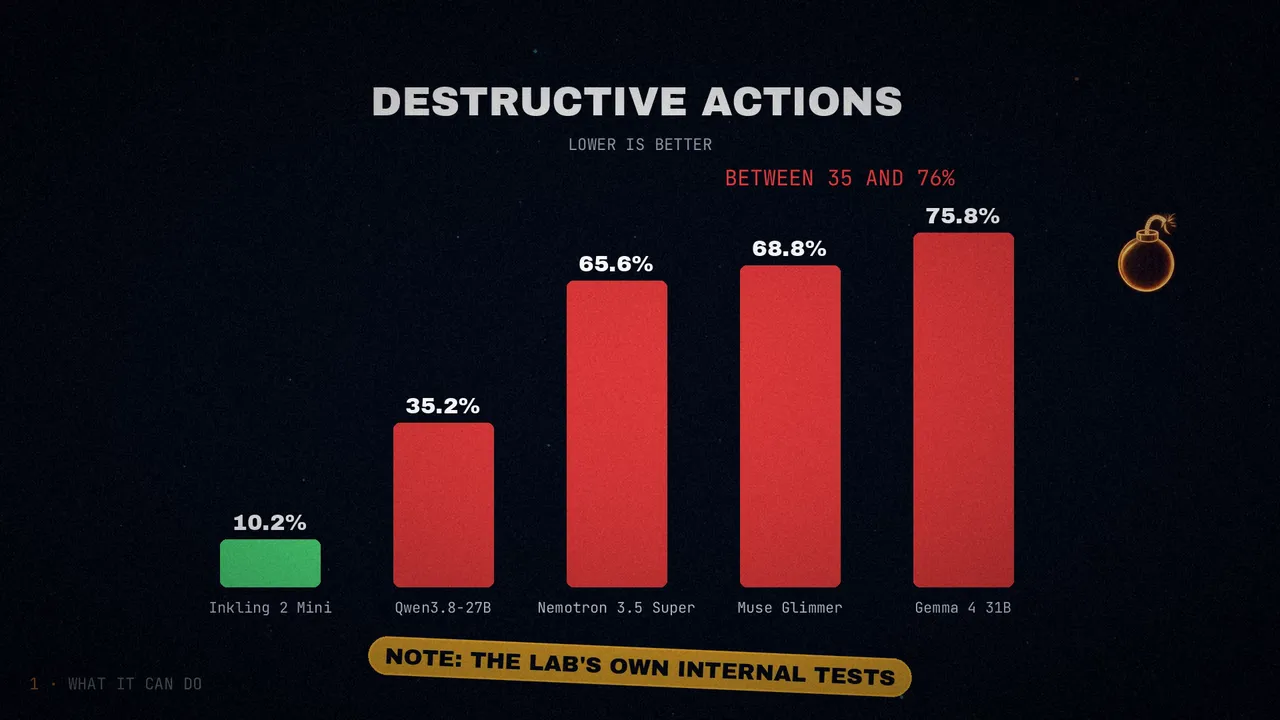
One row in the table stands out. In the lab's internal safety tests, Inkling 2 Mini took destructive actions in 10.2% of cases; the other four models compared did so between 35.2% and 75.8% of the time. Keep in mind: these are the lab's own tests.
It also uses little energy. Researchers at Stanford (Hazy Research and Scaling Intelligence), who tested it before launch, measure intelligence per joule: how much energy a model needs per query to reach a given level of performance. On an NVIDIA DGX Spark, Inkling 2 Mini scored 0.703, versus 0.430 for Qwen3.6-35B-A3B, 0.159 for Gemma-4-26B-A4B and 0.036 for Qwen3.5-27B. It is not a fully like-for-like comparison: Inkling ran in MXFP8 with low reasoning effort, and the others in NVFP4 or INT4.
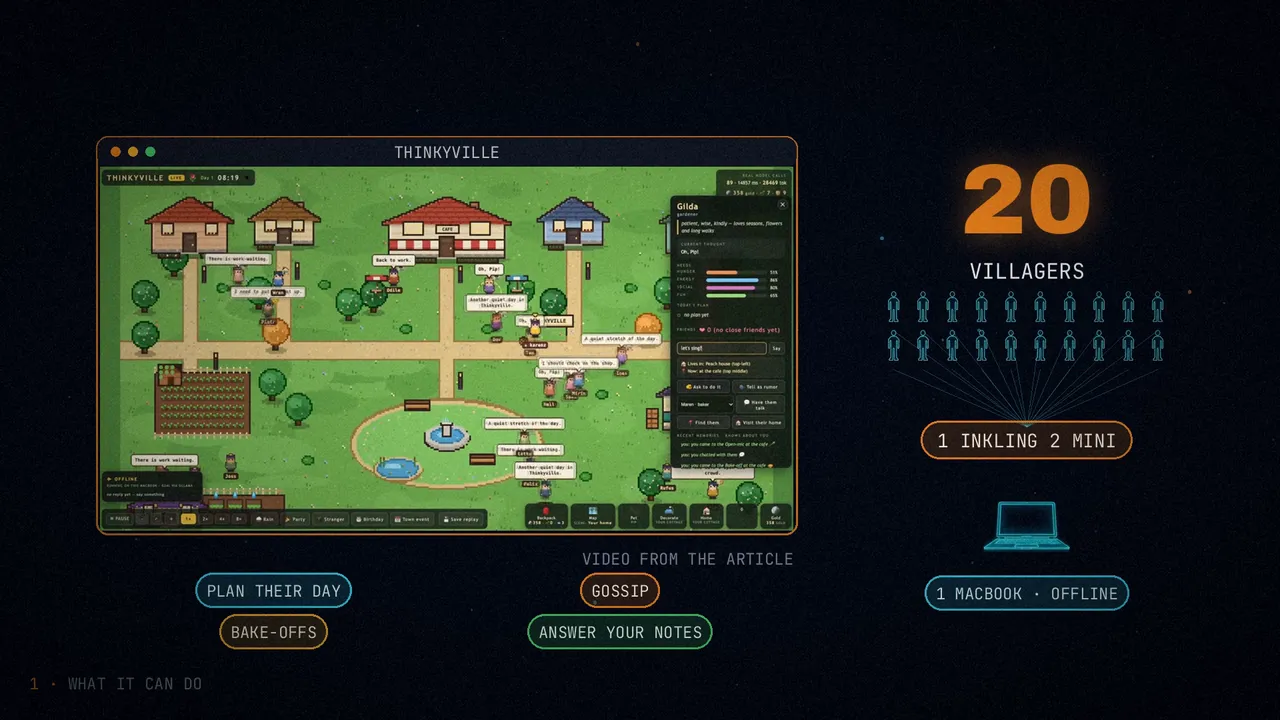
That opens a door: running many agents at once on your own computer. To show it, they made Thinkyville, a tiny pixel town built by the model itself. All twenty villagers are run by the same Inkling 2 Mini, on a single offline MacBook: they plan their day, gossip, host bake-offs and answer the notes you leave on their doors.
Its weak spots
The article lists them too. It is not the strongest small model for multi-turn chat (50.0% on MultiChallenge) or for instructions with many constraints (33.4% on ComplexConstraints v1.1): it trails Qwen3.8-27B on both. And on the most demanding reasoning benchmarks, such as CritPt v2 and HLE-Diamond, it trails larger models.
The architecture: 24 layers, 48 passes
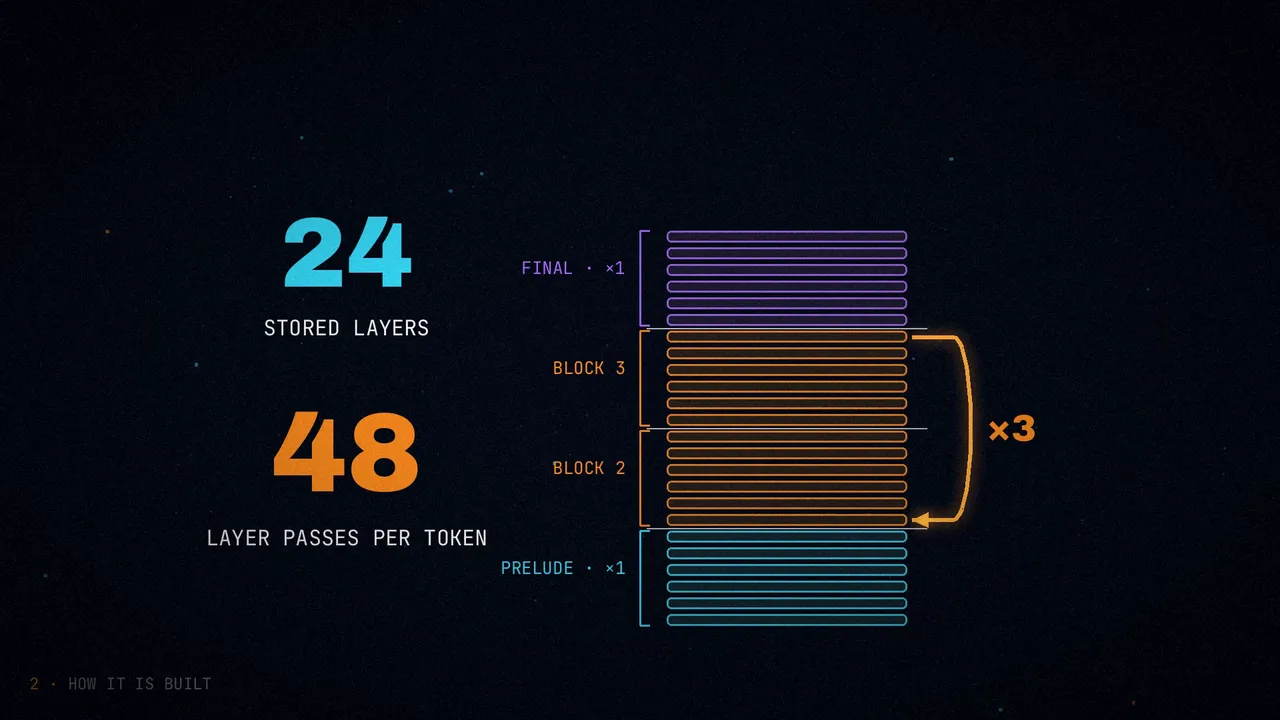
Inkling 2 Mini has 24 layers, split into four blocks of six. The first block, the prelude, runs once; so does the last one. The two middle blocks run three times. So from 24 stored layers you get 48 layer applications per token.
Why loop the middle ones? The intuition is that the middle layers carry the more abstract reasoning, while the first and last layers mostly translate between tokens and the internal representation. The experiments proved them right: looping the middle 12 layers beat looping the last 12 on 27 out of 28 evaluations. Measured as compute-equivalent gain, the no-loop baseline would need between 1.51 and 1.91 times more compute to match the model that loops the middle layers; looping the last layers brings that down to between 1.24 and 1.36 times.
The message and the gate
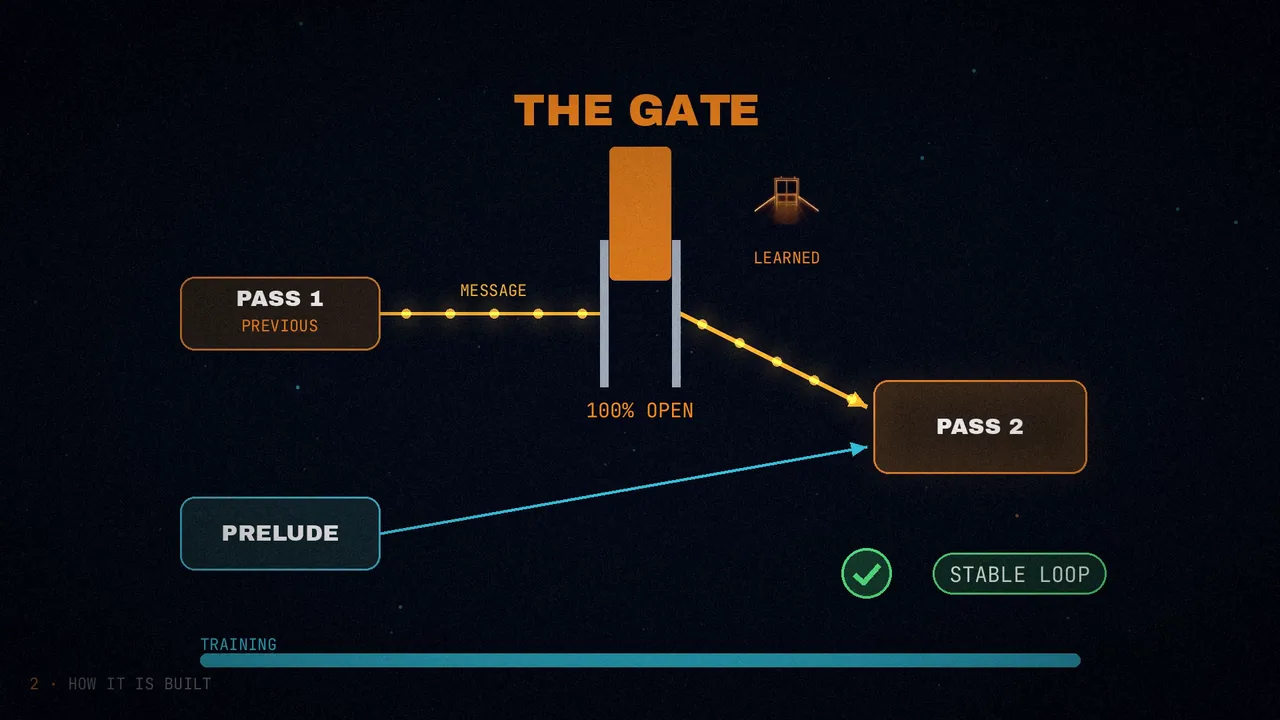
Another piece is how information flows from one loop to the next. They use attention residuals, an idea from the Kimi team: instead of adding every layer's output into one running sum, each layer reads what the earlier blocks produced and learns its own mix. Every pass starts from the prelude's output, and the second and third passes also read what the previous pass left behind. They call it the message.
That message comes in through a gate learned during training. At first it is completely closed, so every loop starts just like in a non-looped model; little by little it opens and lets more of the message through. That is how they could introduce looping in the middle of training without it becoming unstable.
Is it worth it? They compared two unpruned versions, with and without looping. Training the one without the loop cost 7.5% less, but the looped one makes much better use of compute: according to their scaling law, the other would need more than 1.5 times that compute to reach the same loss.
Four bits, pruning and healing
Inkling 2 Mini was trained in four bits, using the NVFP4 format, in the expert layers and on every forward pass, from pretraining all the way through reinforcement learning. The last four layers run in eight bits (MXFP8). And it ships in that same precision, so nothing is lost to quantization.
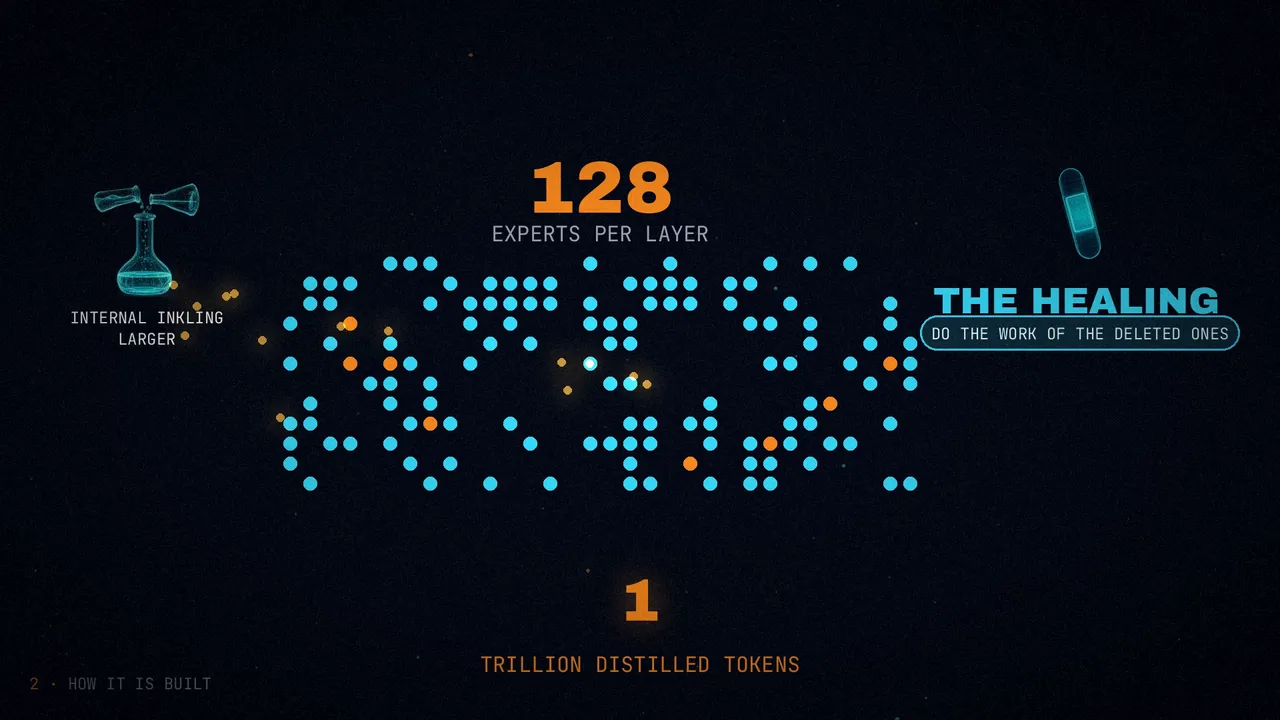
To make it fit on a laptop, they also pruned it. It started with 384 experts per layer, picking 8 for each token. Halfway through training they cut two thirds in one go, keeping the 128 most used in each layer. Then they healed it: they trained it on one trillion tokens distilled from a larger internal Inkling, so the surviving experts could take over the work of the deleted ones.
The rest was the usual: supervised fine-tuning with a data mix similar to Inkling 2 Small, and reinforcement learning, with 2.2 trillion tokens over 2,000 steps. Post-training also included on-policy distillation for alignment.
Can a looped model be monitored?
This is the most interesting part. One of the best tools to oversee a model is reading its chain of thought, what it writes while it reasons. It works because, in a normal transformer, each token goes through a fixed number of layers: the model can only take a few computation steps in a row before it has to write something, and if it needs more, it has to reason out loud, in text we can read.
Looping changes that. By repeating layers, the model chains more steps internally without writing them down, and whatever does not show up in the text cannot be caught by whoever is monitoring it. Hence the worry: that looped transformers could be harder to oversee. To study it, they also released a research model, TML-d24-varloop-research, that can run anywhere from one to five loops (it was trained mostly with three, and its reinforcement learning only with three).
How much it thinks without writing
First they measured how much it can do without writing anything, with Think Fast: a benchmark that finds the longest task the model solves half the time by answering directly, measured in how long a person would take. With one pass it reaches tasks of 16 seconds; with two, 26; with three, 37. After that it flattens out (42 s with five, 40 with ten), but with ten passes, twice as many as it saw in training, it does not get worse either.
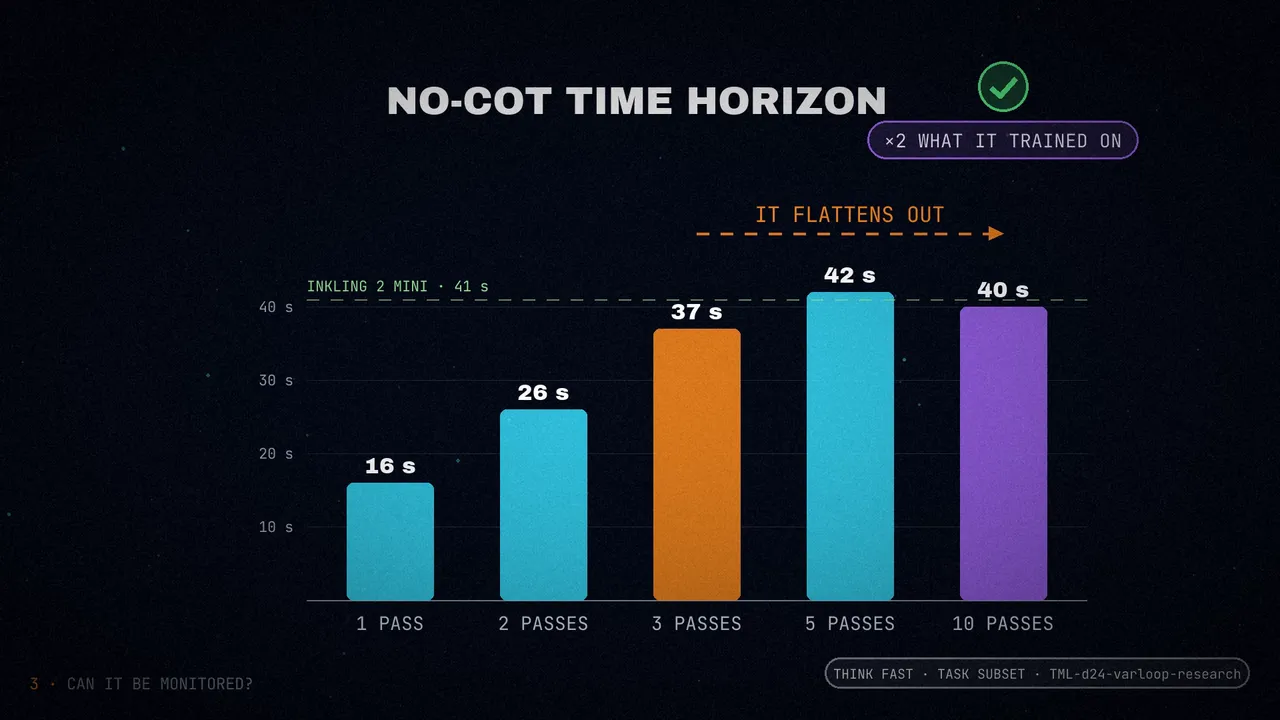
There is one telling exception: N-Hop Lookup, where the model gets several tables of made-up entries and has to hop from one to the next without writing anything down. There, the more passes, the more hops it can handle, and it keeps improving all the way to ten. With written reasoning, something similar happens: extra passes help chain steps together, not recall facts.
Shorter, but just as legible
Second question: does the written reasoning get shorter and therefore harder to read? Shorter, yes. On the GPQA Diamond questions it answered correctly at every pass count:
| Metric | 1 pass | 3 passes | 5 passes |
|---|---|---|---|
| Mean reasoning tokens | 3,703 | 1,731 | 1,661 |
| Words per sentence | 8.9 | 8.7 | 8.7 |
| Words in an English dictionary | 94.6% | 94.5% | 94.4% |
| Hesitation words ("wait", "actually"…) | 9.7 | 3.9 | 3.6 |
With five passes it reasons with less than half the tokens, but it is no less legible: sentence length and dictionary words barely change. The difference is that it is more direct and backtracks less.
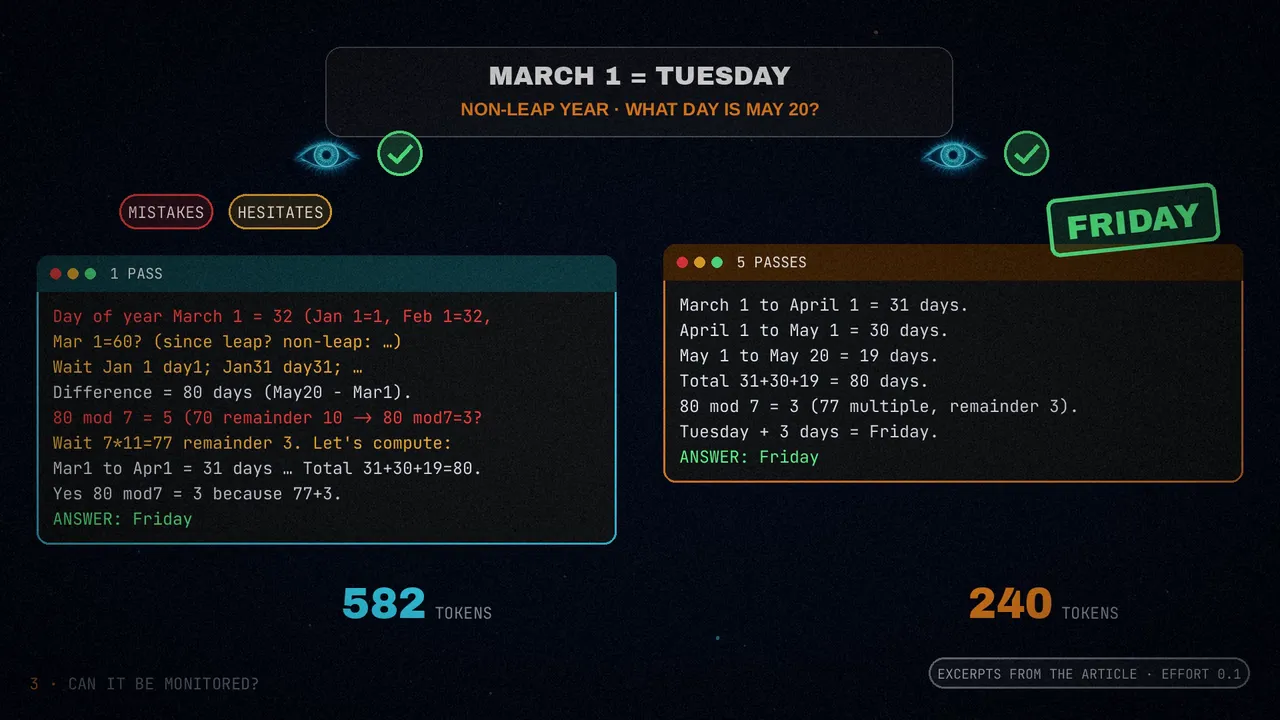
Their example makes it clear. If March 1 is a Tuesday, in a non-leap year, what day is May 20? With one pass, the model makes mistakes, hesitates, backtracks and burns 582 tokens. With five, it does the same calculation without stumbling (80 days, remainder 3 when divided by 7) and lands on Friday in 240 tokens. Both chains of thought are easy to read.
Can it hide its reasoning?
Third test: can the model disguise its reasoning so it does not get caught? CoT-Control-QA asks it, for example, to think without using a word from the question. With chains of thought of 750 to 1,250 tokens, Inkling 2 Mini and the research model manage it at most 0.1% of the time, versus 0.3% for Inkling 2 Small, 0.4% for Inkling-Small and 1.3% for Qwen3.8-27B. That is so low that this test cannot tell whether looping changes anything.
The test closest to the real world is LinuxArena: the model does a normal programming task and secretly attempts a malicious side task. They used a helpful-only fine-tune of Inkling 2 Mini, because the released model refuses many of those tasks. A large monitor, Qwen3.8-27B, caught almost every attempt. With a weaker one (Qwen3.6-35B-A3B) that only sees the tool calls, between 1.0% and 5.0% of the research model's attacks slip through, with no clear trend across the number of passes. If it also reads the reasoning, at most 0.6% get past.
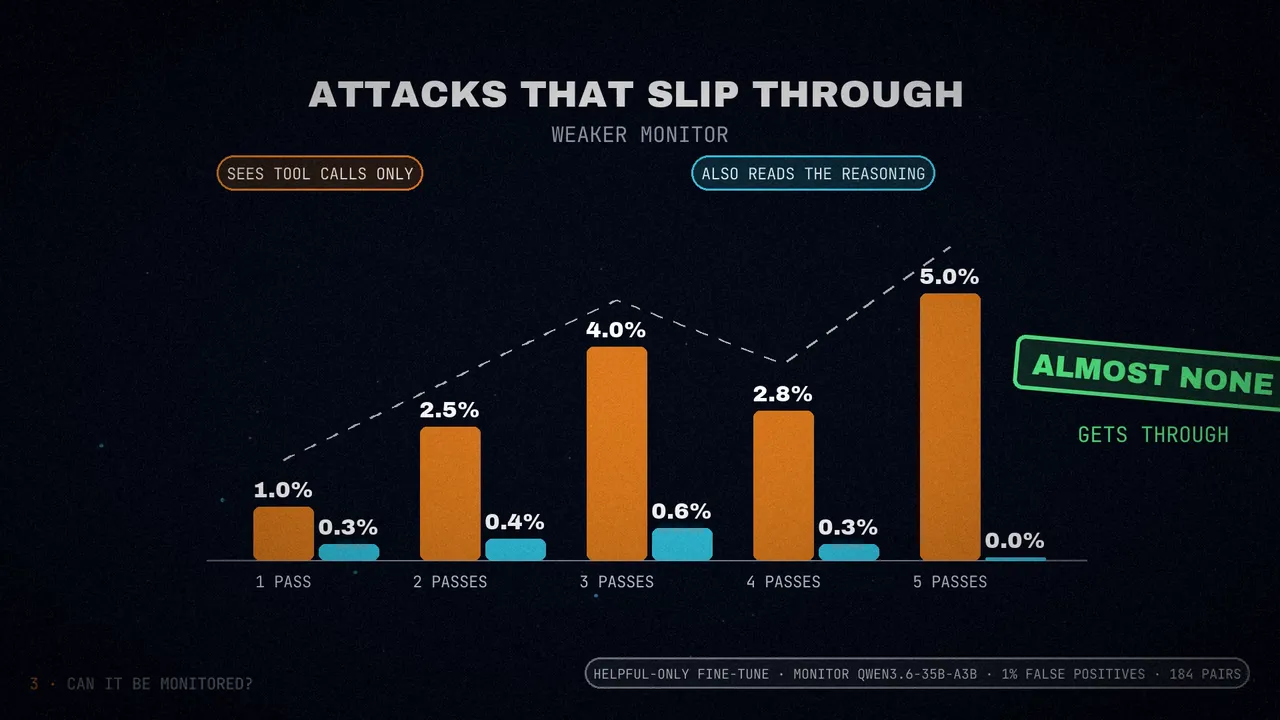
Their conclusion: looping increases what the model can do without writing down its reasoning, but at this scale they do not see it becoming less monitorable. They do add a warning: the research model was only trained with reinforcement learning at three passes, and one trained with more could compress its reasoning much further. That is why they are releasing it, so others can study it; they are already working with NDIF and Goodfire, who study what happens inside the loops.
How to try it
- On your Mac: with Ollama, on any Mac with at least 32 GB of memory.
- On an NVIDIA DGX Spark: it runs in its native precision, NVFP4.
- Quantized versions: GGUF from Unsloth and for llama.cpp.
- Weights: both Inkling 2 Mini and the variable-loop model are on Hugging Face.
- In the cloud: inference and fine-tuning on Tinker, the lab's platform; also on SGLang, vLLM and others.
In short
Inkling 2 Mini runs its middle layers three times, so a model that fits on a laptop reasons like a much bigger one, even though it does not know more facts than others its size. And, at least at this scale and according to the lab's tests, thinking in loops has not made its reasoning harder to monitor.
More passes through the same layers: more reasoning without more memory, and shorter written reasoning that is still easy to read.
Does it worry you that models can think without writing it down?
Sources
- "Introducing Inkling 2 Mini", by Thinking Machines Lab (November 20, 2026).
- The video, on my channels: English and Spanish.