The problem: knowledge thrown away
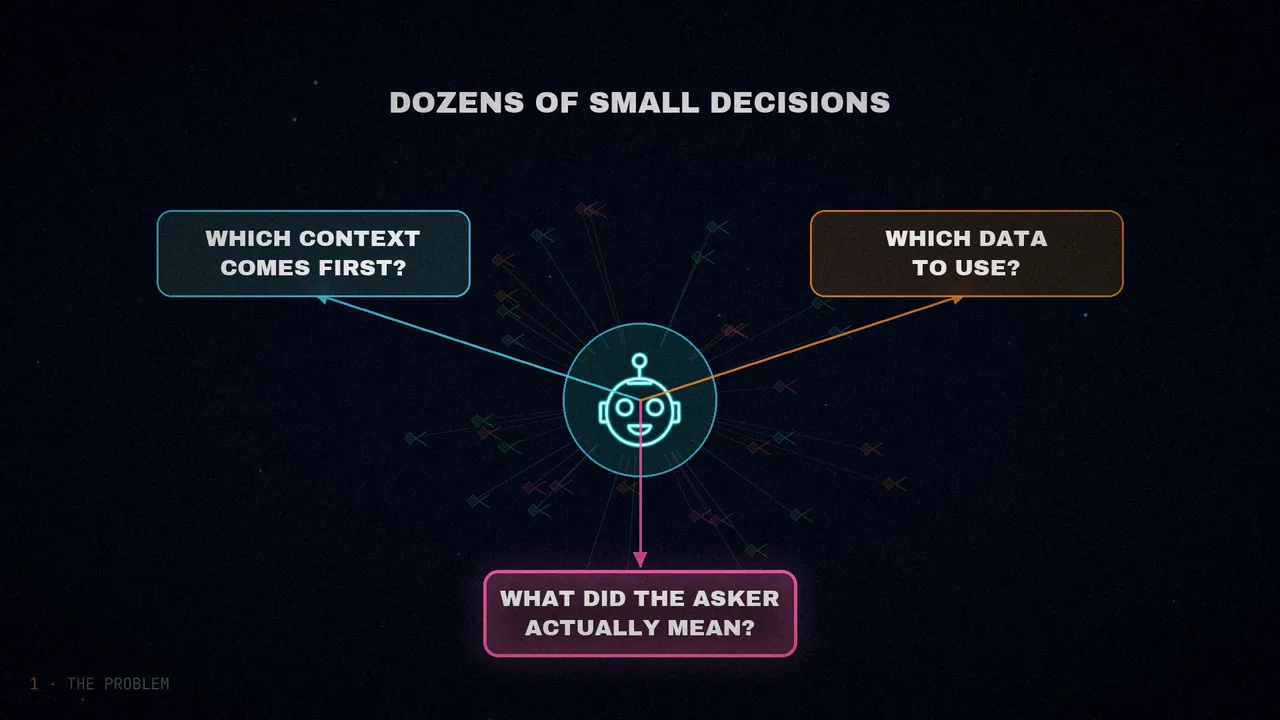
Every time someone asks an analytics agent a question, the agent makes dozens of small decisions: which context to look at first, which data to use, and how to interpret what the person asking actually meant.
For simple questions, it's easy: the agent hits a semantic model and pulls the metric. But most of the work, especially the work that really matters, is more complex. And organizations change fast, so you can't count on having everything perfectly modeled at every moment.
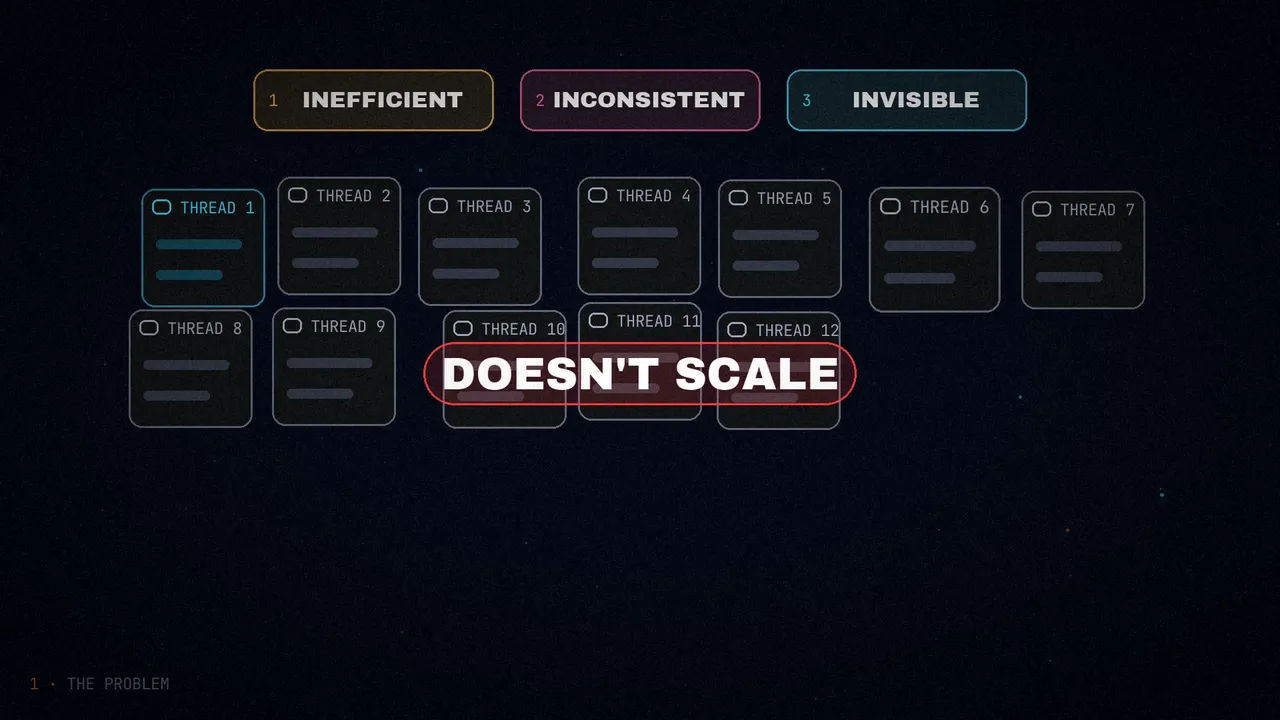
For data teams running self-service analytics, this creates three problems:
- It's inefficient. Every new thread searches and reasons from scratch again, spending time and credits on something another thread may have already learned.
- It's inconsistent. Because the agent starts from scratch, there's a decent chance it lands on a different answer than last time. You can try to document every business rule up front (some teams do), but it's really hard to keep up.
- It's invisible. You can't easily tell what judgment calls your agents are making unless you dig through conversations one at a time. And that doesn't scale.
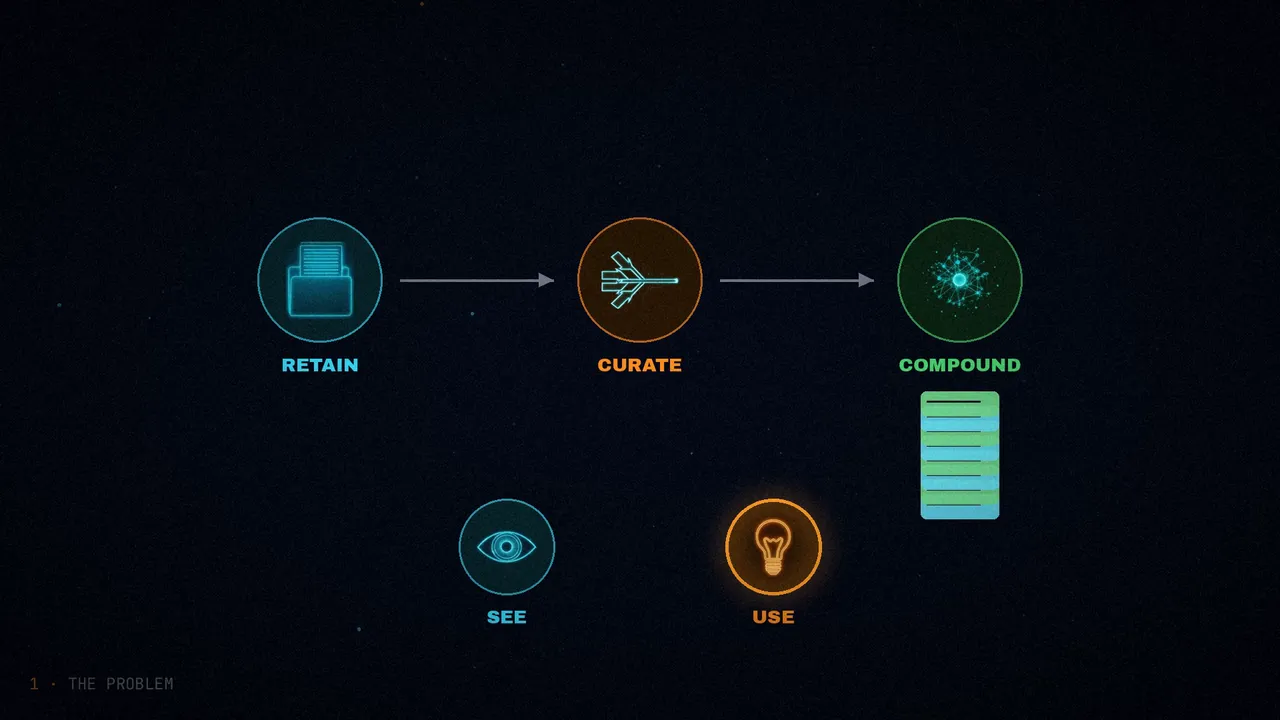
All of those conversations produce findings: knowledge the agent discovers along the way. And as soon as the conversation ends, it's thrown away. Hex calls it context exhaust, and its proposal is to stop letting it escape: keep it, curate it and let it compound, so you can see all of that work and make use of it.
A knowledge graph
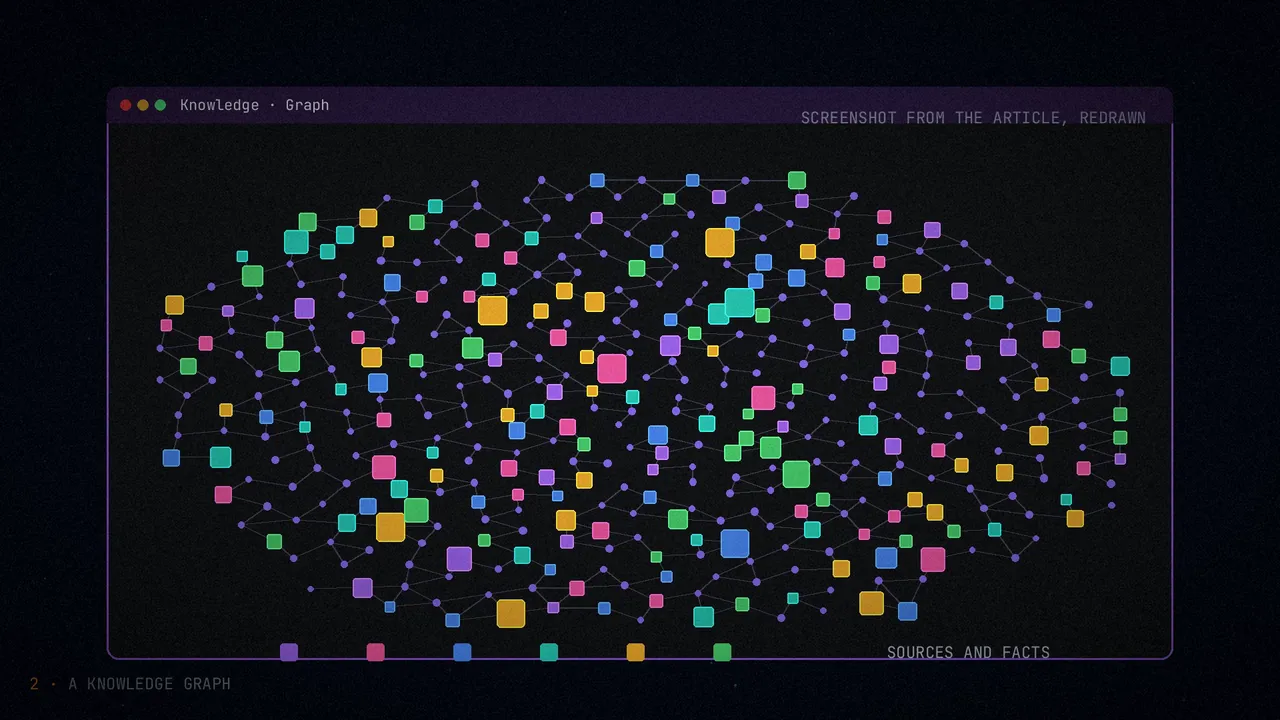
That's where the Knowledge Engine comes in, shipping in beta with Hex 4.0. It's a self-learning system: it picks up knowledge from all your context and from agent conversations, and turns it into a graph built for agents. That graph becomes the main way to search for context and for all analytics work inside Hex. (The article sometimes calls it the Knowledge Engine and sometimes the Knowledge Graph: the engine is what builds the graph.)
Hex describes it as a map of every fact it knows about how data is defined in your organization, and where each one came from. The article's screenshot shows hundreds of colored, connected nodes. When you ask a question in a thread, the agent can reference all of those facts and gets to the answer faster, because it doesn't have to rediscover what was already known.
The promise, according to Hex, has three parts: faster agents, lower token costs, and more consistent, accurate answers.
The curator agent
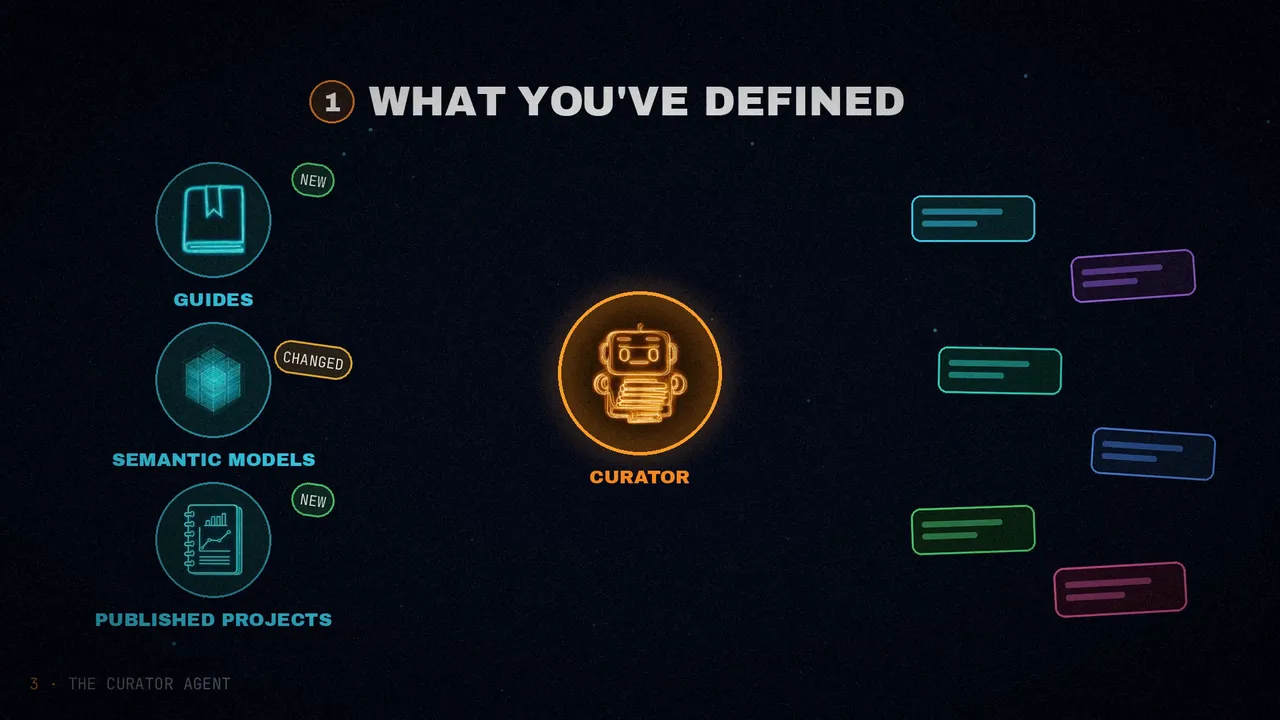
Who builds that graph? Every night, a background Curator Agent reviews your workspace and adds any new learnings to the graph. It builds from two sources:
- What you've defined: guides, semantic models and published projects that are new or have changed, translated directly into individual units of knowledge.
- What the Hex agent has learned: the judgment calls agents made and the context discovery paths they followed while answering questions in your workspace that day.
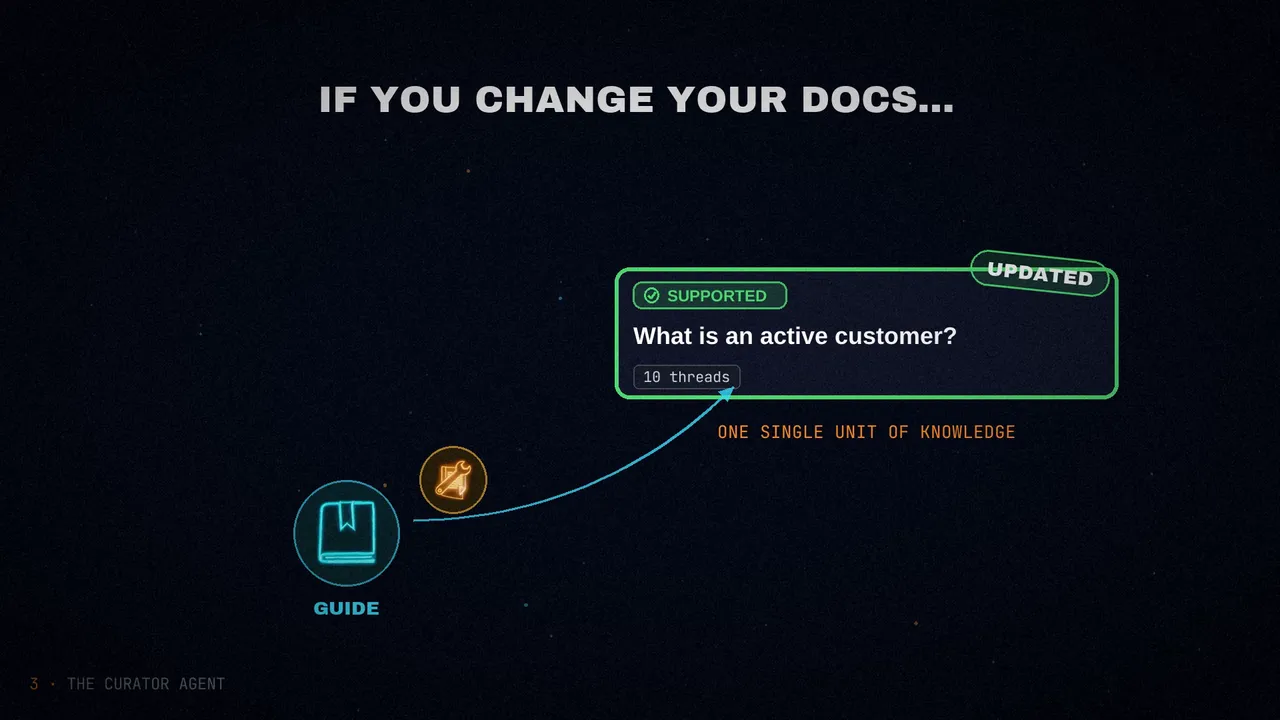
Then the curator reconciles what it has learned. Duplicates are resolved automatically: in Hex's example, if ten threads each defined “active customer”, all ten definitions end up backing a single unit of knowledge. And when you change your documentation, like a guide or a semantic model, the related knowledge is updated automatically.
Five trust statuses
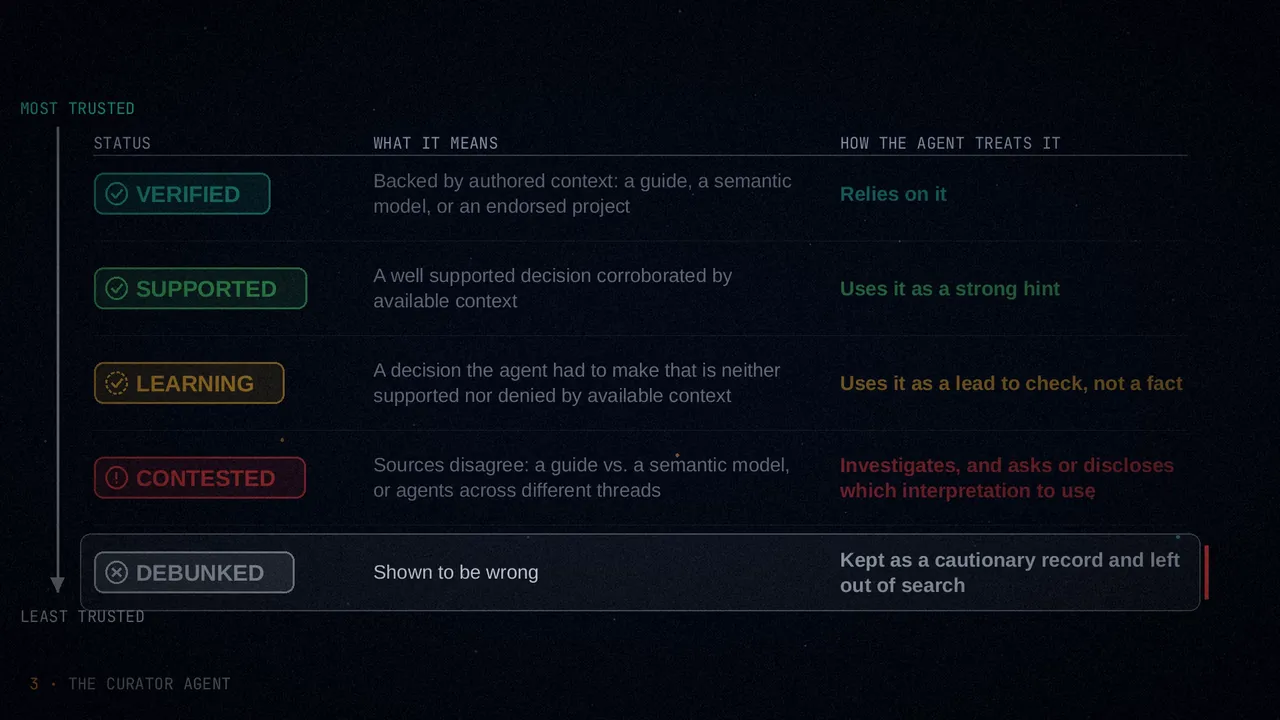
The agent keeps working in the background to verify and validate each unit, and in the end gives each one a status, ordered from most to least trustworthy. Each status changes how the agent treats it:
- Verified: backed by authored context, such as a guide, a semantic model or an endorsed project. The agent relies on it.
- Supported: a well-supported decision, corroborated by available context. The agent uses it as a strong hint.
- Learning: a decision the agent had to make that available context neither supports nor denies. It's used as a lead to check, not a fact.
- Contested: sources disagree (for example, a guide vs. a semantic model, or agents across different threads). The agent investigates, and asks or discloses which interpretation it uses.
- Debunked: shown to be wrong. It's kept as a cautionary record in the graph and left out of search.
Contested knowledge
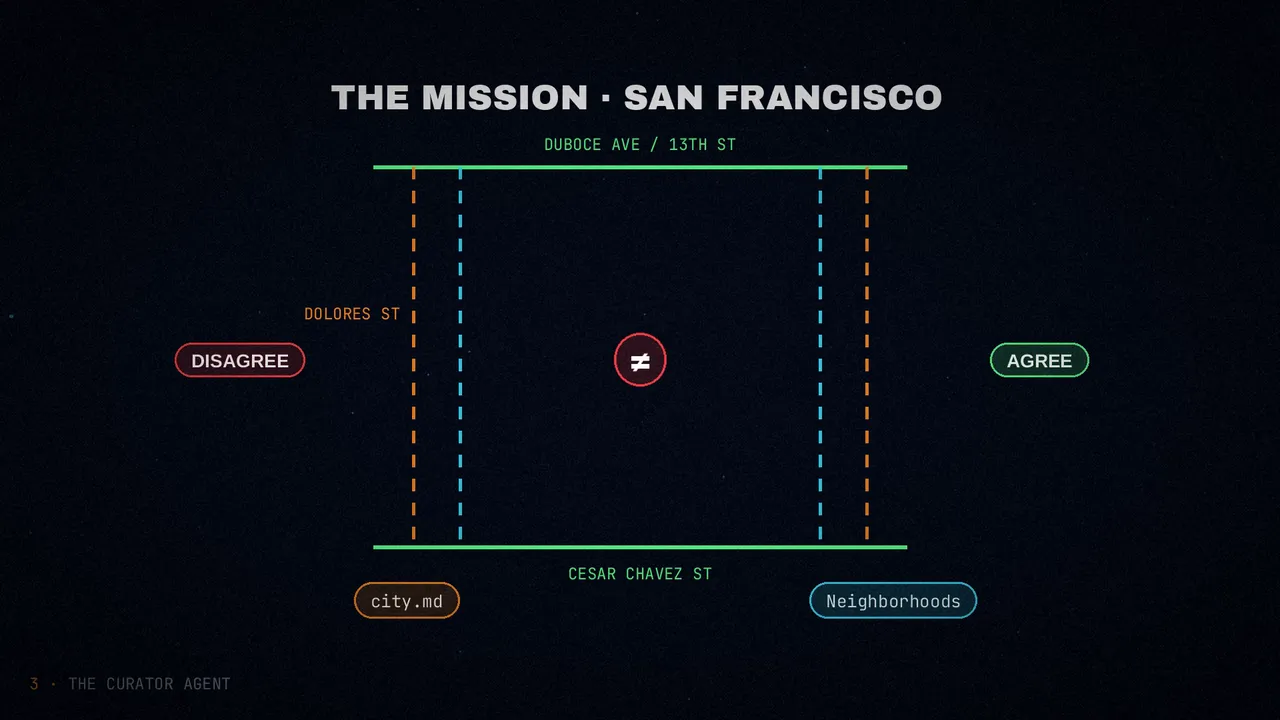
Of the five statuses, contested is my favorite. Many teams have conflicting context and don't even realize it. When the curator runs into a conflict, it creates a unit of contested knowledge, so agents proactively know about the gap instead of silently going with whichever guidance they happen to find first.
The article's screenshot has an example using San Francisco public data: what are the boundaries of the Mission? The sources agree on the north (Duboce Ave / 13th St) and the south (Cesar Chavez St), but disagree on the east and west edges. A text file, city.md, puts the west edge at Dolores St and the east edge at US-101, and the neighborhoods table doesn't say the same. So it's flagged as contested, with both sources right next to it.
Faster and cheaper
The Knowledge Engine is Hex 4.0's new interface to workspace context. Before, the agent searched through all your raw context: guides, semantic models, repos and endorsed projects. Now it searches the graph first to find and reuse existing knowledge, and only goes back to the raw context or the warehouse when it needs to discover or validate something no agent in your workspace has done before.
Because the engine distills each day's discoveries, the graph lets agents skip context and data discovery and routes them straight to the table, definition or method they should use, since earlier agents already did the research. That means fewer tool calls, and fewer chances for agents to make analytical choices that contradict each other.
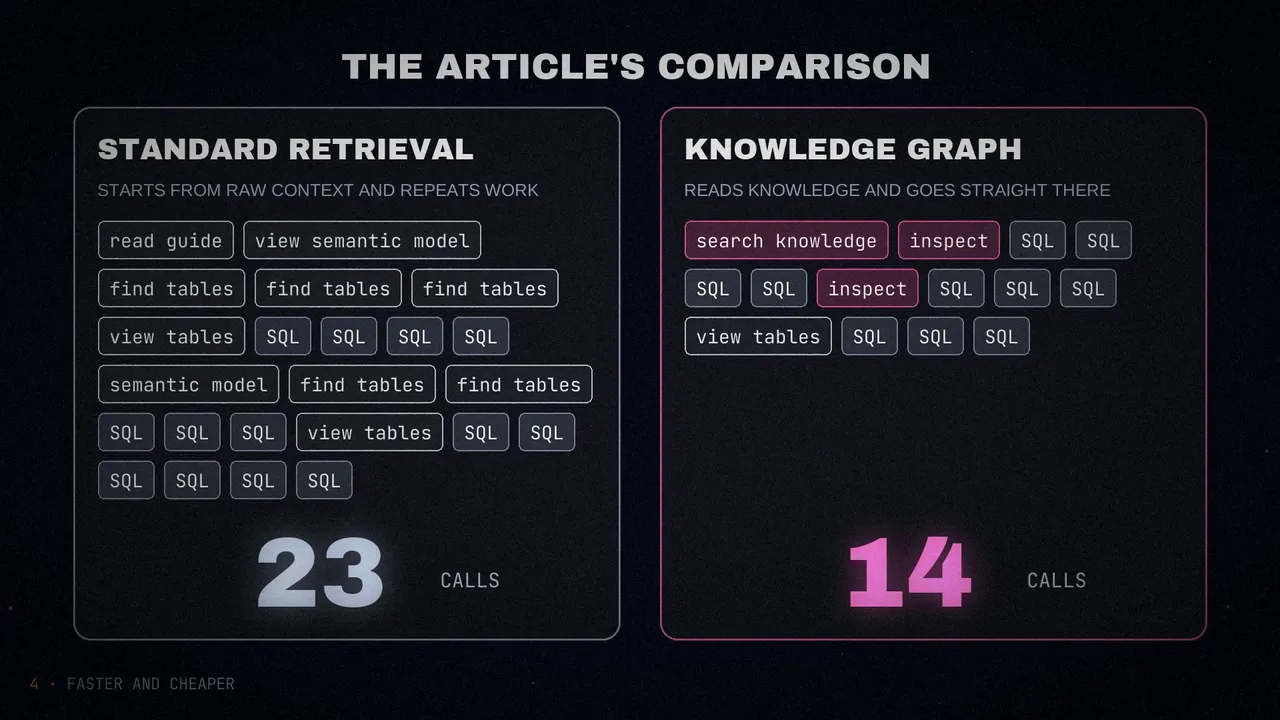
A figure in the article compares the two in one example. With standard retrieval, the agent starts from raw context and repeats work: it reads the guide, views the semantic model and finds tables again and again, adding up to 23 tool calls. With the graph, it searches knowledge, inspects and goes straight to the queries: 14 calls. It's one example, not an average.
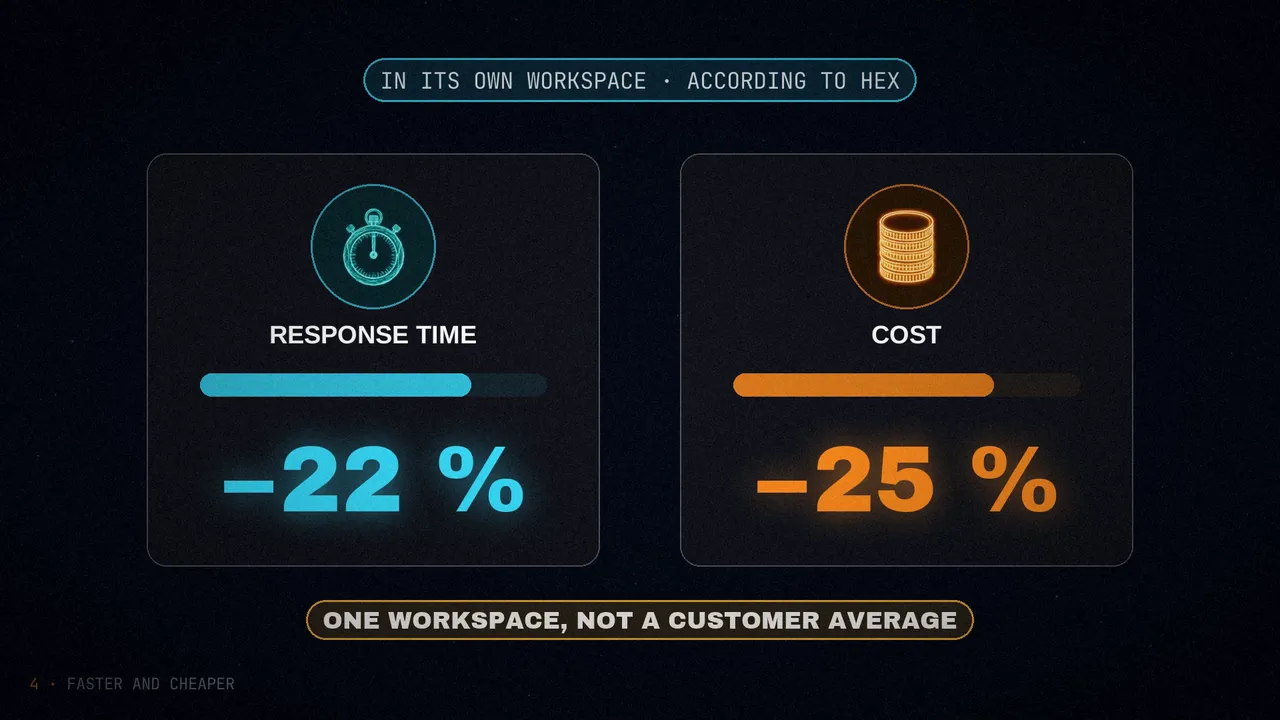
And in numbers? In its own workspace, Hex says it has seen significant efficiency gains: the graph has cut response time by 22% and cost by 25%. Keep in mind that's Hex's own workspace, not an average across customers.
What if it learns something wrong?
There's an obvious objection. People get things wrong and agents aren't perfect, so a self-learning system could spread incorrect beliefs, and you'd get wrong answers, only faster. Hex's answer is “yes, we thought of this”, and its solution is visibility:
- A window into the agents. By writing down the decisions they're already making, the graph shows how they use your context, what they learn from it and what they have to make up when there's no clear guidance. The engine does the review your data team would otherwise have to do, and finds hidden gaps and inconsistent or incorrect behavior.
- Usage tracking. Whenever an agent retrieves a unit and relies on it, Hex records when and how often it's used. Commonly held beliefs, including wrong ones, now come with a signal your team can act on.
- Fix it at the source. A learning that doesn't feel right is a sign the agent couldn't find what it needed. Update your context (a guide, a semantic model or an endorsed project) and the engine brings the change into the graph and reconciles it.
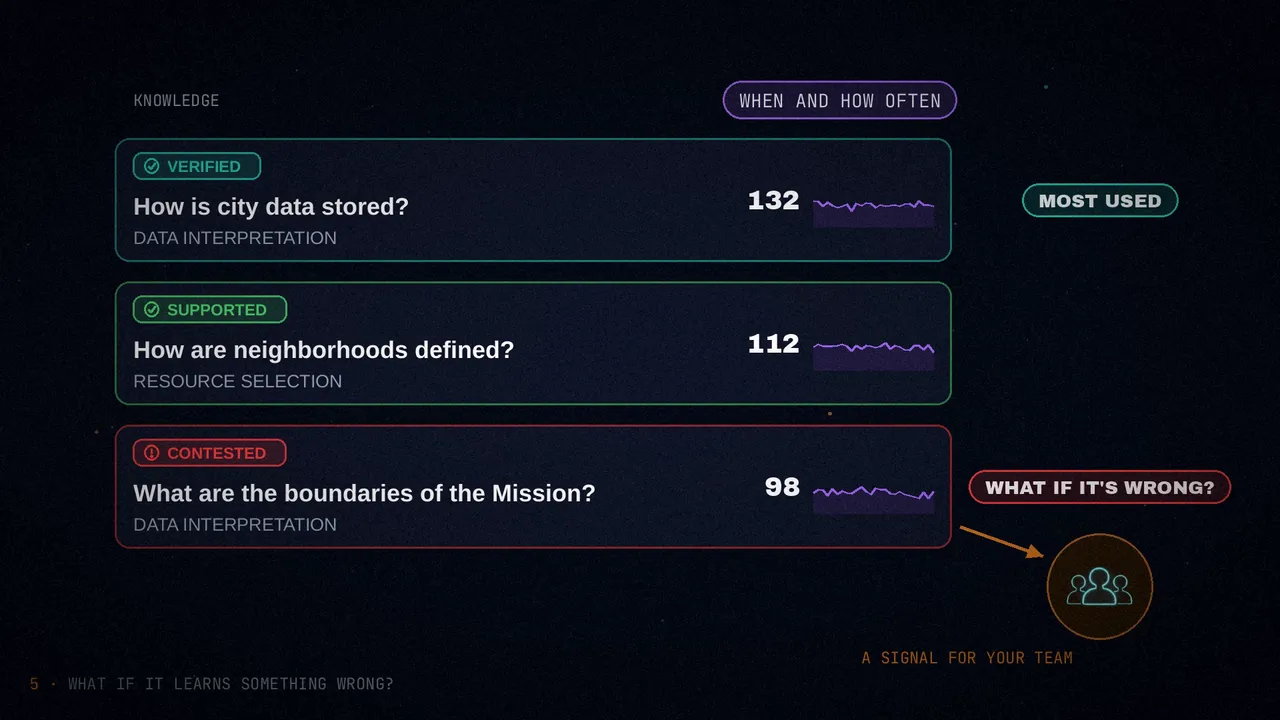
In other words, the curator doesn't remove mistakes on its own: it gives them a status and a signal, and people fix the context they come from.
What's next and what you need to do
Hex believes the future belongs to agentic systems that learn on their own while keeping governance, observability and, ultimately, trust. The engine doesn't replace what you already have: it works with it, like semantic models, and according to Hex it makes them work even better. Earlier this year they launched Suggestions, a first step that surfaced gaps in context so people could improve the system; the graph goes further, automating more of the learning while the data team stays in control.
So what do you need to do? According to Hex, nothing. If you're on Hex 4.0, the engine runs every night and starts powering your threads automatically: you'll see knowledge in the agent's thinking and your threads will be faster. If you want to take a look, review the contested knowledge, which can point to inconsistencies in your context or places where agents don't agree. And as usage builds, that visibility will tell you where to invest in context management.

On availability: Hex says it has rebuilt the core of its platform to be truly agent native. The engine is rolling out as a preview to workspaces in the Hex 4.0 public beta starting November 19, and self-service workspaces are expected to follow in early December. One important detail: in this first beta, the engine only learns from sources everyone in the workspace can access; Hex plans to evolve its access controls so it can safely learn from more.
In short
Data agents discover things in every conversation, and almost all of it gets lost. Hex's Knowledge Engine collects it every night with a curator agent, stores it in a graph, ranks it by trustworthiness, flags contradictions and lets agents go straight to the answer. The gains Hex reports (−22% time, −25% cost) come from its own workspace, so it remains to be seen how it performs in customers' workspaces.
What your agents discover while answering shouldn't be thrown away: keep it, rank it by trust, and let the next agent start there.
Would you let your agents learn on their own from their own conversations?
Sources
- “Introducing the Knowledge Engine”, by Katherine Harrison, Hex blog, November 19, 2026.
- The video, on my channels: English and Spanish.