The missing knowledge
When a company wants its agents to do real work, the first thing it thinks is that it needs a smarter model, or more context in every request. Chase says neither is the missing piece. What's missing is knowledge of how your company works: what standards it operates by, where the data is stored and how it's accessed.
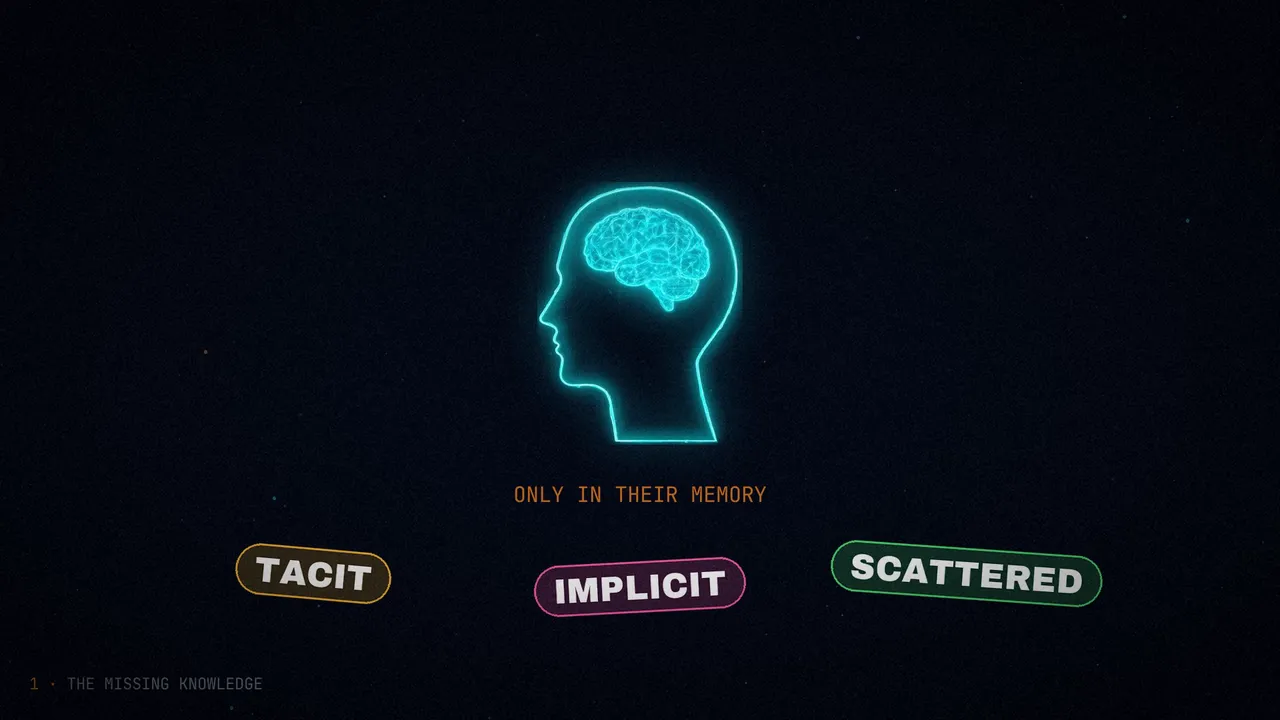
So where does that knowledge live today? In the heads of your most effective employees. They know who to talk to, where to go for an answer, and why things are done a particular way. It's tacit, implicit and scattered: sometimes it exists only in their memory, other times it's spread across a pile of different documents.
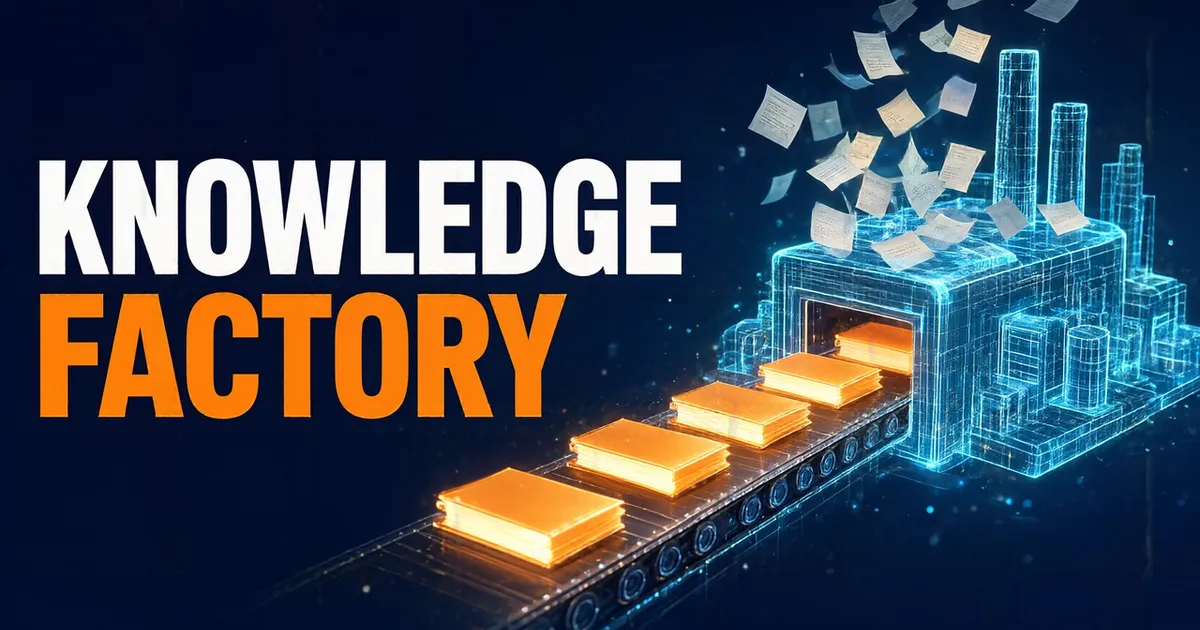
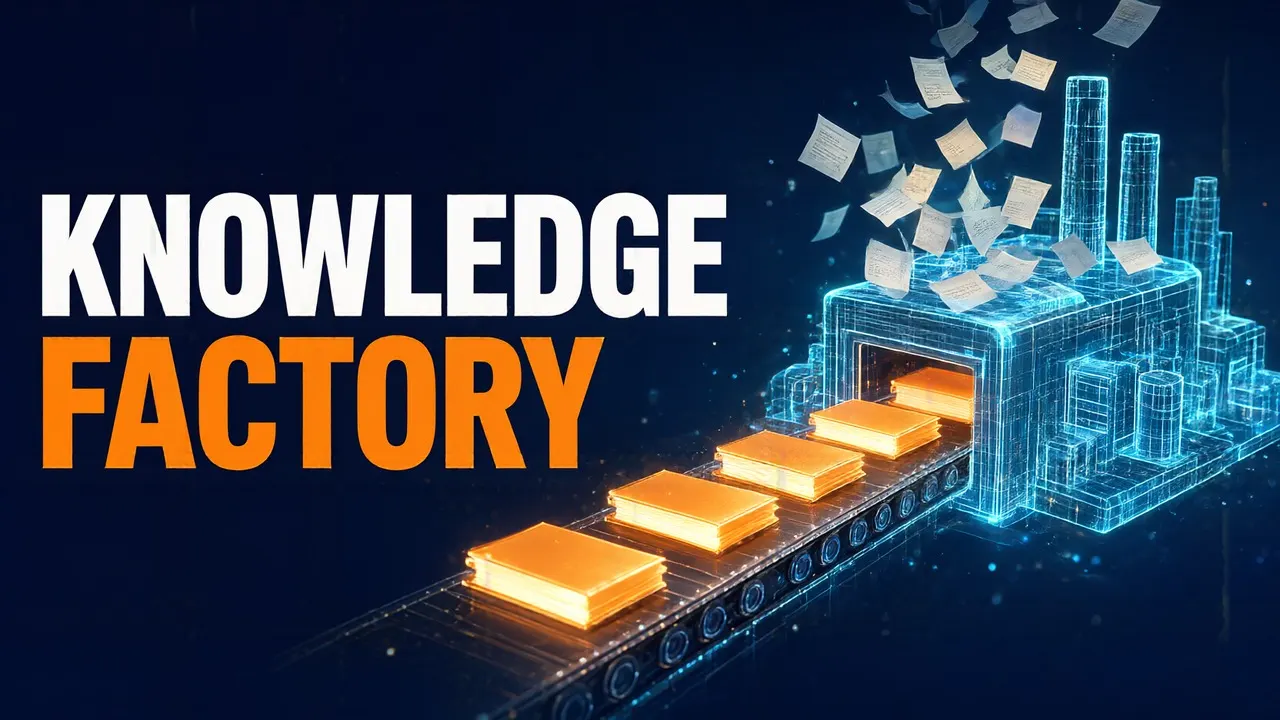
That's why you need to collect that knowledge, curate it and keep it up to date so you can pass it to your agents. The system that does this is what LangChain calls a knowledge factory. It's not a single document or just another database: it's a process that never stops.
For them it's not theory. According to Chase, LangChain's internal go-to-market (GTM) agents and its content studio agents run on a factory like this. And LangSmith Engine, their agent that runs over traces and suggests fixes, maintains a separate factory for each agent it watches. The article shares what they've learned along the way.
Context vs knowledge
Before going further, it's worth separating two words that get mixed up a lot:
- Context is what the agent has available while doing a task: the user's message, the files it has opened, the results of its tools. What's in front of it at that moment.
- Knowledge is the reusable understanding you maintain so it can do that task correctly: what a metric means, which source to trust, how a particular situation is handled at your company. Sometimes it's written down; often it isn't.
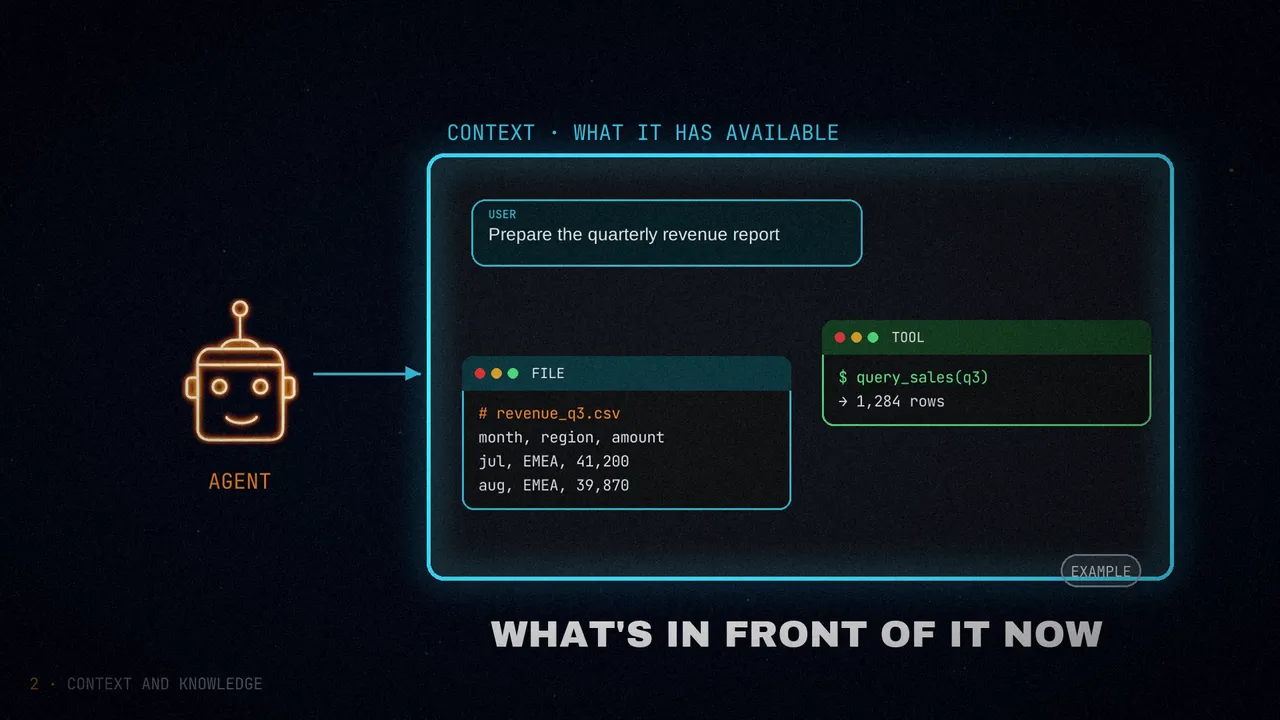
The factory turns scattered documents and experience into knowledge, and that knowledge becomes context for future work. So it's one form of context, but it shouldn't be the only one. Data you already store reliably can simply be handed to the agent directly, without going through the factory. We'll see that in the final example.
From software factory to knowledge factory
The idea comes from another one that, according to Chase, has taken off over the past year and a half: software factories. Instead of having your best engineers write programs, you have them build the factory, the systems that help everyone at the company build software more efficiently. The software itself gets built by agents.
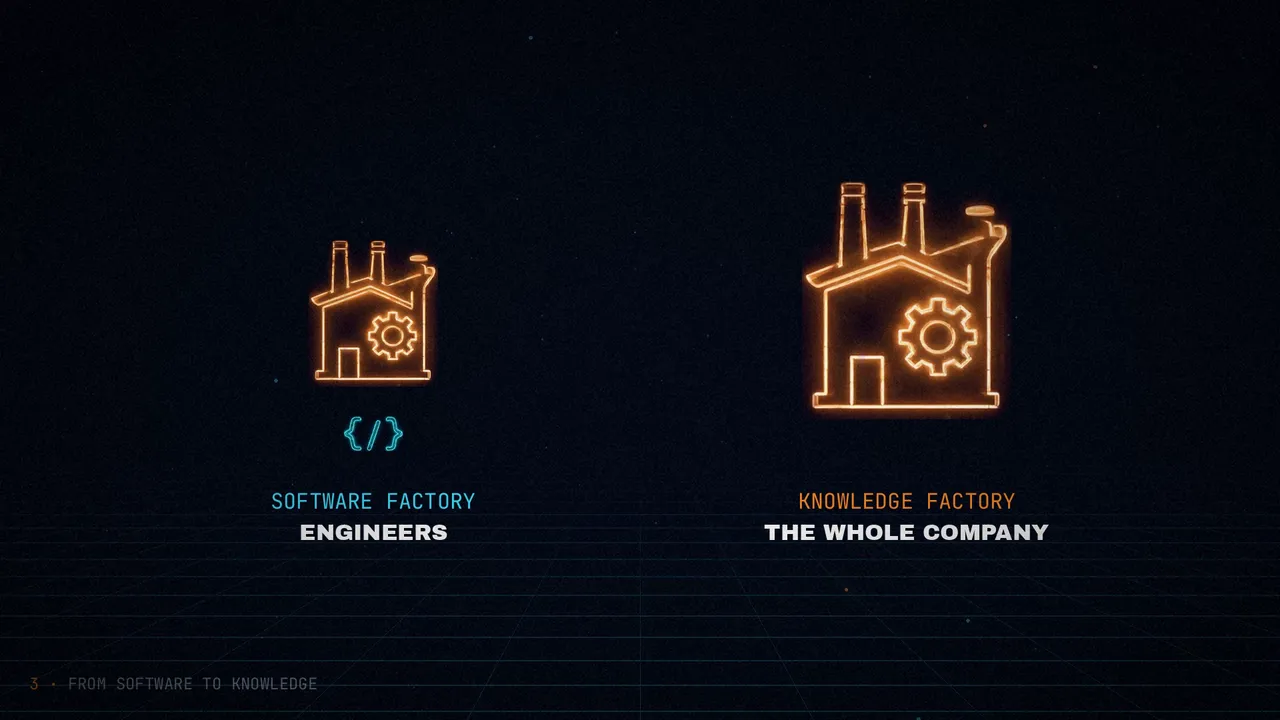
Chase thinks general knowledge work is following the same path. Agents are already good enough to make presentations, produce launch videos or do outbound, and you should lean on them as much as you can. But to do those tasks well, they need exactly that tacit, implicit, scattered knowledge.
That's where he suggests putting your resources: not into gathering the knowledge once, but into building the factory that collects, curates and maintains it. That's what will let you hand more and more knowledge work to agents.
The three pieces of knowledge
What gets manufactured? Chase identifies three pieces:
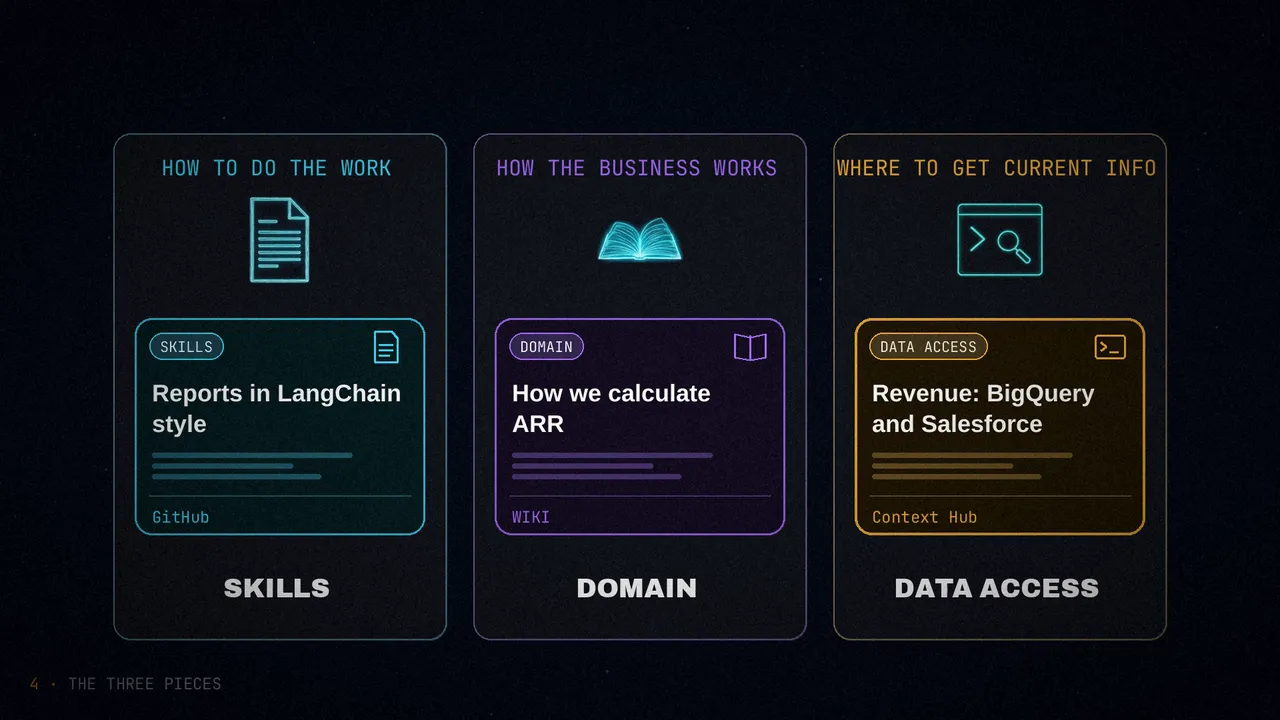
- Skills: how to do the work. Procedures, instructions and scripts for completing a task the particular way your company requires. Often they were never written down, just passed from coworker to coworker. His advice is to make the effort to write them down. For example, how to put together a report in LangChain style.
- Domain knowledge: how the business works. Definitions, policies and facts about products, customers, competitors and the organization itself. It doesn't go stale often. It's usually written down somewhere, but incomplete or wrong, simply because there's so much of it. One example: how you calculate annual recurring revenue (ARR).
- Data access guidance: where to get current information. It starts from a foundation: a good data strategy, with something like Snowflake or Databricks, which is the bedrock of any useful agent. If the source of truth already lives there, complete and up to date, there's no need to maintain another copy. The new thing to maintain is clear instructions: what data lives where, and how to query it.
To me this is the most useful distinction in the article: quickly changing data doesn't get copied into the factory; what gets manufactured is how to reach it.
Agents that raise flags
Agents need all of this, but Chase warns: don't try to maintain it by hand, it's a herculean effort. You need a system that maintains it, and that system has three parts. The first is the simplest: have the agents themselves flag what's missing as they work.
If an agent is asked to do something and can't find the information, or finds information that turns out to be wrong, it should say so. For that you give it a tool: at a minimum, to report what's wrong or missing; and optionally, to suggest what the fix should be. The agent doesn't rewrite the knowledge on its own: it records the problem and its suggestion, and carries on with its task.

The curator agent
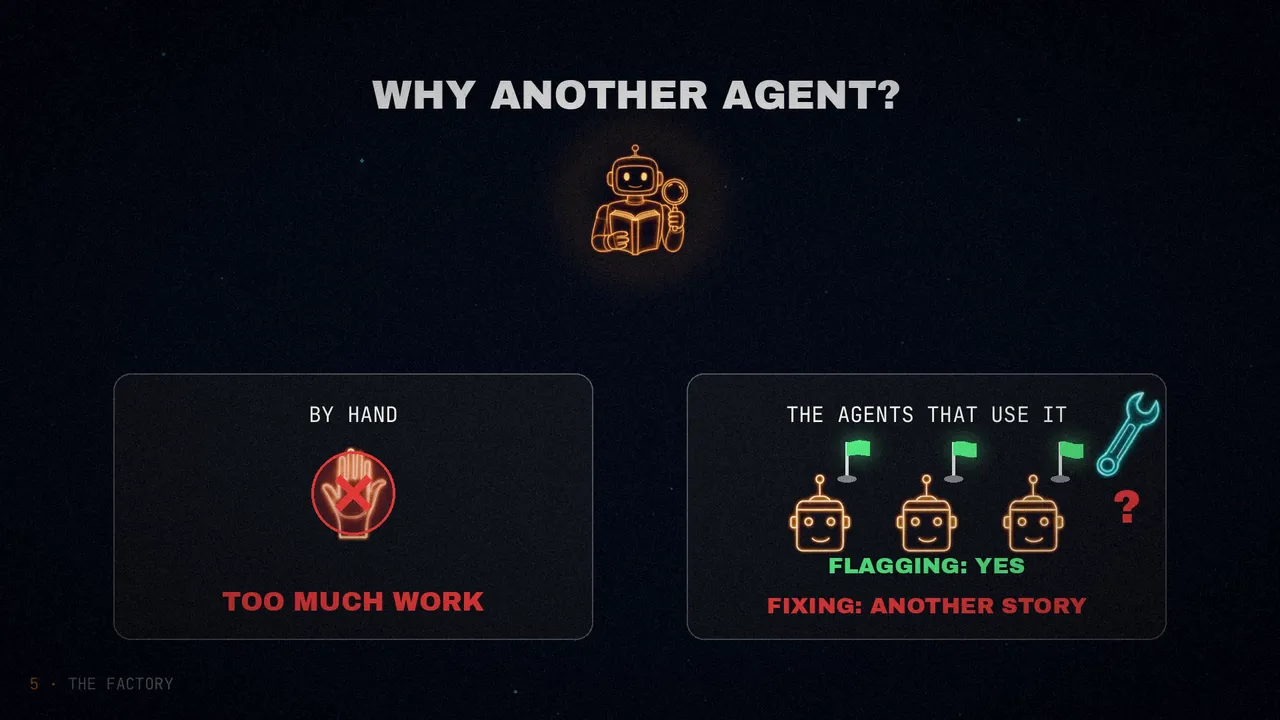
The second part is the heart of the factory: a curator agent that updates, curates and maintains the knowledge. Why another agent? Two reasons:
- Maintaining it by hand is too much work.
- It shouldn't be maintained solely by the agents that use it either. They're great at flagging what's broken, but fixing it properly requires a deep understanding of the underlying knowledge and the other data sources. And those agents are mainly pursuing their own goals: if you also ask them to maintain the knowledge, each one will tweak it its own way. According to Chase, it would end up unruly and full of contradictions.
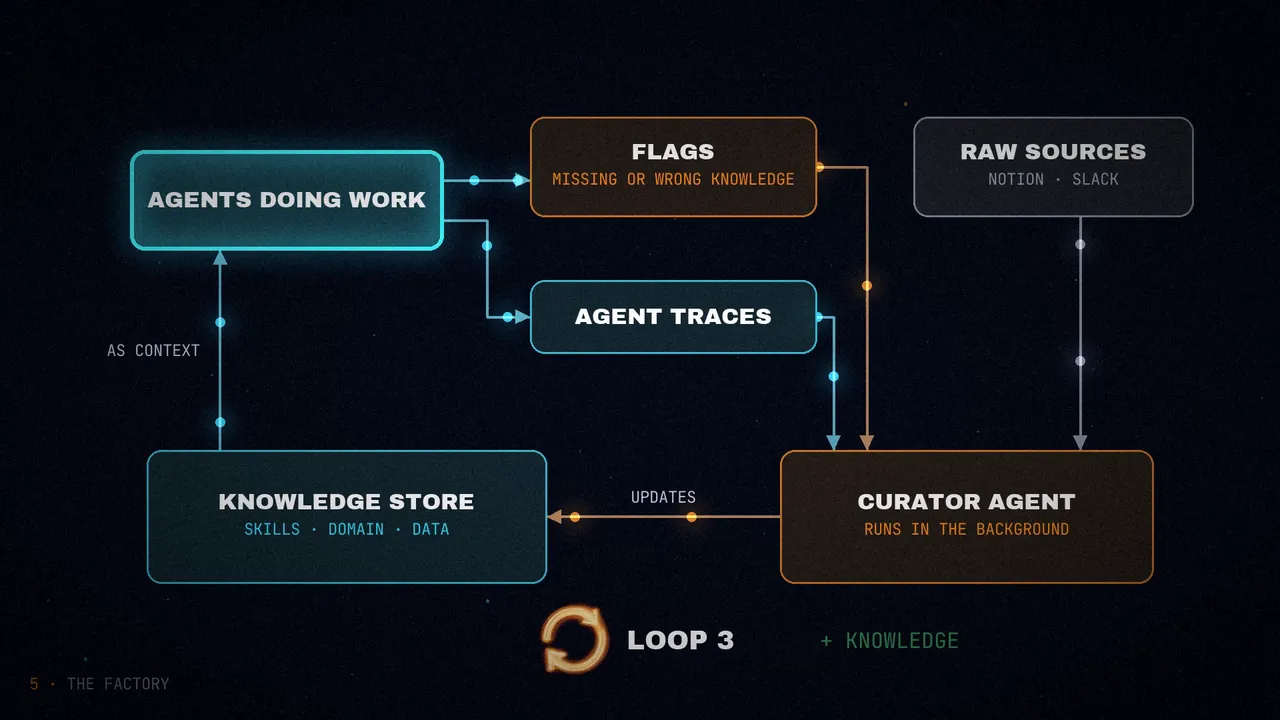
So the curator runs in the background, on a cadence, and needs access to three things:
- The raw sources, like Notion or Slack, where knowledge is scattered.
- The agents' traces, to see how people are trying to use them and codify that into skills.
- The flags the agents have raised.
Put it all together and you get a closed loop: agents do their tasks and, along the way, leave flags and traces; the curator reads them along with the raw sources and updates the knowledge store; and that store flows back to the agents as context for their next task.
Where to store it
The third part is the store, and Chase says two things that sound contradictory. In some ways it's the least important: you can keep the knowledge as skills in GitHub, in a single Notion file, in OKF format inside LangSmith Context Hub, or in a knowledge graph in Neo4j. The curator should know how to work with all of those formats, which he says isn't that hard.
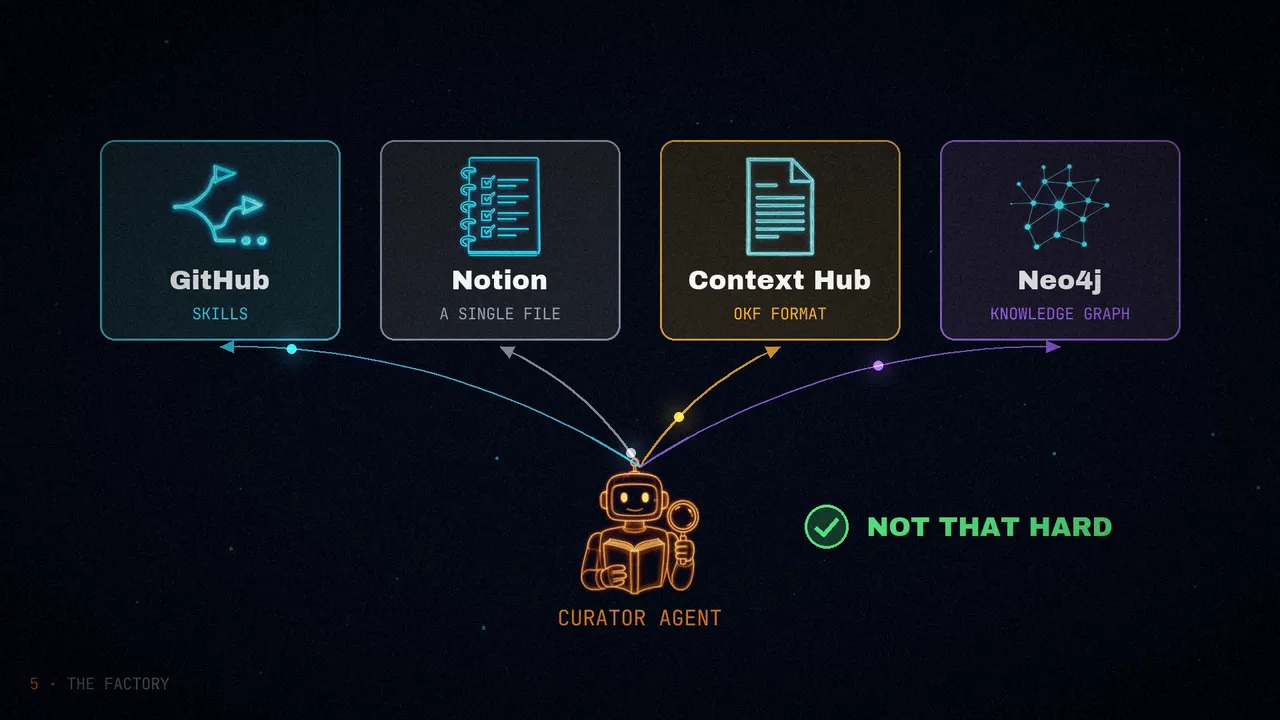
But in other ways it's the least explored area: how do you represent memory? The industry has converged on skills for procedural memory, the kind about how to do things. For semantic memory, the kind about facts, a different standard will likely emerge. OKF? Chase leaves it with a question mark: it's early and no standard has emerged yet, so he recommends not being too prescriptive or overcomplicating the format.
An end-to-end example
Chase closes with an illustrative example: an agent preparing a revenue report.
First, the base context: the raw revenue numbers, stored in BigQuery and Salesforce. That isn't knowledge: it's data that's already stored reliably and handed to the agent as is. Then there's the knowledge, of all three kinds:
- Skill: how to create reports in LangChain style, stored in GitHub in the standard skills format.
- Long-lived knowledge: how ARR is calculated, in the company wiki.
- Access to quickly changing data: how to query BigQuery and Salesforce, also stored as skills, but this time in Context Hub.
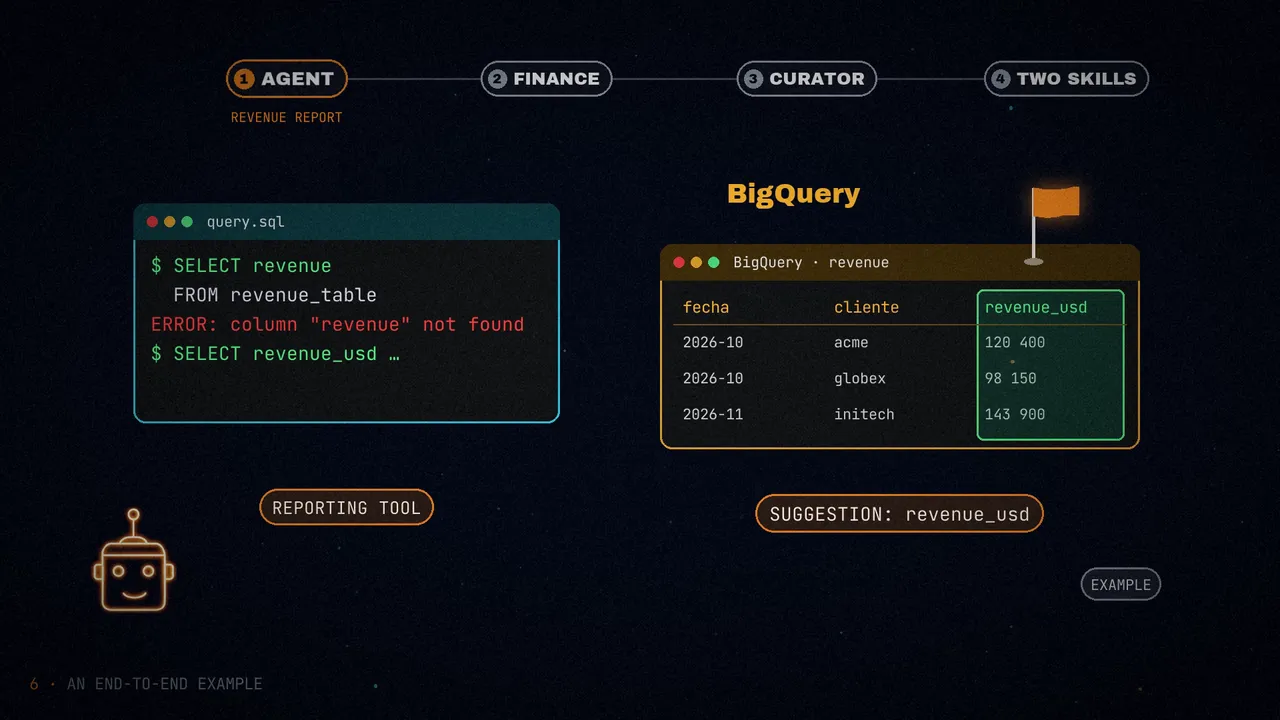
The agent gets to work and maybe notices that someone renamed a column in BigQuery. It doesn't get stuck: it figures out the correct column on the fly, then uses its reporting tool to raise a flag with the column name it suggests.
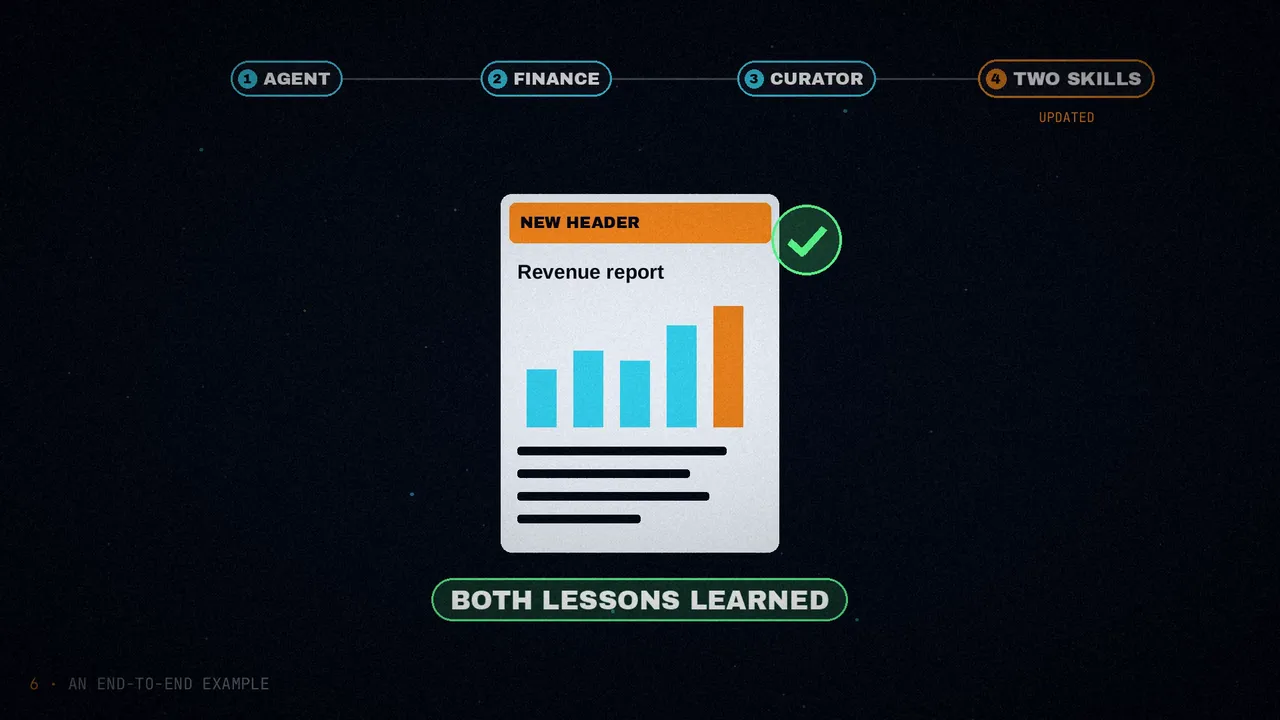
Once the report is done, the finance lead works with the agent, live, to fix a few formatting issues. Among them, they ask for a new header that all LangChain documents now need to carry. That conversation stays in the trace.
That night, the curator steps in. It sees the flag, inspects the traces and finds that back and forth with finance. Then it updates the two skills involved: the data fetching one, to use the new column, and the report drafting one, to add the new header. The next report starts out with both lessons learned.
In short
Chase's lesson is that the goal isn't to document everything before agents can get started. It's to build a system where doing the work reveals what knowledge is missing, and where closing those gaps makes whatever comes next better. His recipe for getting started fits in three steps:
- Pick one recurring workflow.
- Look at where the agents struggle.
- Close the loop.
LangChain says it already uses this in its own agents and is helping a few customers bring it to theirs, both internal and customer-facing. One caveat: the article gives no measurement of how much results improve; it's the experience and opinion of the people who built it.
Your company's knowledge isn't written once: it's manufactured as you work, with agents that flag the gaps and a curator that closes them.
What knowledge at your company lives only in someone's head?
Sources
- "How to build a knowledge factory", by Harrison Chase (@hwchase17), article on X, November 21, 2026.
- Open Knowledge Format (OKF) and LangSmith Context Hub, linked from the article.
- The video, on my channels: English and Spanish.