The report
First, what is an open model? Here it means an open-weight model: its maker publishes the weights, the numbers that make up the model, and anyone can download them, run them on their own machines or serve them to others. Closed models, like Claude, GPT or Gemini, can only be used through their company's API.
And one important detail before going on: Helmcode is a European inference platform for open-weight models. In other words, it makes a living from them. That is why it is worth noting that the report shows its sources, calculations and limits for every chart (on its methodology page), and why it is best read separating the data from the interpretation.
Ecosystem: each source has a different leader
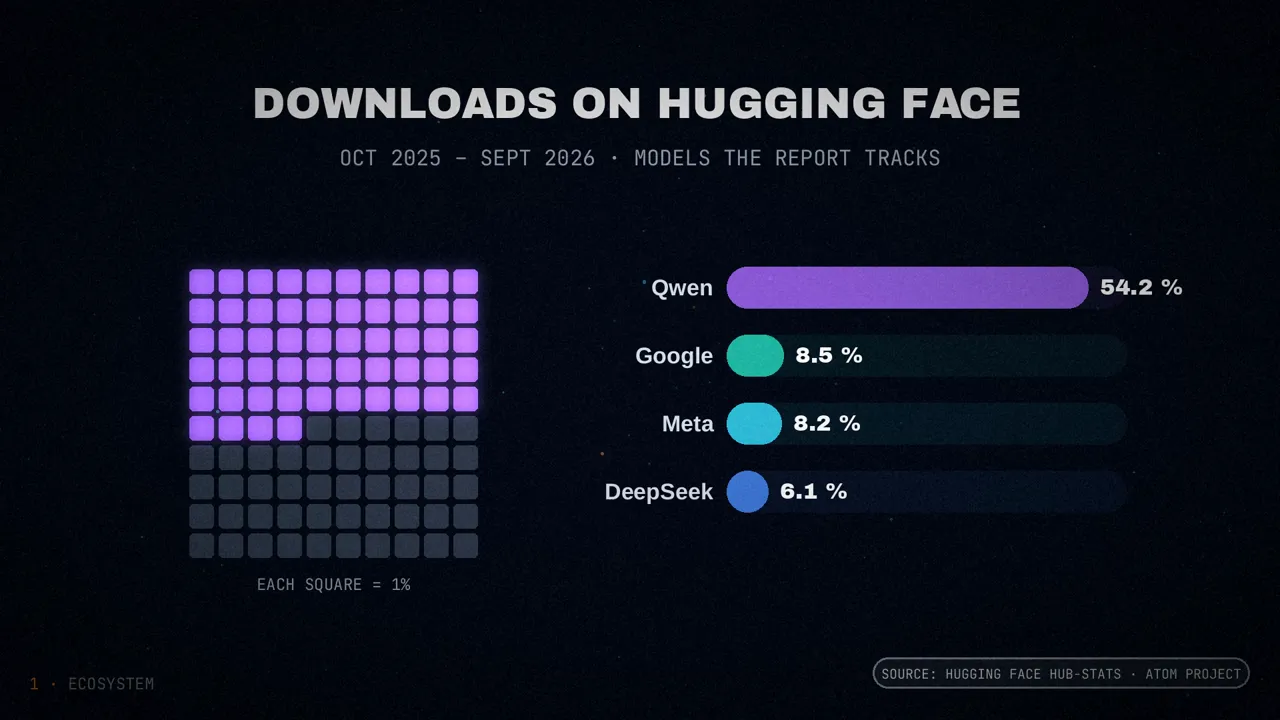
It starts with downloads on Hugging Face. From October 2025 to September 2026, 54% of the downloads of the models the report tracks (1,676 models on the ATOM Project's list) went to Qwen, from Alibaba. Eight of the ten most downloaded repositories are its own. Far behind come Google (8.5%), Meta (8.2%) and DeepSeek (6.1%).
They are small models. The most downloaded, Qwen3-0.6B, has 600 million parameters and passed 200 million downloads, twice the most downloaded model from Meta, OpenAI or Google. Twelve of the top fifteen have fewer than 10 billion parameters: they fit on a home graphics card. Mind you, as the report itself warns, a download is a request for files, not a user.
The map has also changed country. Labs based in China went from 17% of downloads in August 2024 to 68% in October 2026; the United States has 30% and Europe 2%. Qwen explains much of the change, but not all of it: without it, the other Chinese labs (mostly DeepSeek and Z.ai) rise from 9% to 29% of the remaining downloads, although the US would still lead.
Another way to measure influence is what gets built on top. Following the references of fine-tuned and quantized models, the report counts 470,289 derivative repositories, and nearly half start from Qwen. More than 35,000 accounts have published something built on Qwen, more than on Llama and Google's models combined (and an account is not a person: some publish automatically).
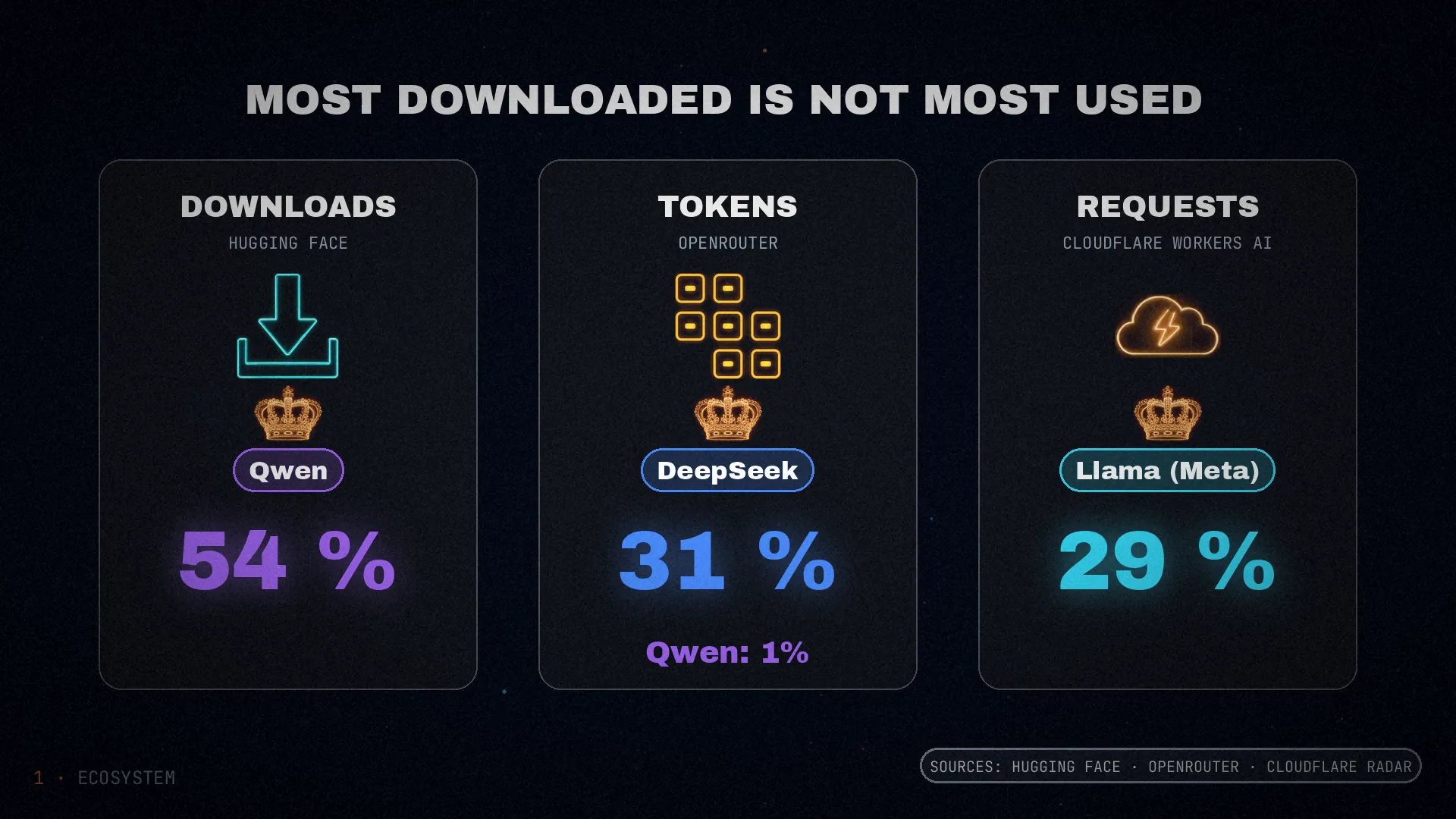
But the most downloaded is not the most used. In the open-weight tokens going through OpenRouter, DeepSeek leads with 31%; Qwen gets 1%. And on Cloudflare's Workers AI, which counts requests, Meta's Llama wins with 29%. Each source crowns a different lab. The report assumes downloads point to local use at home, not use through an API: that is its reading, not something it measures.
Capability: the gap depends on the task
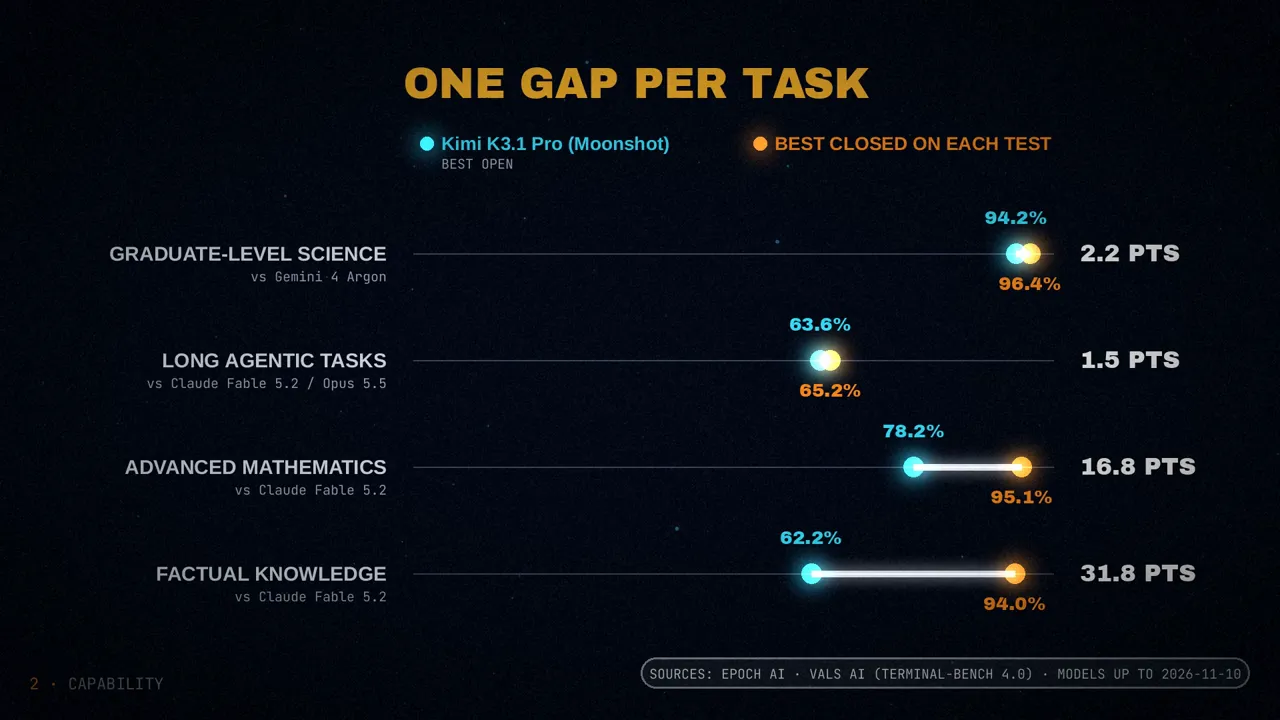
How far is the best open model from the best closed one? It depends on the test. The best open model on almost all of them is Kimi K3.1 Pro, from Moonshot AI:
- Graduate-level science (GPQA Diamond): 94.2% against 96.4% for Gemini 4 Argon. 2.2 points.
- Long agentic tasks (Terminal-Bench 4.0): 63.6% against 65.2% for Claude Fable 5.2 and Claude Opus 5.5. 1.5 points, per the report.
- Advanced mathematics: 78.2% against 95.1% for Claude Fable 5.2. 16.8 points.
- Factual knowledge: 62.2% against 94.0% for Claude Fable 5.2. 31.8 points.
It can also be measured in time: take today's score of the best open model and look back to when a closed model first reached it. In agentic work, 2 months ago; in advanced mathematics, 8; in science, 9; and in factual knowledge, 11. Where the gap in points is smaller, the delay is smaller too.
Graduate-level science needs care: of the 38 models released since July 2026, 30 score above 90%, the best twelve fit within 2.5 points and their error margins overlap (Kimi is ninth). When everyone is near the ceiling, two points are not enough to decide. The tests that still separate the leaders are the hard ones, like a new one from Artificial Analysis that asks models to read lab images (gels, microscopy, plasmid maps) and only counts a task if it is right three times out of three: Claude Fable 5.2 reaches 67.1% and Kimi 45.3%, almost 22 points apart.
At the other end, Terminal-Bench 4.0 gives an agent up to eight hours to finish real work in a terminal (build a service, fix a system, train a model), with the same agent for every model. Kimi is fourth out of 47; the next open model, GLM-5.3, is 25 points lower. The chapter's advice is practical: check whether the test resembles your work and whether the models were evaluated comparably, then test the candidates on your own tasks.
Usage: follow the tokens
OpenRouter is a middleman: developers send it requests and it spreads them across many models. Adding up a year of its daily ranking, DeepSeek took 31% of open-weight tokens, followed by Tencent (17%), Xiaomi (12%) and Z.ai (12%). A single model, DeepSeek V4 Flash, took 18%. These are tokens on one platform, not users or market share.
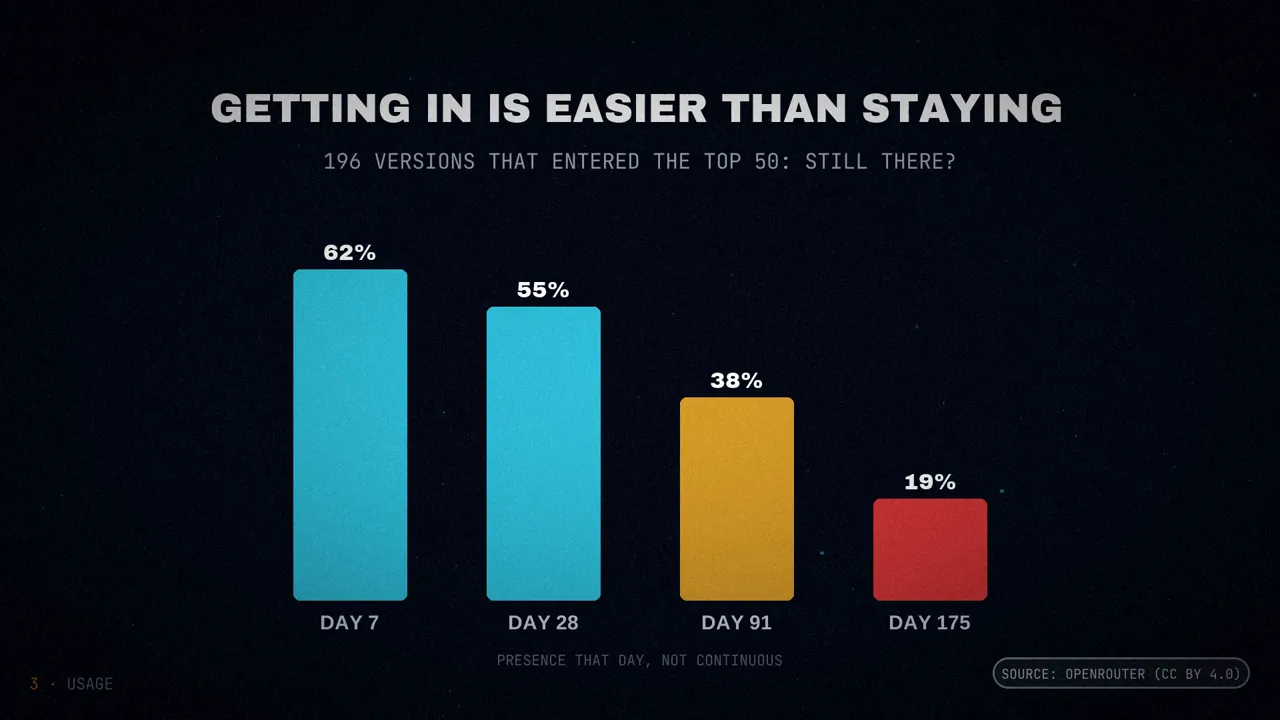
What stands out most is the turnover. None of the ten most used versions in January 2026 was still in the top ten in September. That month, three in four tokens in the top 50 went to versions that had entered it in the previous 90 days, and a new version overtook the previous one from the same lab in a median of four days.
Getting in is easier than staying: of 196 versions that entered the top 50, 62% were there a week later; 38% after three months; only 19% after six (presence on that day, not continuous survival). Labs last longer than their models: DeepSeek was the most used open lab in 19 of the 21 months since January 2025.
And on another platform the picture changes completely. On Cloudflare's Workers AI, since June 2026 between 76% and 87% of the requests are embeddings, which turn text into numbers for search; a single model, bge-m3, handled almost 84% in October. There, an open model is more a part of a search system than an assistant.
The lesson for anyone building on these models: a ranking is a snapshot of one month. It pays to review the alternatives every few months and to be able to switch models without rewriting the application.
Cost: a cheap token is not a cheap task
Prices are published per million tokens, but a team pays for finished work. So the report measures cost per solved task on the same 66 tasks of Terminal-Bench 4.0 (data from Vals AI): what it costs to attempt a task, divided by the share of tasks the model completes. Failed attempts are paid for too, and two things the price list leaves out come into play: how many tokens the model spends on each attempt, and how many attempts fail.
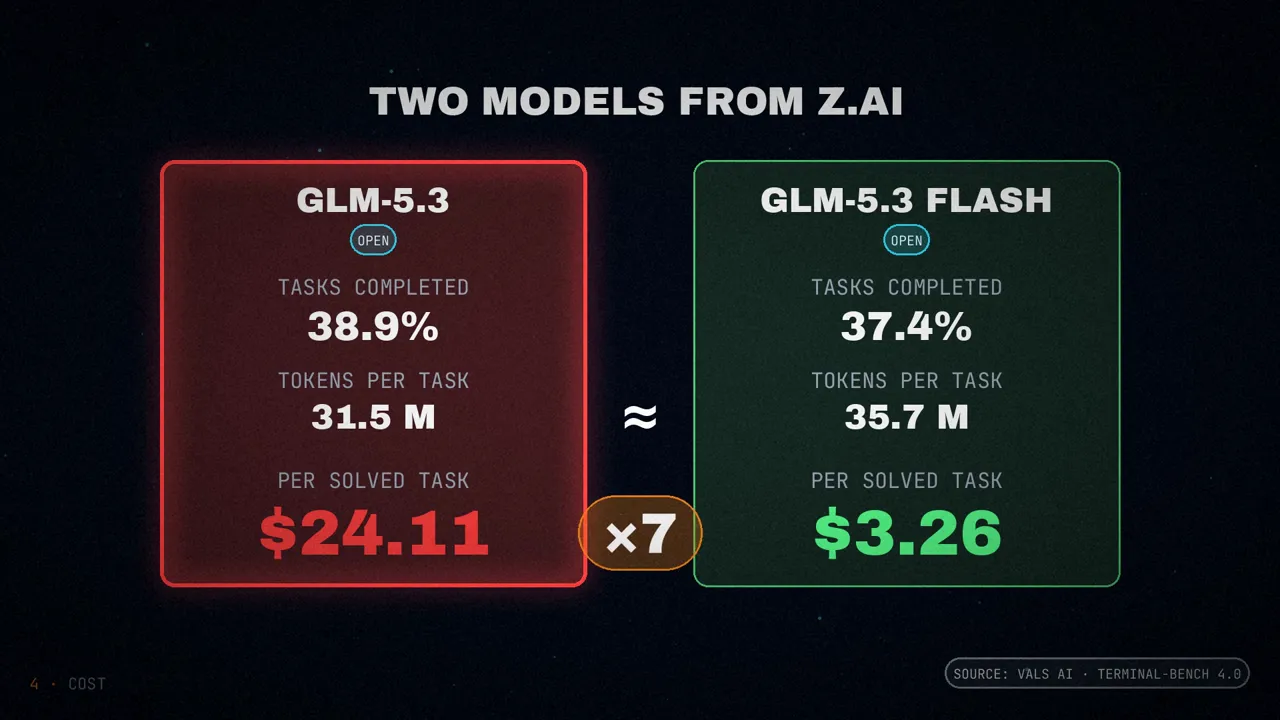
The clearest example: GLM-5.3 and GLM-5.3 Flash, both from Z.ai, complete almost the same (38.9% and 37.4%) with a similar number of tokens. But a solved task costs $24.11 with the large model and $3.26 with Flash: seven times more, because the large model's tokens are pricier and Flash ran on a cheaper provider. And it is not a one-off: of 741 pairs of models with different token prices, in 197 the one with the cheaper token spent more per solved task.
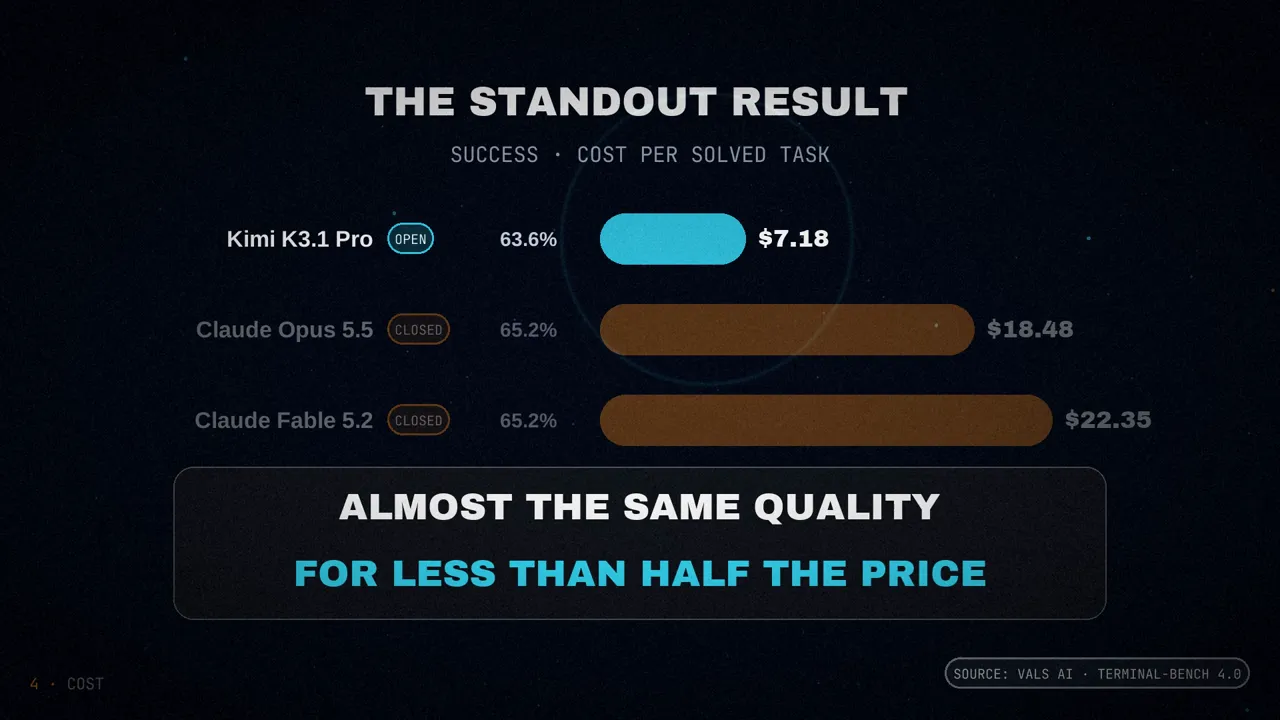
The result that stands out most: Kimi K3.1 Pro completed 63.6% of the tasks at $7.18 per solved task; Claude Opus 5.5 and Claude Fable 5.2 completed 65.2% at $18.48 and $22.35. Almost the same quality for less than half the price.
But being open does not make a task cheap. The cheapest strong result is closed: GPT-6.1 Sol completed 55% at $3.13. The previous Kimi, Kimi K3, cost $72.67 per solved task. In 28 pairs of an open and a closed model with similar success (within three points), the open one was cheaper in 18, by a median of 2.6 times, and pricier in the other ten.
Then there is time: closed models are usually faster, a median of 54 minutes per task against 70 for open ones, although Kimi took 49 and Claude Opus 5.5 took 64. If the agent works overnight or in parallel, time matters little; if a developer is waiting on it, the minutes are the product. All of this is a single benchmark of long agentic tasks: before choosing, measure cost per task, success and time on tasks like yours.
Adoption: lots of volume, little money
According to an estimate by Menlo Ventures (a model built on a survey of about 400 decision-makers, not an observed figure), in September 2026 open models processed 19% of the tokens of US enterprises but received only 4% of the spending. On Vercel's AI Gateway, among developers and startups, the same happens: 71.5% of the tokens and 23% of the spending.
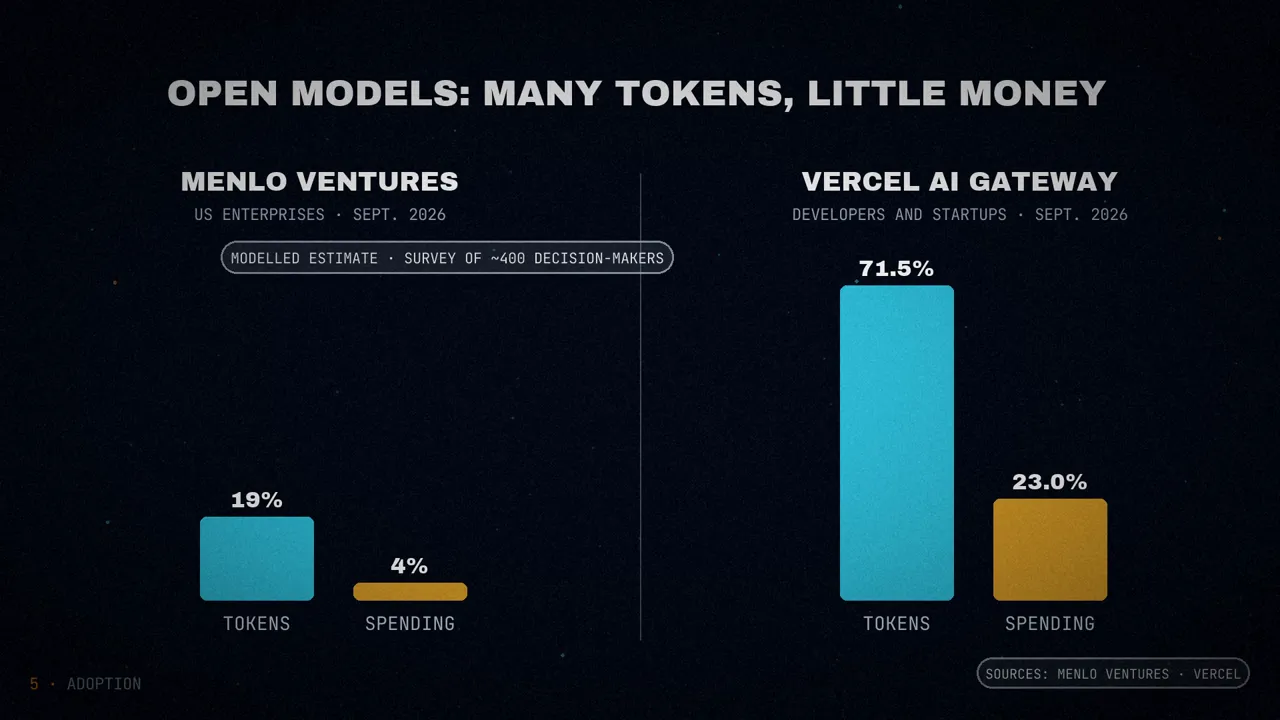
Volume concentrates in cheap models: on Vercel, DeepSeek V4.1 Flash carried nearly half of the tokens for 2.6% of the spending. And where they are already used, open models grow fast: on Vercel they went from 13% of the tokens in April to 71.5% in September.
Counted in companies, adoption is still small. Ramp, which sees its card payments, counts 6.4% of US businesses that pay for AI also paying a platform for open models (4.5% in January). And of those, 96% still pay OpenAI or Anthropic: open models are added alongside closed ones, not instead of them.
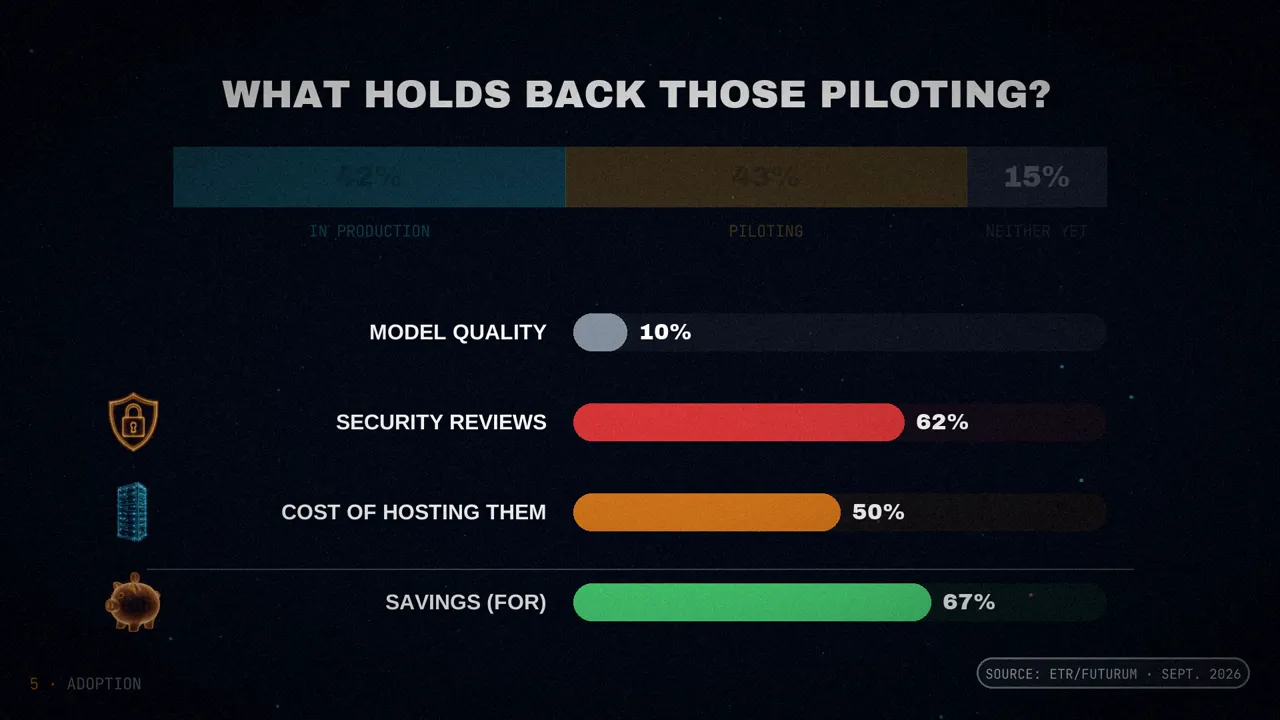
In an ETR/Futurum panel of 200 large companies (mostly North American, not a random sample), 42% have open models in production and 43% are piloting them. What holds back those piloting is not quality, which only 10% mention, but unfinished security reviews (62%) and the cost of hosting them (50%). The reason to try them is savings (67%).
Deployment: who runs them and when it pays off
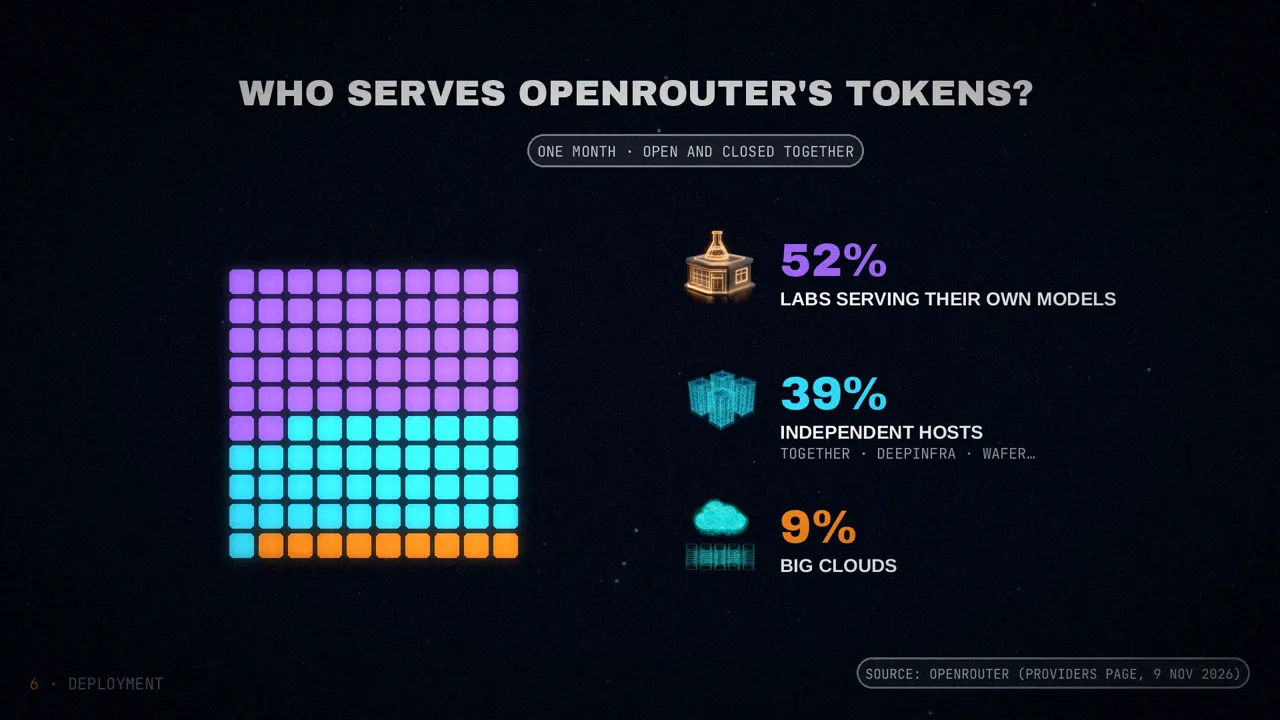
Publishing the weights lets others serve a model, but it does not decide who runs it, where or at what price. On OpenRouter, over the month to 9 November 2026 and counting open and closed models together, labs serving their own models took 52% of the tokens; independent hosts like Together or DeepInfra, 39%; and the big clouds, only 9%. The ten most used open models have a median of 17.5 providers each; the typical open model, two.
There are three ways to run an open model: a shared API, where you pay per token and the provider decides precision, version and location; dedicated capacity, where you pay per GPU hour, busy or idle; and your own infrastructure, where every decision and every failure is yours. Interestingly, of nine providers offering Kimi K3, eight charge exactly what Moonshot does.
When does renting your own GPUs pay off? The report works through an example: eight rented B200s running DeepSeek-V4-Pro cost about $48,700 a month, busy or idle, while DeepSeek's API costs nothing when you are not using it. In that scenario, the node is only cheaper if it works flat out more than 56% of the month.
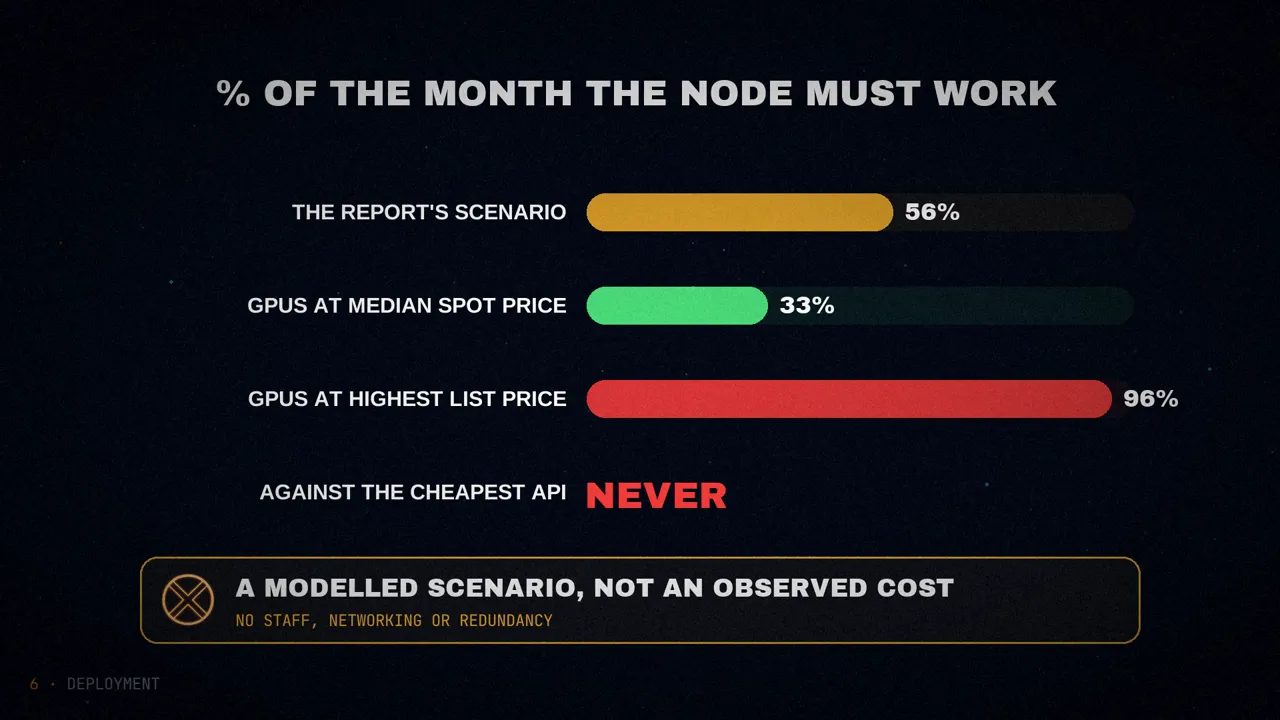
And that threshold moves a lot: at the median spot GPU price it drops to 33%; at the highest list price it rises to 96%; and against the cheapest API on OpenRouter it never pays off. It is a scenario with assumptions that leaves out staff, networking and redundancy. For a European company, location can weigh as much as price and is the hardest thing to check: providers headquartered in the European Union served only 0.6% of OpenRouter's tokens, and a provider's headquarters does not tell you where it processes requests.
The five conclusions
- There is a different leader depending on what you look at: Qwen in downloads, DeepSeek in tokens and Kimi in capability.
- Models change fast; labs, not so much.
- The gap with closed models depends on the task.
- The price of a token is not the cost of a task, and hosting the model yourself does not pay off by default either: it depends on how busy the GPUs are kept.
- Open weights widen the options, but almost every company that adopts them keeps paying for closed ones.
In short
Open models already compete on some tasks and on cost, but there is no single answer to whether they are as good as closed ones. It depends on what you measure (downloads, tokens or tests), on your task and on how busy you keep your GPUs. And it is worth remembering who signs the report: a platform that makes a living from open models, even if it shows all its numbers so we can check them.
Open models have no single gap with closed ones: it depends on what you measure, on your task and on how busy you keep your GPUs.
Do you use any open model at work?
Sources
- The State of Open Models 2026, by Helmcode Research, 24 November 2026. Text and charts under the MIT licence; third-party data keeps its own.
- The report's methodology and sources.
- The video, on my channels: English and Spanish.