
The mirror
Every year Manfred publishes an X-ray of tech talent in Spain: what it knows, what it earns and where it wants to work from. But that was only half the story. A market has two sides and, as the report puts it, if you only look at one you end up with bar-room conclusions.
So this year they crossed data from 127,665 professionals in their community with 167,645 tech job offers published in Spain between October 2025 and September 2026, collected by TheirStack, a platform that tracks thousands of job boards, company websites and aggregators.
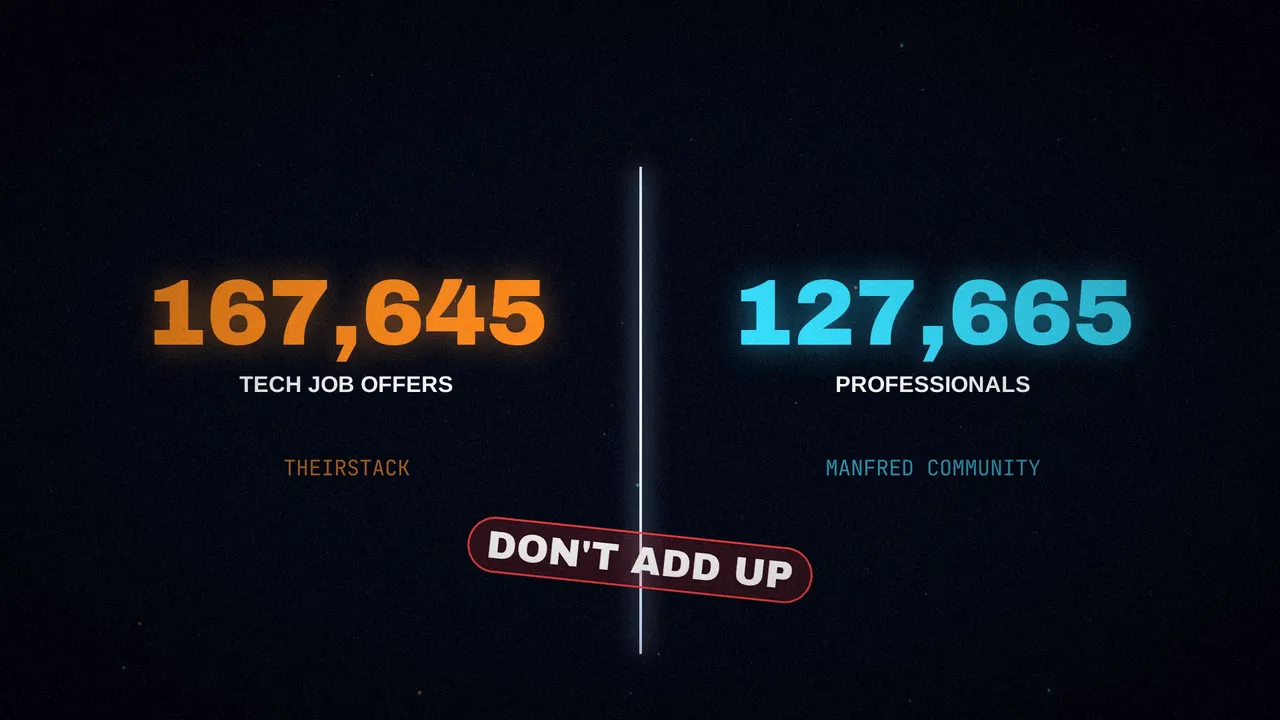
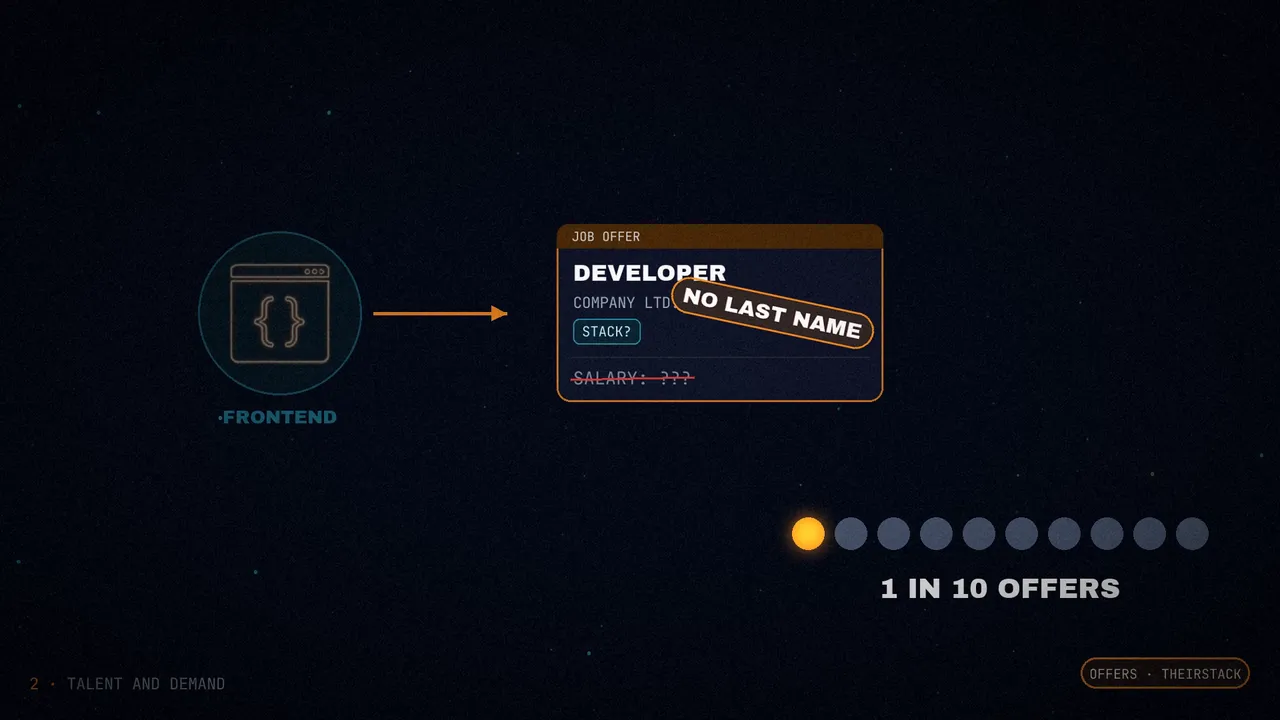
The first figure already hurts: only 10.3% of development offers publish the salary. One in ten. At Manfred, every offer has one.
One warning before going on, valid for the whole post: when the report talks about the salary of talent, it is almost always what those people ask for to change jobs, not what they earn today. And the colours follow the report's code: talent (Manfred community) in one colour, offers (TheirStack) in another.
Talent and demand
Roles: what there is versus what is asked for
Backend fits: it is 23% of talent and 22% of offers. Frontend does not: it is 14.7% of talent but barely 3.8% of offers, almost four times less. That demand has not disappeared: it has moved to a role with no last name, since one in ten offers asks for a plain "developer" without saying which technology.
Artificial intelligence is the other way around: its weight in offers (9.6%) is 5.5 times its weight in talent (1.7%). Security comes next: 6.3% of offers against 1.2% of talent (5.3 times). Product Manager is also in higher demand than supply (1.3 times). And with Tech Lead and Engineering Manager it is the opposite: there are more profiles than offers.
They want judgement, but they measure years
Offers do not know how to ask for judgement, so they ask for years. Of those that say how many, 55.5% ask for 2 to 4: someone who already knows the job but is still not expensive. Their median is the whole market's, €34,500. Only 3 in 100 accept less than two years.
And from five years on, the published salary almost flattens. Manfred's reading: it is not that experience stops paying, it is that the companies that pay seniors best do not show the salary.
The junior crossroads
For me, this is the toughest figure in the report. One in five tech professionals has less than two years of experience; many chose this career in the middle of the pandemic, with the promise of good salaries. But only 4.4% of offers look for a junior, and they pay little: a median of €25,500, barely above Spain's median salary (€24,497, INE).
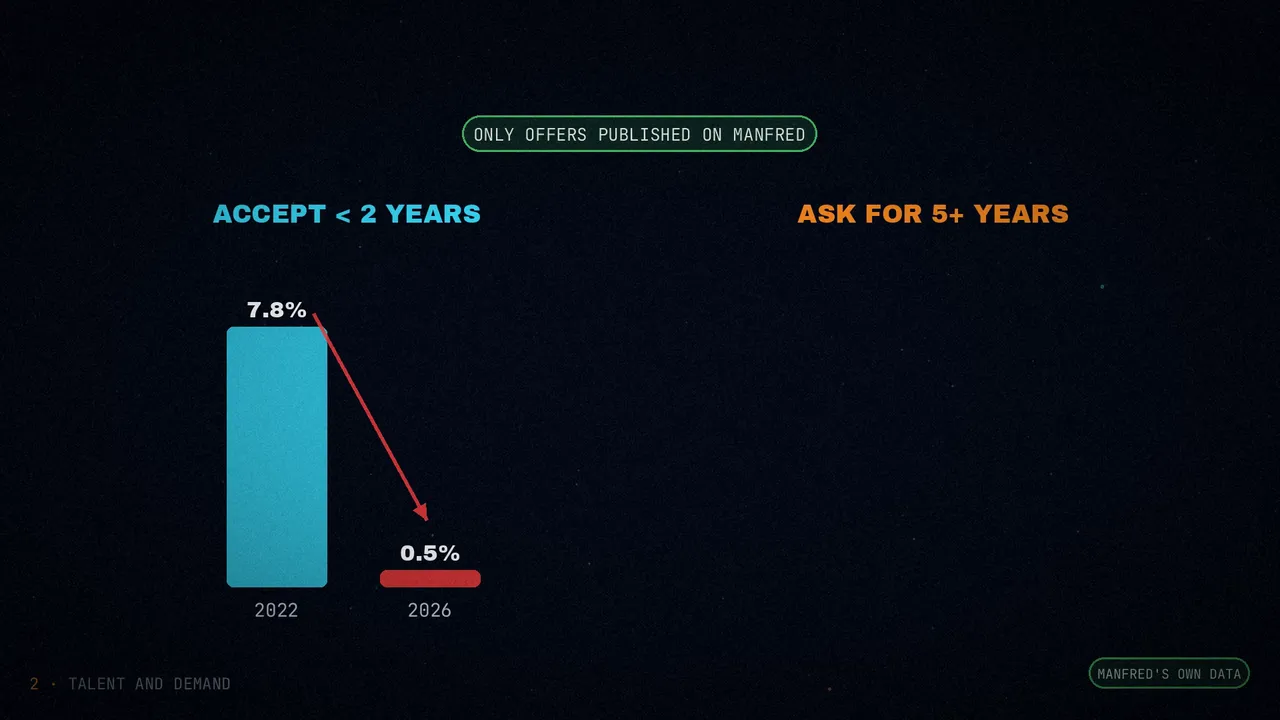
And it is getting worse. In the offers Manfred publishes (not the whole market), those that accepted someone with less than two years went from 7.8% in 2022 to 0.5% in 2026, while those asking for five years or more went from 24% to 60%. As the report says, the ladder is still there, but it is missing the first rung.
The door is also badly distributed: where there are the most juniors (Andalusia, Castile-La Mancha and Extremadura, where more than one in four profiles has under two years) is where the fewest offers appear. Manfred's bet is that AI will not close the junior door but move it: what will matter in a junior is not typing code fast, but understanding the business early. And its warning to companies: those who do not train people today will have no seniors tomorrow.
Salaries
There is not one backend median: there are four
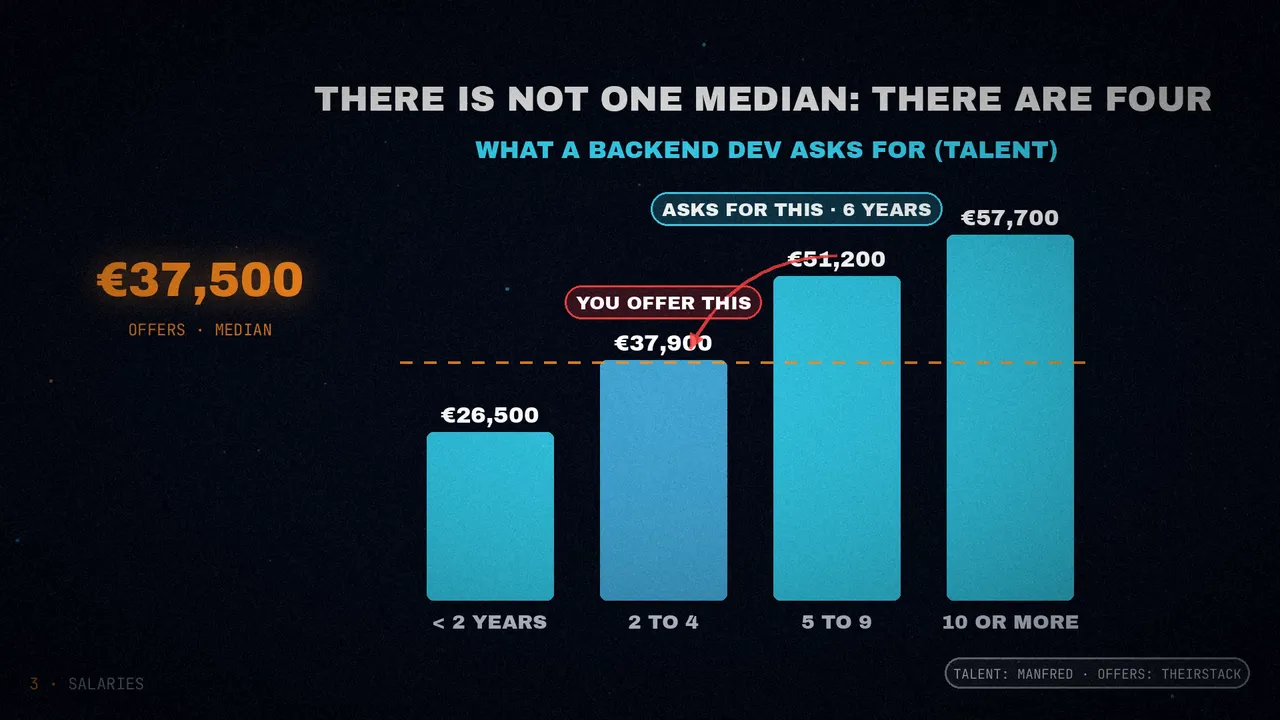
The median backend offer is €37,500. Sounds reasonable, until you put it on the map: it is what a backend developer with 2 to 4 years asks for (€37,900). With 5 to 9 years they ask for about €51,200, and with 10 or more, about €57,700. If you offer the market median to someone with six years, you are offering what someone with three asks for.
Size barely matters; the type of company matters a lot
From companies of up to ten people to those with more than five thousand, the median offer only rises from €31,500 to €39,000. What really changes pay is the type of company. Manfred splits the market into six (its "hexamodal" analysis), from small consultancies to big tech, and for a senior profile the typical base salary goes from about €40,000 to about €90,000: more than double. With variable pay, a big tech package ranges from €110,000 to €250,000; according to the report, up to 3.5 times a small consultancy. These are Manfred's estimates checked against salary guides, not offer medians.
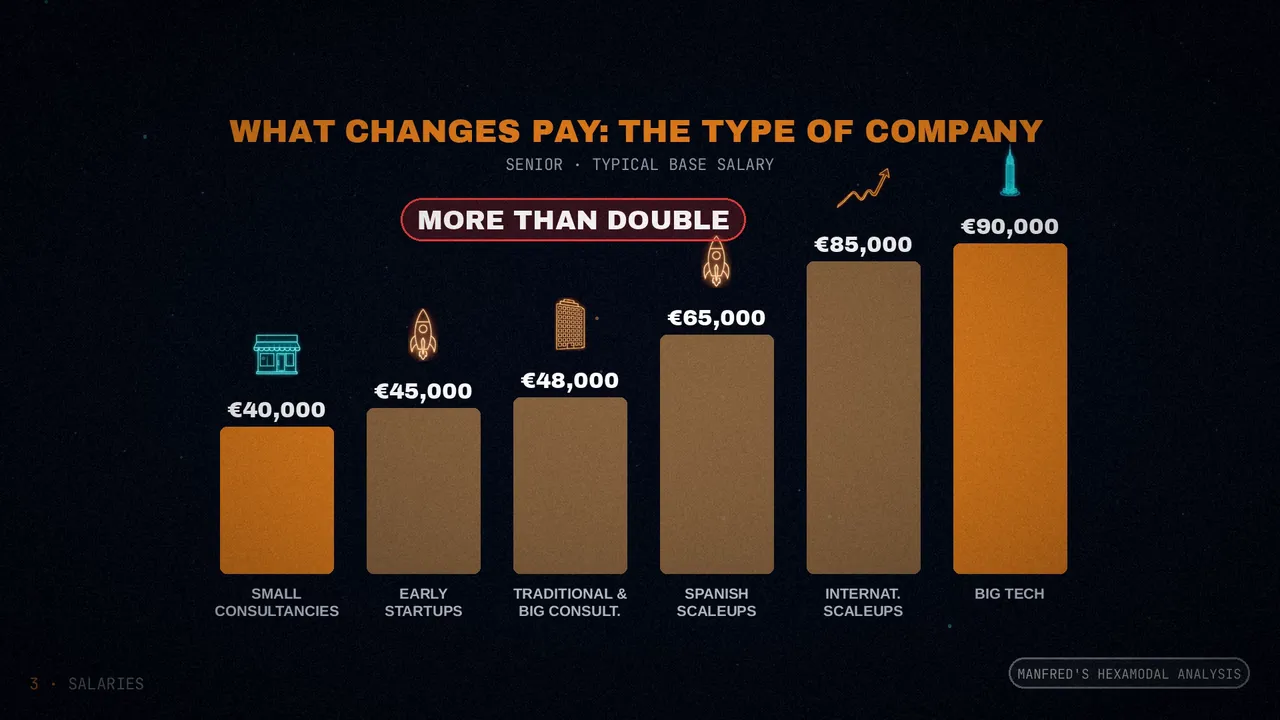
And careful: published salaries are not the whole market. The ones who publish them most are consultancies and traditional companies; international scaleups and big tech rarely show them.
Almost frozen since 2023… except what gets signed
A backend role was offered at €39,000 in 2023 and at €37,500 today. With inflation in 2024 and 2025, that €37,500 buys what €35,500 bought in 2023: almost 9% less. Only AI, Data Scientist and Data Engineer rise by more than €1,000. For Manfred, the money has not disappeared: it has gone to experience (from junior to lead the median doubles, from €25,500 to €55,000) and to a handful of companies playing in another league.
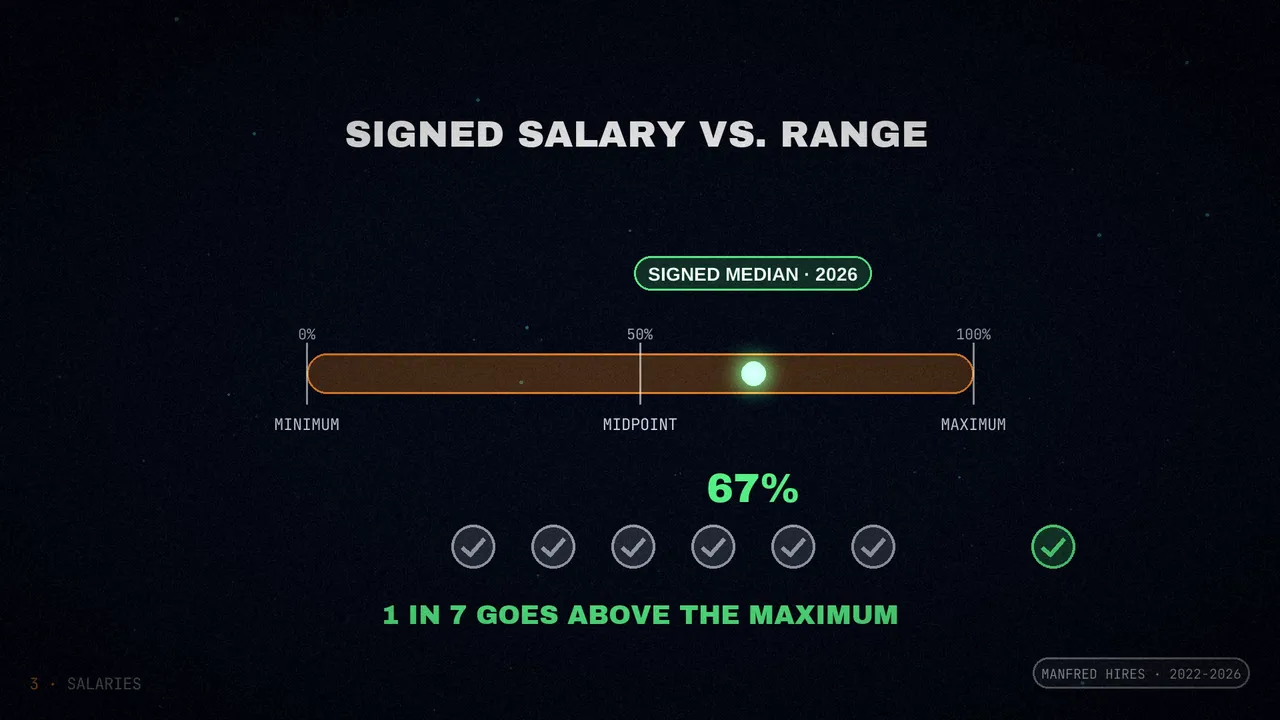
But there is a twist. In the hires Manfred closes, until 2023 half were signed below the midpoint of the published range; in 2026 the median is already signed at 67% of the range, and one in seven goes above the maximum. The range is not a ceiling: it is a starting point.
English pays
One in three tech offers in Spain is written in English. In offers written in Spanish, asking for English raises the median by about €3,000 (from €33,000 to €36,000), and asking for C1, up to €37,500. Among talent, the difference grows with the years: with ten or more, a native or bilingual profile asks for 65% more than one with basic English.
Where, who and how
Remote, hybrid and on-site
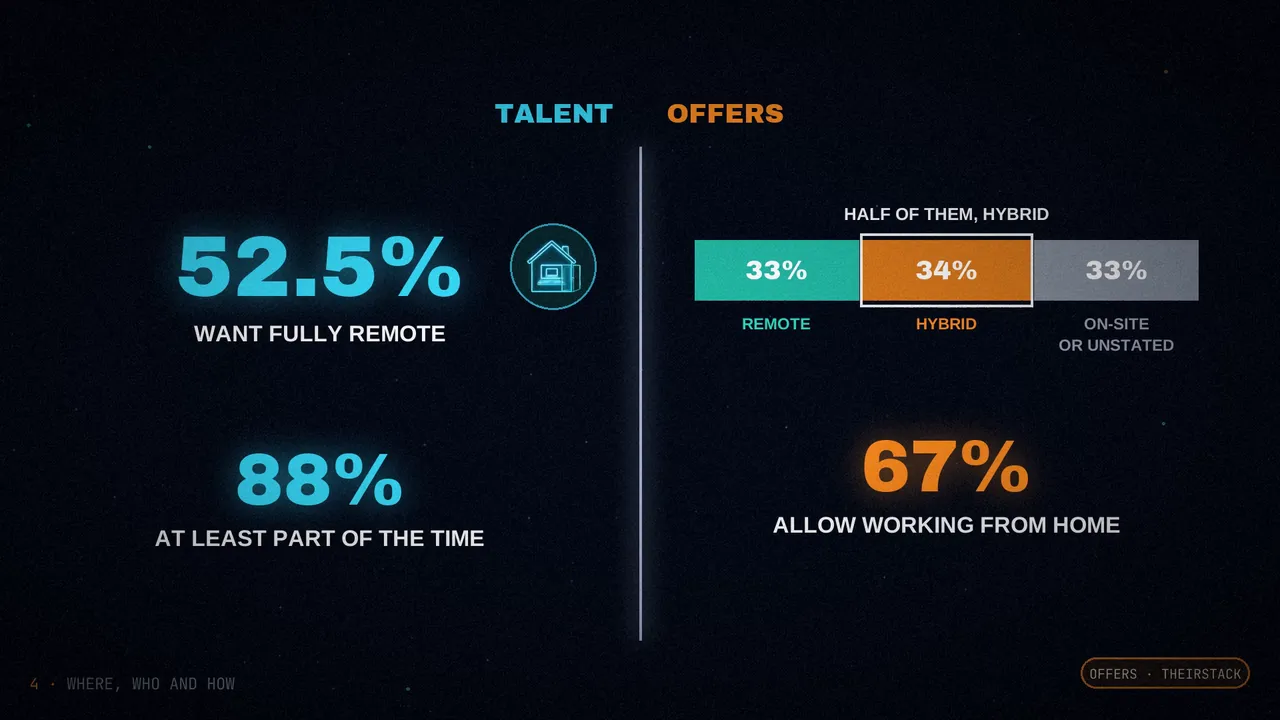
Talent is clear: 52.5% want fully remote work and 88% want to work from home at least part of the time. 67% of offers allow it (33% remote, 34% hybrid), but half of those are hybrid, and the remaining third is on-site or does not say. The trend goes the other way: in Manfred's offers, fully remote dropped from 85% to 57% between 2021 and 2025. And going to the office does not pay more: the three work models offer similar salaries (from €34,500 remote to €36,000 hybrid).
Offers have a capital; talent does not
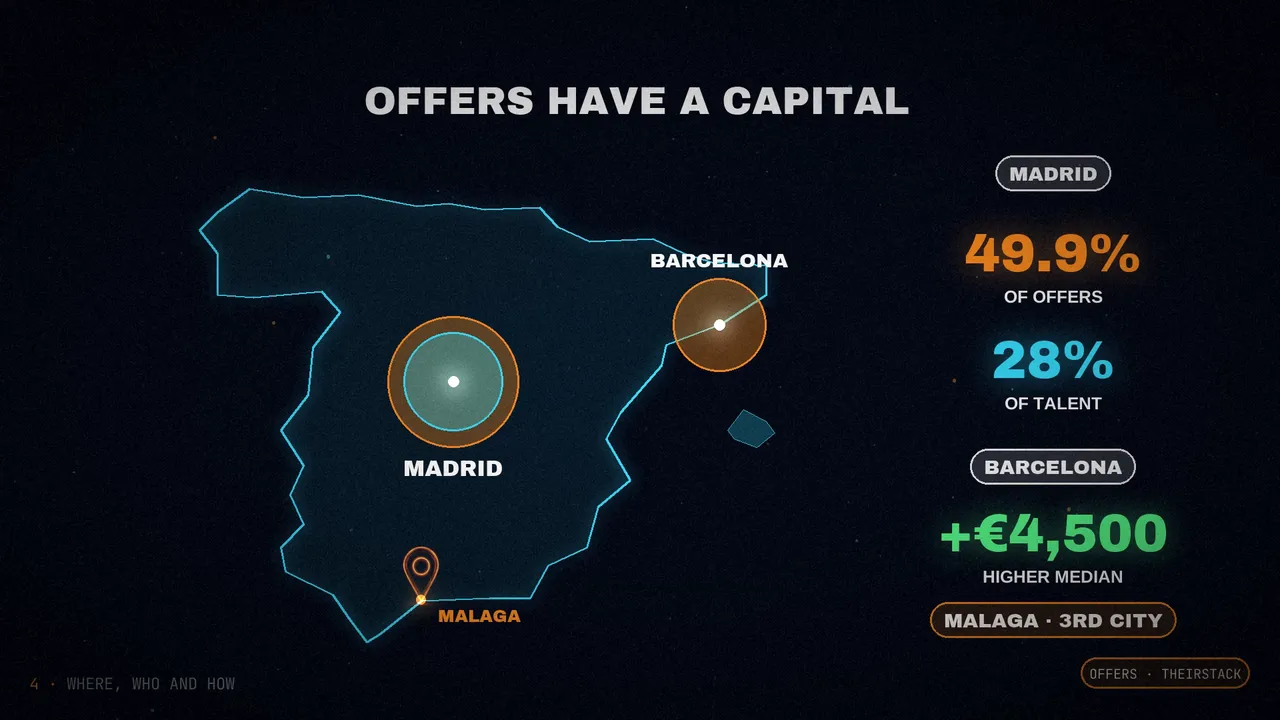
Madrid takes half of the offers that state a region (49.9%) with 28% of the talent. Barcelona has half the volume but pays €4,500 more at the median. And the surprise is Malaga, already the third city by number of offers, ahead of Valencia and Seville.
Talent, by contrast, is spread out: half of it lives outside Madrid and Catalonia, where only one in five offers appears. Madrid has almost two offers for every point of talent; the Canary Islands, one for every seven. Outside Madrid and Catalonia, more than 90% want remote work. For the report, every office day in an offer is a geographic filter.
Benefits, who posts and how long it takes
52% of offers do not mention a single benefit. The most cited, health insurance, appears in one in four (26.5%), and flexible hours, which cost nothing, in only 21%.
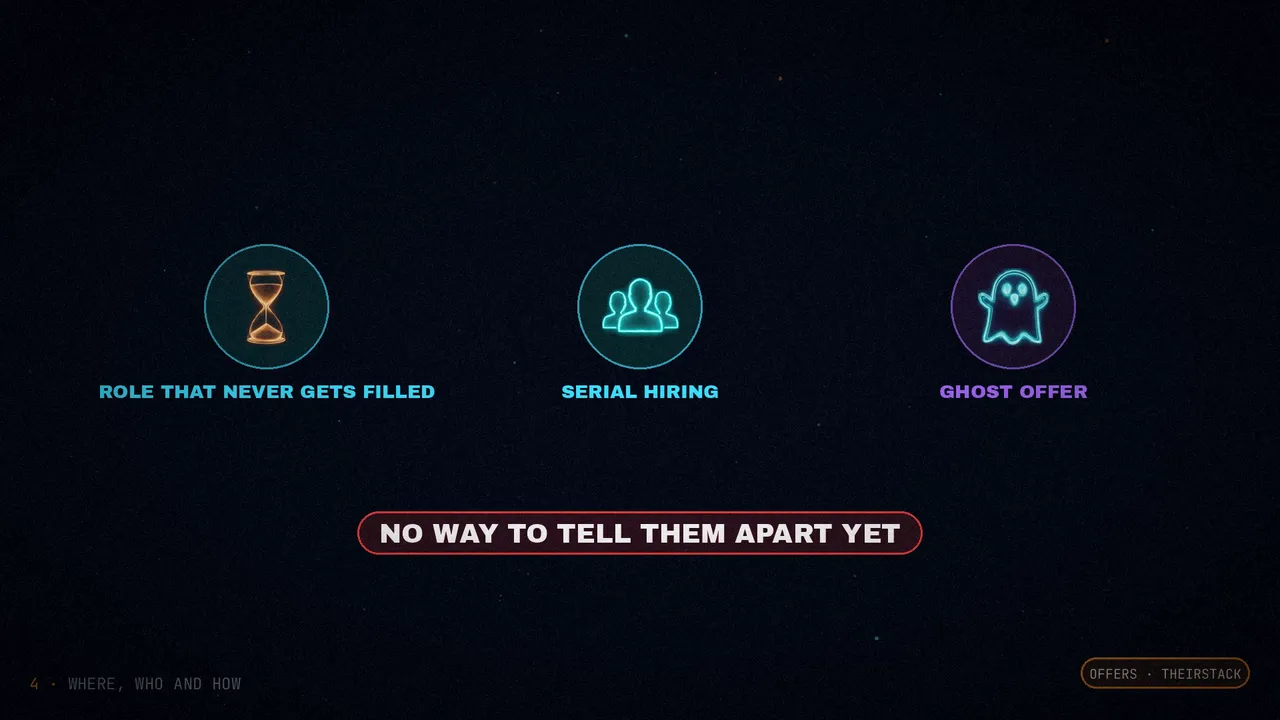
Who posts the offers? 39% come from consultancies and IT services firms; another 15% from recruitment agencies. More than half are not posted by the company where you will actually code. And one in five (21%) reappears, with the same company and title, in at least three different months: it could be a role that never gets filled, serial hiring or a "ghost" offer. There is still no way to tell them apart.
Filling a tech role takes a median of 42 days in Manfred's hiring processes. Leadership, architecture and cybersecurity take longer (half of those offers are still open after a month); full stack and mobile close in about ten days. It is a first snapshot, with a short LinkedIn and Indeed sample, and an offer closing does not mean it was filled.
Technologies
The report's summary: Spanish tech talent was trained on the web, and the market has moved to the cloud. JavaScript is used by 45% of talent but only 16.4% of offers ask for it. Kubernetes is the opposite: 17.4% of offers ask for it and 8.8% of talent uses it, double. Azure and Terraform, 1.7 times.
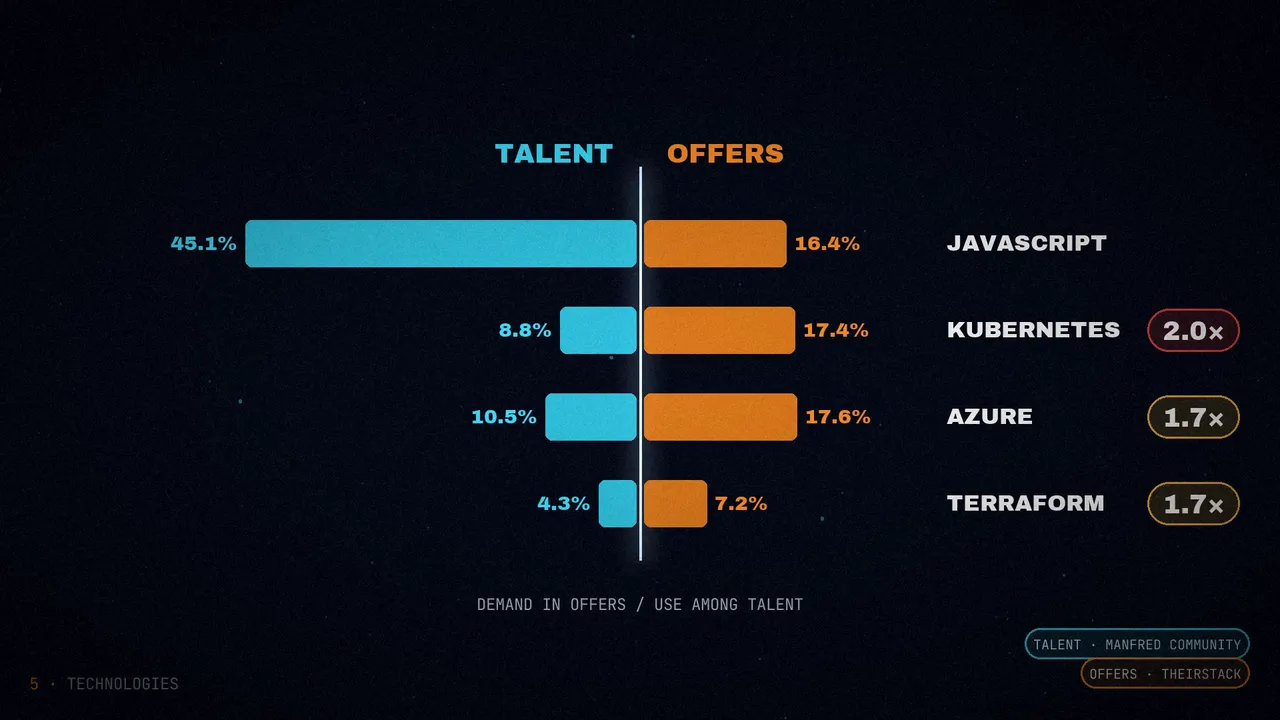
Some curious figures: Java is requested by 25% of offers, and yet 26.5% of talent marks it as a technology they do not want to work with. CSS is used by almost a third of talent and requested by only 7.5% of offers.
And what is scarce is held by veterans: in Kubernetes, fewer than one in ten have less than two years; in Terraform, two in three have five or more; in Ansible, 40% have ten or more. Pandas and React, by contrast, are the way in. Manfred's warning: without a new generation, the cloud bottleneck will be people, not technology.
So what is going up? AI is what grows most in offers: it gains almost ten points in a year and now appears in 15.7%. Behind it come CI/CD, Python, Docker and Kubernetes, which has almost doubled since 2023. What is going down is exactly where talent is most concentrated: JavaScript, CSS and Java.
Women in tech
In the Manfred community, women are 15.6% of tech profiles (18% in Madrid, 8% in Murcia). Only one role reaches parity, Product Design / UX (50%); Software Architect stays at 5% and Tech Lead at 6%.
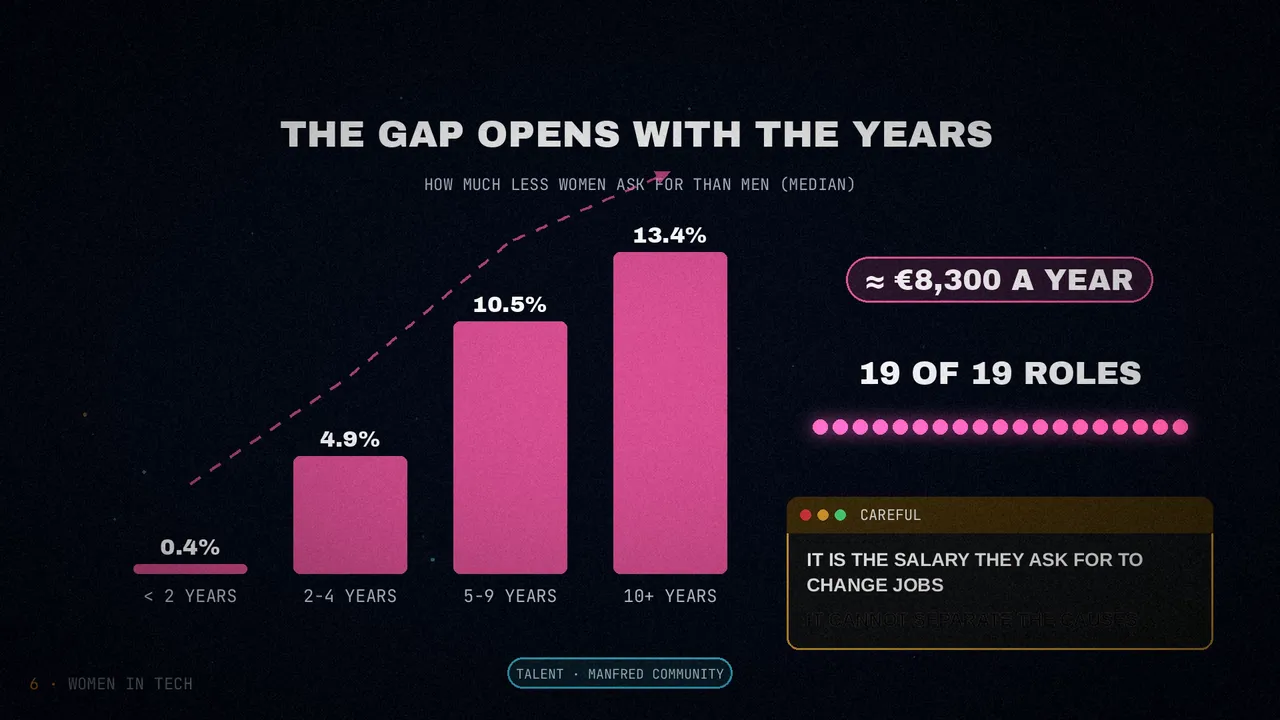
And the pay gap does not start at entry: it opens with the years. With less than two years, women and men ask for practically the same (0.4% difference). With 2 to 4 years, 4.9%; with 5 to 9, 10.5%; and with ten or more, 13.4%, about €8,300 a year. It happens in all 19 roles. Two important caveats: this is the salary they ask for to change jobs, not what they earn, and the report explicitly says this data cannot separate the causes. Measuring it, they say, is the first step to closing it.
Artificial intelligence
Everyone uses it; hardly anyone teaches it
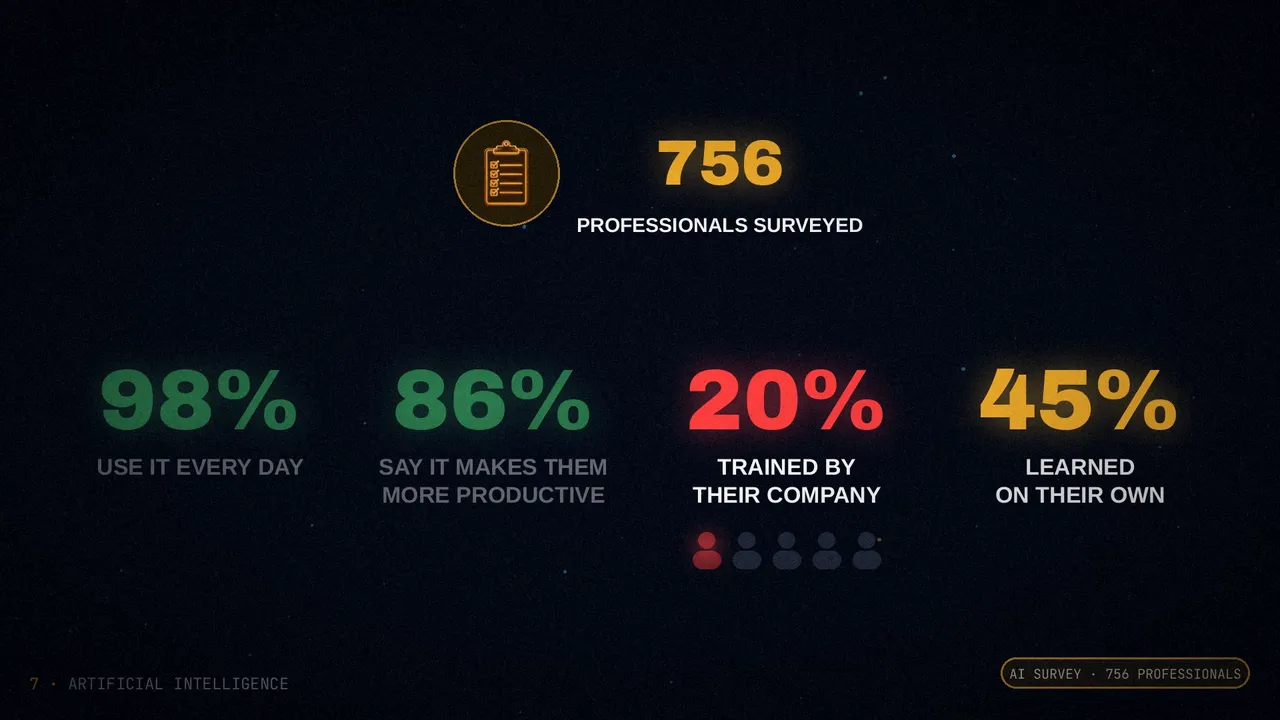
Manfred surveyed 756 professionals in its community. 98% use AI every day and 86% say it makes them more productive, but only 20% have received training from their company; 45% learned on their own. Company size changes almost everything: in small companies, 81% have total freedom and Claude leads (64%); in companies of more than a thousand people that freedom drops to 48% and GitHub Copilot leads (50%), although that is where the most training happens. Almost nobody trusts it blindly: only 21% use generated code without touching it. Careful: it is a self-selected, very experienced sample (56% have more than ten years), not the whole market.
The technical interview is changing
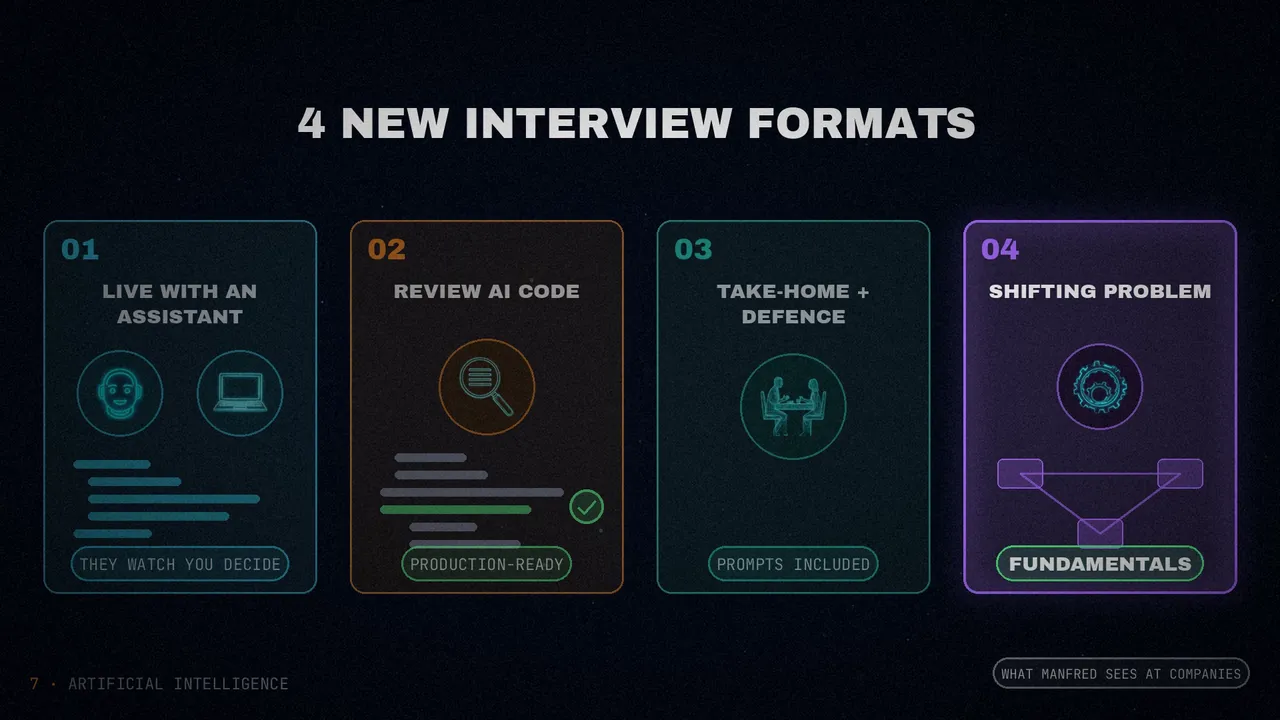
84% of the community would allow AI in a technical test. And of the thirteen companies Manfred talked to, six have redesigned their test, and four of those six have dropped the take-home test or the algorithm exercise (the report's 46% and 67%; a small, non-representative sample). In their place, four interview formats are emerging:
- Live coding with an assistant, while they watch you work and decide.
- Reviewing and debugging AI-generated code until it is production-ready.
- A take-home test with AI and a live defence, explaining your decisions and your prompts.
- The problem that changes mid-session, or system design, where AI helps less and fundamentals show.
The idea behind it: if an assistant solves your test in two minutes, you are measuring the assistant.
What offers ask for and the roles being born
One in six offers already mentions AI (15.7%), and those asking for agents have multiplied by eight in a year. Two in three AI offers ask for Python, almost one in three asks for LLMs or RAG, and LangChain is now requested more than TensorFlow. But in the Manfred community only 1.7% have an AI role.
AI Engineer jobs (people who integrate models into products) have multiplied by about twenty since 2023, and there are now almost three times as many as ML Engineer jobs (people who train them): what Spain hires for is integrating, not training. And the Forward Deployed Engineer appears, half engineer and half consultant, who sits down with the client to deploy: still few offers (273), almost all in English.
What the mirror says
The report's takeaways cross the data with thirteen conversations with CTOs and engineering and People leads. These are the four I keep:
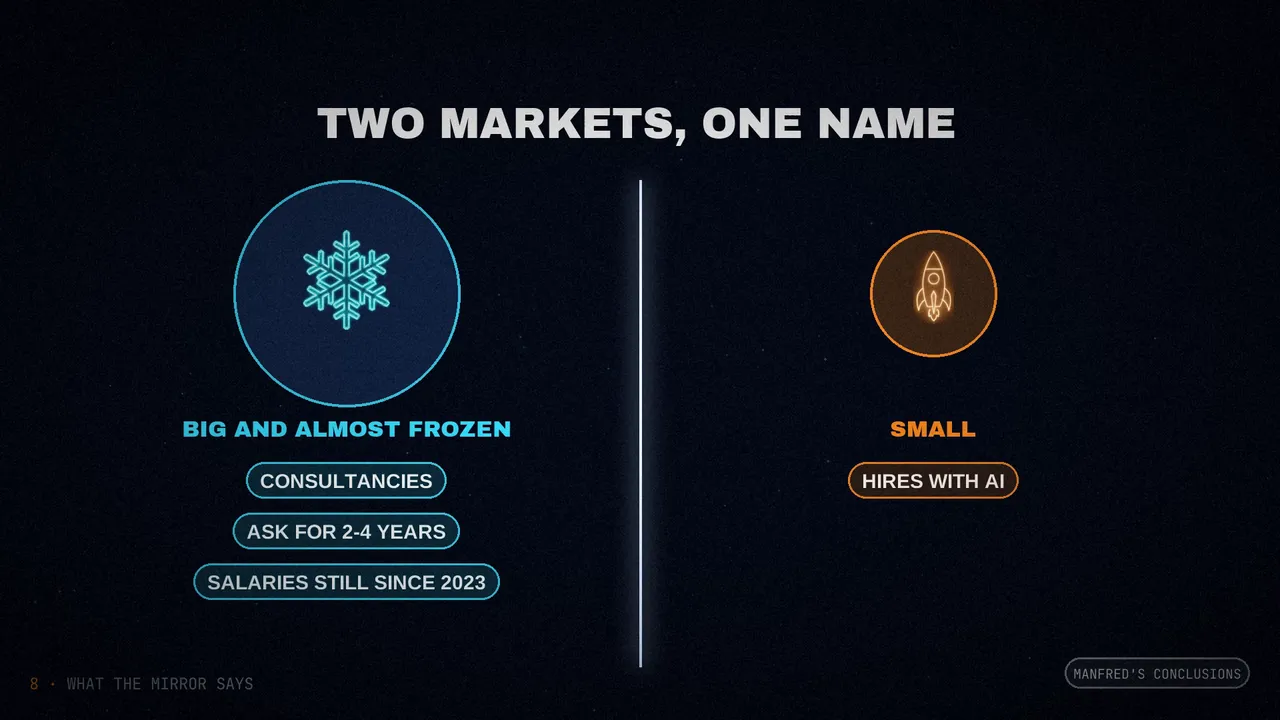
- Two markets under one name. A big one, almost frozen (consultancies, offers for 2 to 4 years and salaries that have barely moved in three years), and a small one that hires with AI and pays a senior more than double in base. As one interviewee put it: the market has parted like the Red Sea, and the middle class is disappearing.
- Using AI no longer sets you apart; reviewing it does. Much more code is shipped, so much more is reviewed: "The bottleneck is now in the review." The way in is moving towards what you can build and fundamentals no assistant gives you.
- The classic technical test is dead; the new one measures judgement.
- Publishing the salary will be mandatory. The EU pay transparency directive requires giving the range before the interview, and the deadline to transpose it ended on 7 June 2026. Companies that already publish bands see it as an advantage: "Nobody has dropped out on me over money," says one CTO.
And one last figure for perspective: the median development offer in Berlin is €76,000; in Madrid, €34,900. Your commit is worth double in Berlin.
In short
The Spanish tech market is two markets under one name. Talent was trained on the web and the market asks for cloud, security and AI. Juniors find the door narrower every year, offered salaries have barely moved in three years and only one in ten offers says how much it pays. The full report also has interactive tools to see where you stand.
Talent and market no longer recognise each other in the mirror: what is asked for (cloud, AI, security, judgement) is not what there is, and what is paid is almost never published.
Did your last job offer state the salary?
Sources
- Tech Career Report 2026, by Manfred × TheirStack, November 2026 (in Spanish and English). Data under CC BY-NC 4.0.
- TheirStack, the source of the job offers.
- The video, on my channels: English and Spanish.