GPT-6 Astra impressions
Raschka used Astra for a few days and says it is probably the best model he has tried. It beats its predecessor, GPT-5.6, at almost everything (writing, math, coding), but where it stands out most is graphical demos: 3D rendering and animation.
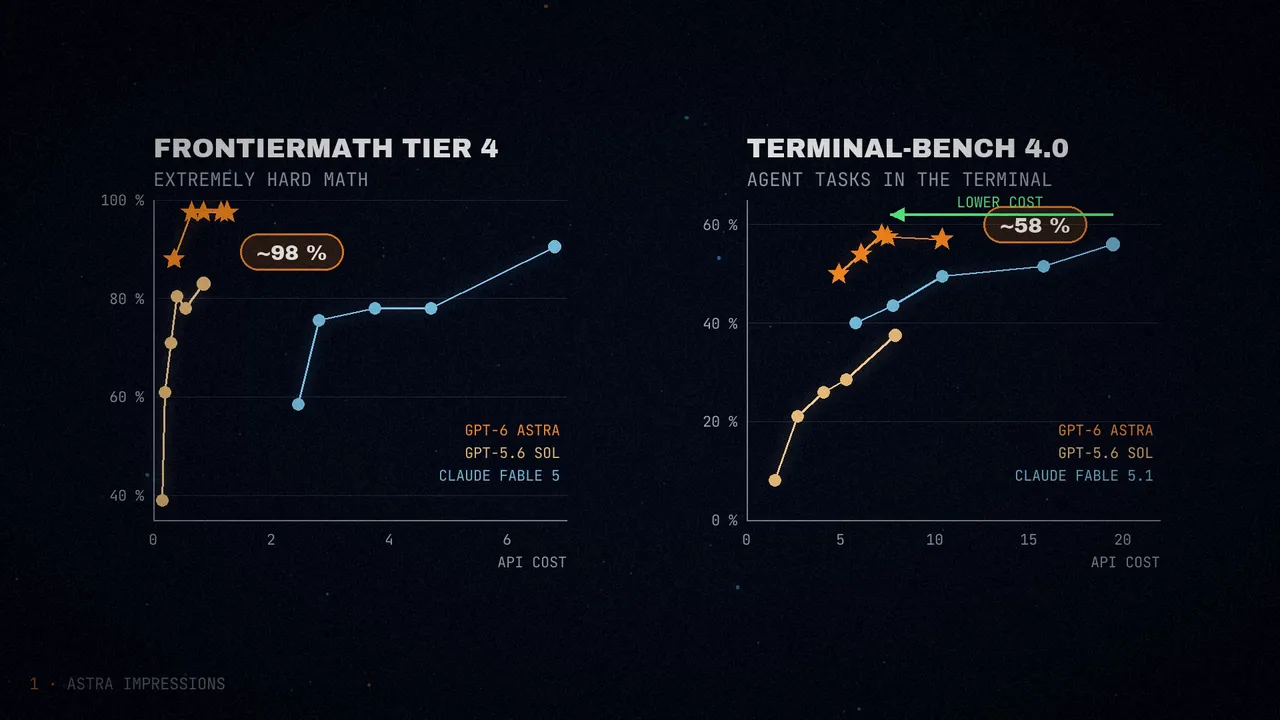
OpenAI's benchmarks reflect that:
- FrontierMath Tier 4 (extremely hard math): Astra gets close to 98% at a very low cost.
- Terminal-Bench 4.0 (agent tasks in the terminal): it reaches about 58%, above Claude Fable 5.1 while spending less.
- ARC-AGI-3 (logic and generalization): according to the author, Astra scores 99.9%, against 7.8% for GPT-5.6 Sol.
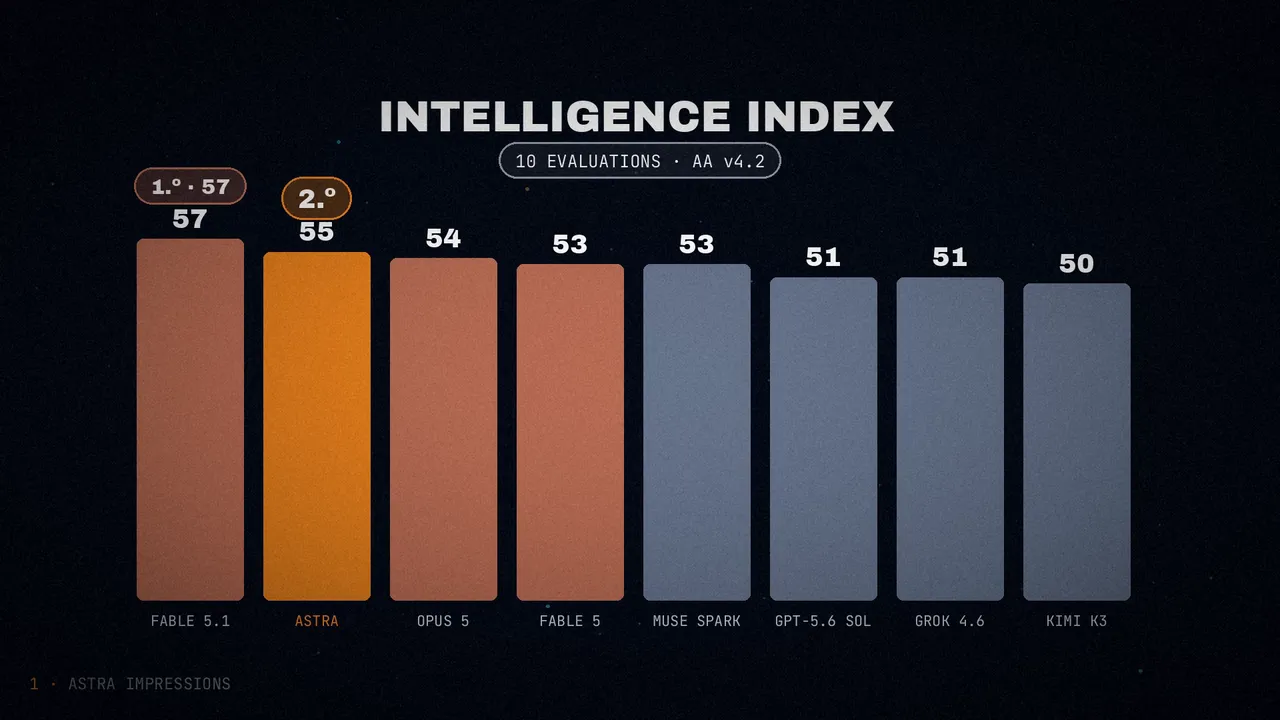
On independent benchmarks the gap narrows. On Artificial Analysis's Coding Agent Index, Astra is at the frontier without pulling ahead. And on their general Intelligence Index (v4.2, which blends ten evaluations), Astra scores 55 points and comes second, behind Claude Fable 5.1 at 57. The nice thing about these indexes is that they are not published by whoever sells the model.
There is a caveat: the harness. Several of these benchmarks use the same harness for every model, which makes the comparison fairer. But each model is trained with its main harness in mind, and that harness is built to amplify its strengths. Away from home, Astra might perform worse than in its own. OpenAI itself reported that two harness changes tripled Sol's ARC-AGI-3 score, from 13.3% to 38.3% (a different setup from the 7.8% one).
That leads to a practical tip, which a colleague gave Raschka and which the Claude Code lead also recommends: archive part of your AGENTS.md files and your skills. Newer models understand the problem better, and all that extra hand-holding can constrain them and lead to worse solutions. It's not about throwing everything away (skills save work when a task repeats), but about updating or regenerating old descriptions.
Computer use
Where Astra really shines is computer use: the model operates software on your machine through the Codex or ChatGPT app. Raschka asked it to draw a portrait of him in a browser version of Paint, moving the mouse, at the medium and high effort levels. The interesting part is not the drawing, but that the model uses the interface the way a person would.
It is not the first model to do this, but computer use is still immature. That makes sense: language models are text models, so the low-hanging fruit was writing, coding and using APIs and CLIs. But many programs have no command line, and instead of waiting for someone to build one, you can teach the model to use the graphical interface. Raschka compares it to humanoid robots: not the most efficient on an assembly line, but versatile.
It fits a recent report: OpenAI bought tens of thousands of Mac Minis and Mac Studios for reinforcement learning. The Macs don't train the model (that's what GPUs are for; according to NVIDIA's CEO, Astra was trained on about 100,000 Grace Blackwell GPUs). They are the environment: the operating system the model learns to work in. The loop goes like this:
- The model gets a task (“open this app and do that”).
- The harness hands it a screenshot.
- The model decides mouse and keyboard actions: clicks, key presses, scrolling.
- The harness runs them on the Mac and returns a new screenshot.
- Repeat until the task succeeds or fails.
- Success or failure, together with verifiers, becomes the reinforcement learning reward, just like regular reinforcement learning with verifiable rewards (RLVR).
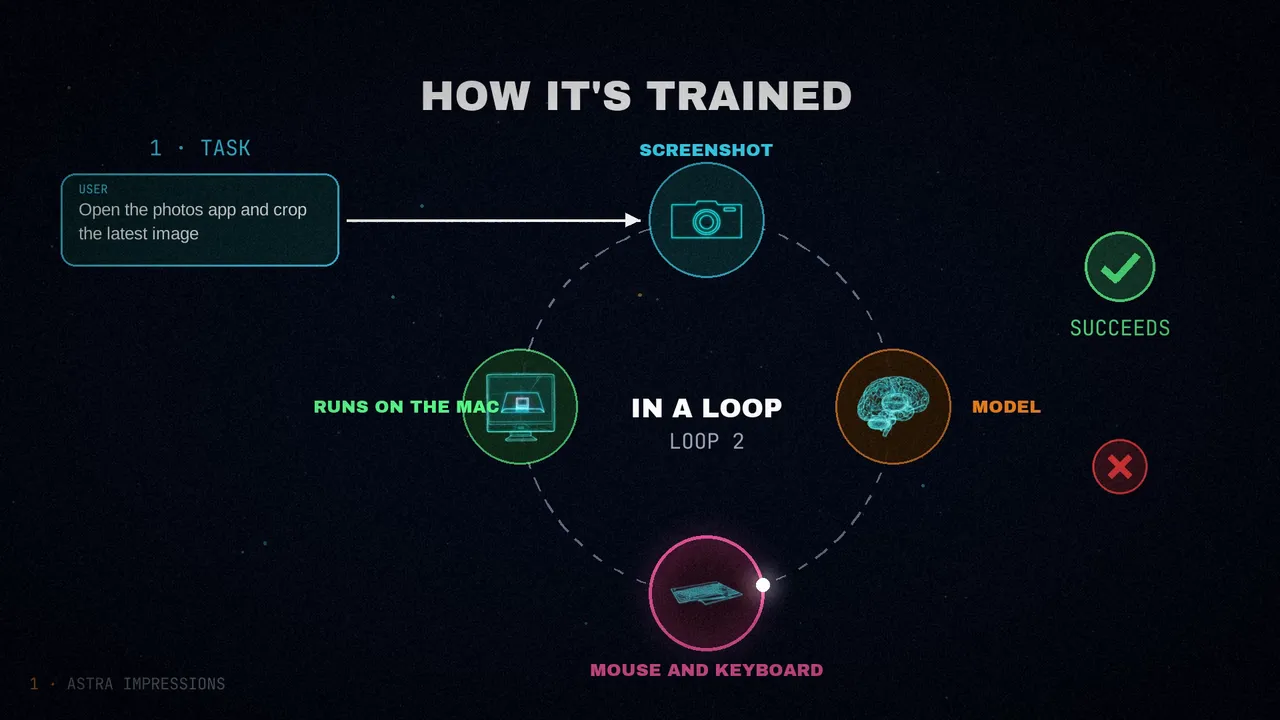
So computer use doesn't change the paradigm: Astra is still a reasoning model, trained with verifiable rewards, that writes intermediate steps (its chain of thought) before answering. And that's where the controversy starts.
The rumor
Two days before the launch, The Information reported that, according to inside sources, Astra uses a technique called recurrent depth, or looped transformer. It added that, unlike other models, which show in writing how they think, this technique would obscure some or all of its reasoning: humans could not easily read its steps.
It's a rumor, with no official confirmation. To judge it, Raschka first explains what a looped transformer is.
What a looped transformer is
It's an architectural tweak: the intermediate representations pass through the same blocks several times, instead of just once. The difference from adding more blocks is that the weights stay the same across passes. Three terms the article uses:
- Transformer block: attention, a feedforward module, normalization and shortcut connections. Papers often call it a layer.
- Stack: a sequence of blocks.
- Block application: running an input through a block once.
The idea isn't new: it already appeared in the Universal Transformer, from 2018. But the simplest example is Nanbeige4.2-3B, an open-weight model from July. From the outside it looks like a regular transformer: the text becomes tokens and vectors, which pass through 22 blocks, each with its own weights. The difference is an arrow looping back to the start: after the first pass, everything goes through the same 22 blocks again.
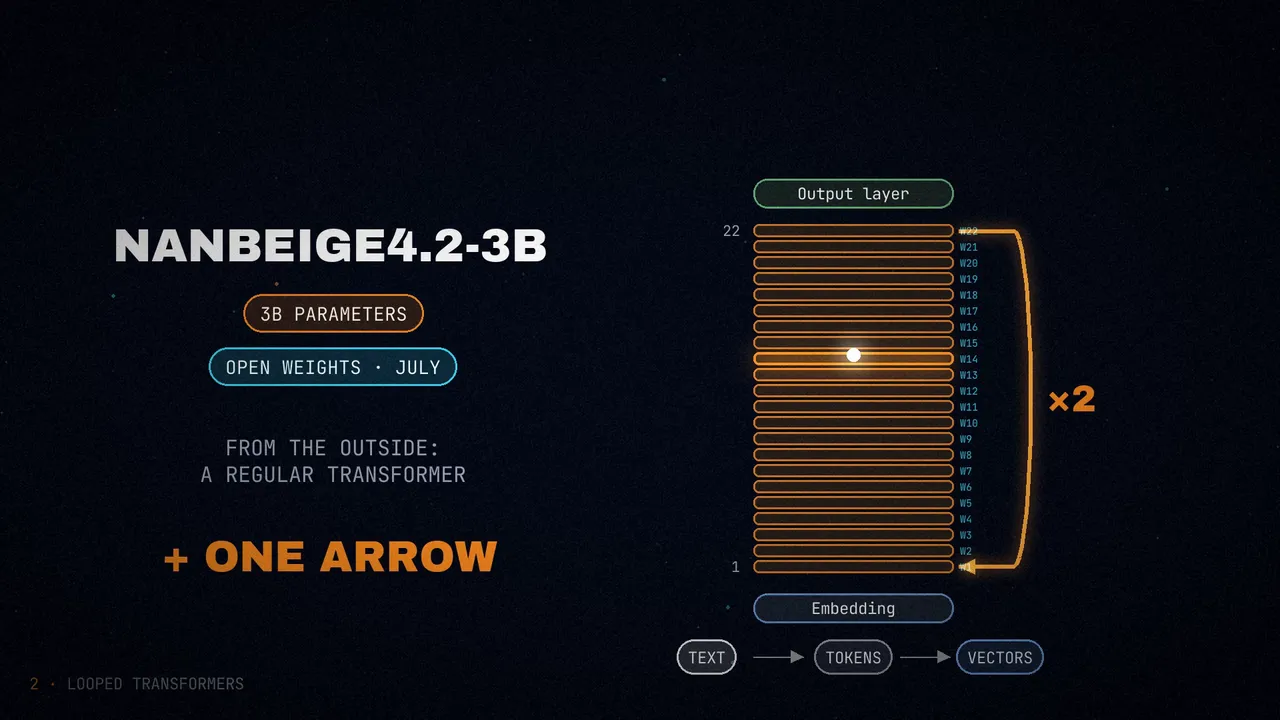
Unrolled, that's 44 block applications, but the second round reuses the first one's weights: application 23 uses the weights of block 1, application 24 those of block 2, and so on. The effective depth goes from 22 to 44 without adding a single weight.
Why two rounds, not three or four? The Nanbeige paper gives few details, but says two was the most efficient setup: with three the model improves a bit, but the extra compute isn't worth it, and more passes brought small gains, slower training and less stable optimization.
What looping costs
Looping is an alternative to making the model bigger. Twenty-two blocks used twice have half the block parameters of 44 distinct blocks. In Raschka's comparison:
| 22 blocks, 1 pass | 22 blocks, 2 passes (Nanbeige) | 44 blocks, 1 pass | |
|---|---|---|---|
| Distinct blocks | 22 | 22 | 44 |
| Block applications | 22 | 44 | 44 |
| KV cache depth | 22 layers | 44 layers | 44 layers |
| Total parameters | 4.17B | 4.17B | 7.32B |
It takes less memory, although the embedding and output layers, which aren't repeated, are heavy: about a quarter of the total in Nanbeige. (The name says 3B and the author's figure gives 4.17B in total; I use the figure's numbers.)
What looping does not save:
- Compute. Every forward pass goes through all 44 applications, and during training the gradients flow back through both repetitions. It costs about the same as 44 distinct blocks; the only saving is that the optimizer has fewer parameters to update.
- KV cache. On the second pass, block 1 receives different states and produces different keys and values. Applications 1 and 23 use the same block, but each needs its own cache entries: the same cache as 44 distinct blocks.
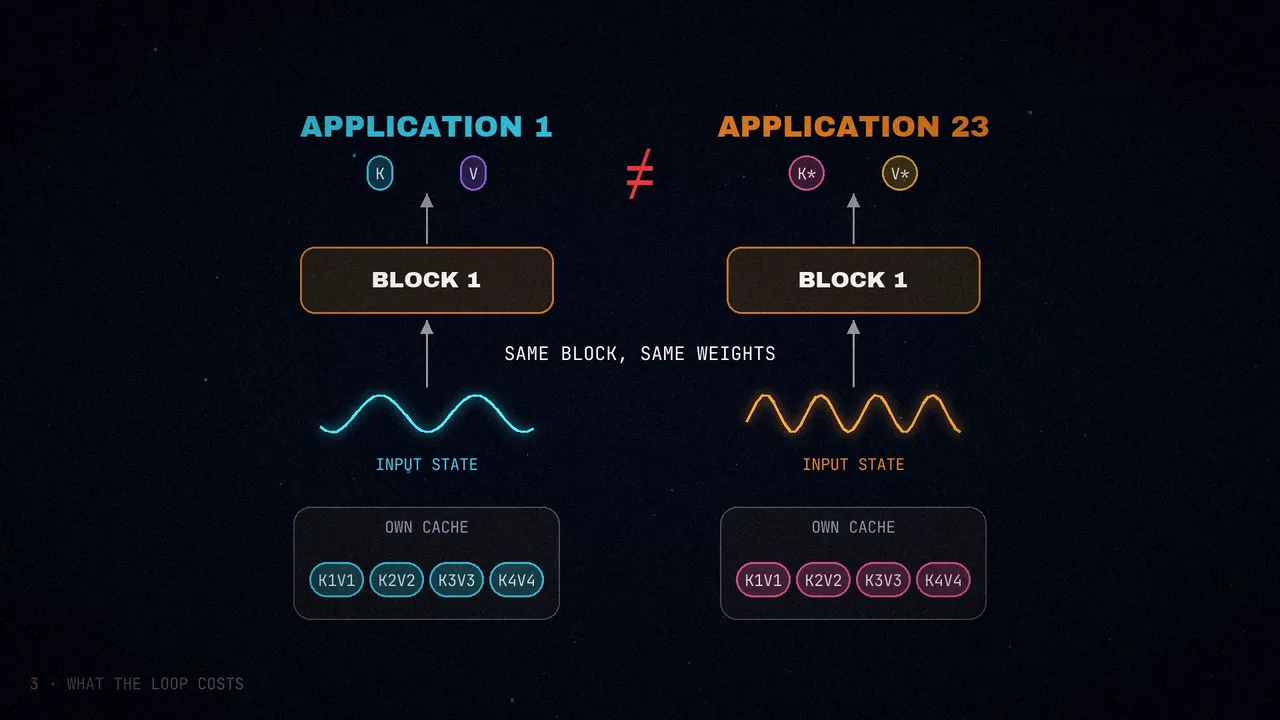
The Nanbeige team tried sharing the cache between passes: it was cut in half, but the model performed worse, so they released the version with separate caches. Another lesson from their report: training the looped model from scratch worked better than converting an already trained transformer (upcycling).
Loops on demand
The number of passes is another design choice. In Nanbeige it's fixed at two, but it can depend on the token:
- Universal Transformer (2018): repeats a single block (not a stack) and explores adaptive halting. A small trained function outputs, at each step and for each position, a halting probability; the model adds them up and, once the sum crosses a threshold, that position stops. Just in case, there's a maximum loop count. That way, compute goes where it's needed.
- Ouro (ByteDance): Ouro-Thinking 2.6B runs four times through the same stack of 48 blocks, 192 applications with the weights of 48, and a learned exit gate decides which pass supplies the answer. But the version released on Hugging Face always computes all four passes, so in practice the count is fixed.
- Mixture-of-Recursions (2025): the repeated stack (the recursion block) sits between its own first and last blocks, and each token goes through it one, two or three times. A small learned router decides, like in a mixture of experts, except here it picks how many loops instead of an expert. Since it looks at the token's hidden state, which includes its context, the same word can loop a different number of times depending on where it appears.
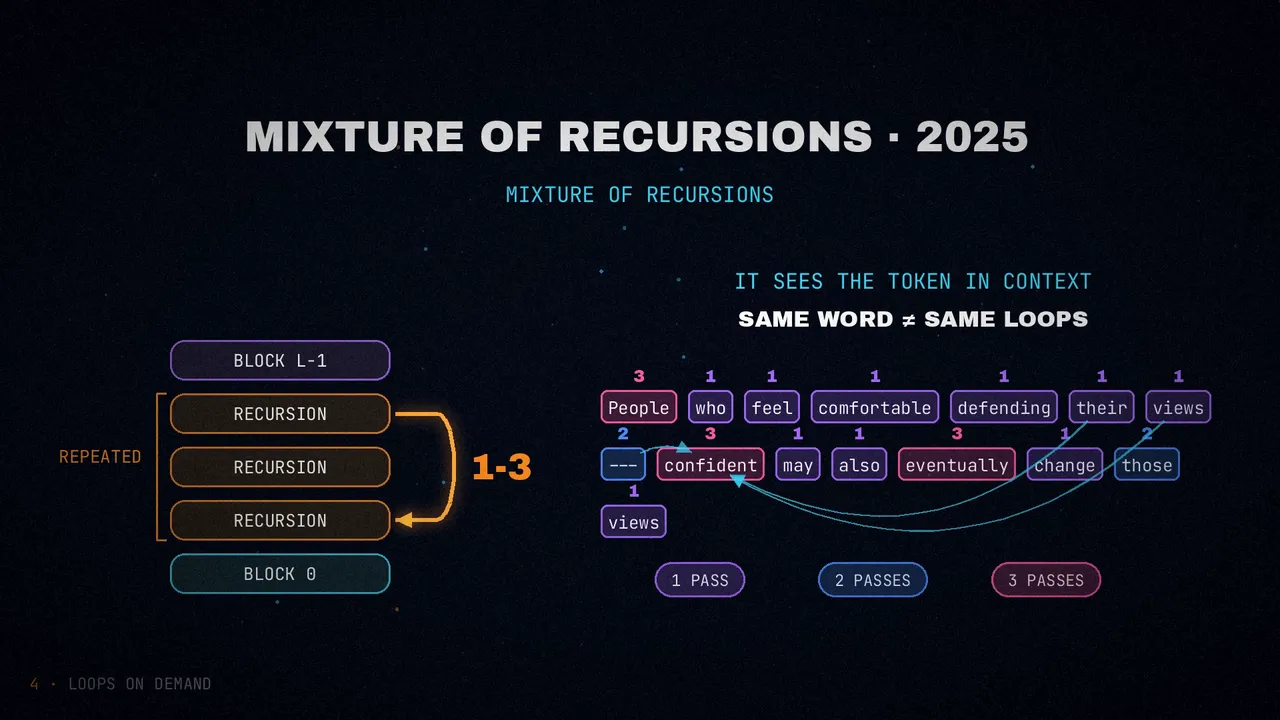
The Mixture-of-Recursions paper tests two ways of routing. In expert-choice routing, each recursion step selects which tokens it processes, and tokens that exit never come back. In token-choice routing, the router decides at the start, once, whether each token takes the one, two or three pass path. In both cases the weights are reused, and the model and its routers are trained together.
Does it work? It was compared with a regular transformer and a fixed-recursion one, at four sizes (135M, 360M, 730M and 1.7B) and three compute budgets. At the smallest size the regular transformer wins. At the larger sizes, Mixture-of-Recursions catches up and often wins, especially with small budgets; at the largest budget the curves almost meet. Also, by skipping some computation, it processes more tokens for the same spend.
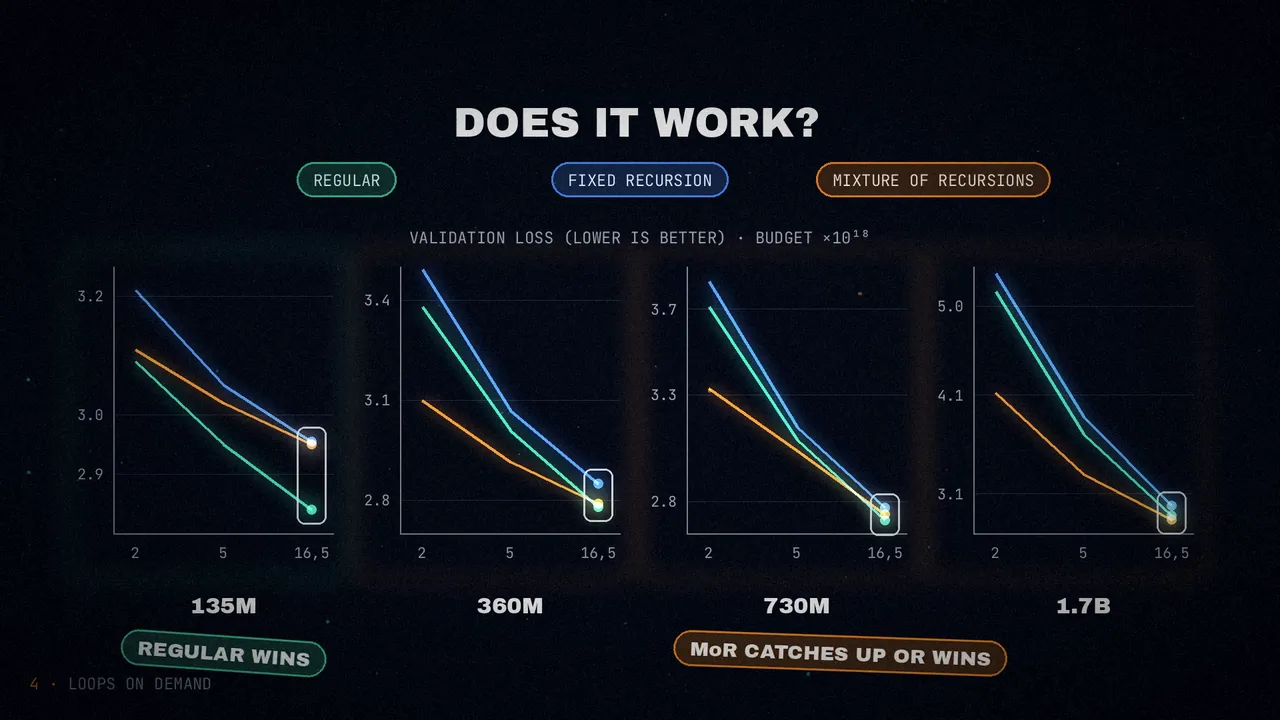
Raschka's takeaway: looping can improve quality at a fixed compute budget, if the model is large enough. And a lesson about experiments: looking only at the 135M model, we would have drawn the opposite conclusion. You have to test at scale.
What about RNNs?
If you come from deep learning, this will remind you of recurrent neural networks (RNNs), which reuse the same weights at every iteration. The difference is the axis:
- An RNN repeats across time: it reads one token at a time and carries a hidden state from one word to the next.
- A looped transformer repeats across depth: the same token goes through the stack several times, and attention still passes information between tokens.
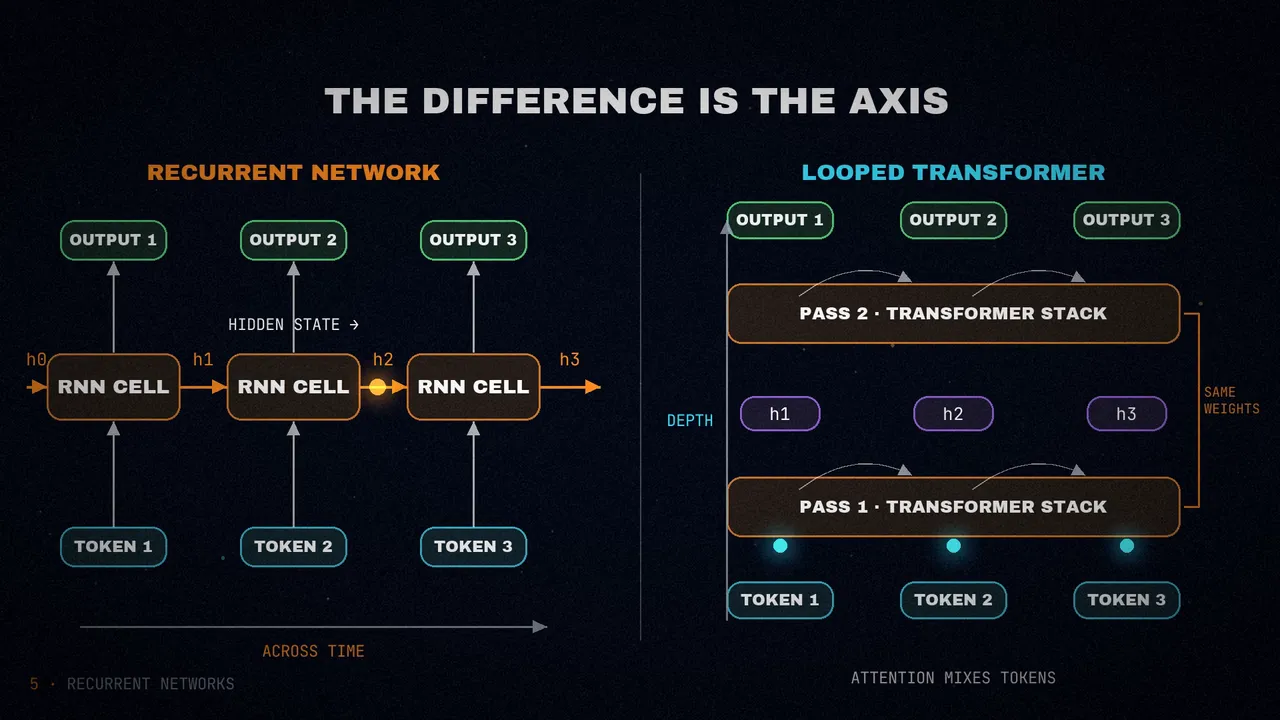
If the analogy is confusing, Raschka suggests something simpler: think of a looped transformer as a bigger model that shares weights.
Does Astra loop?
We don't know. If the model were open-weight we could check, but it isn't. Still, Raschka thinks it's highly likely that it uses some variant, for three reasons: The Information's report; the technique has shown promise in earlier studies; and a quote from OpenAI's chief scientist: “the depth of the computation graph for our present frontier models, including Astra, is within a factor of two of GPT-4.”
That quote doesn't confirm looping: it could simply mean twice as many regular blocks. And for Raschka, Astra's success is mostly due to other things, better training recipes and better data. Looping may help a bit, but he thinks The Information overestimates its contribution.
Does looping hide the reasoning?
The elephant in the room. To begin with, OpenAI has hidden most of its reasoning traces from users ever since its first reasoning model, o1, so for the end user not much changes: the concern is mostly for the developers. And Raschka doesn't think looping contributes much to hiding anything.
To see why, consider how a model reasons. It generates intermediate steps before the final answer, using regular text tokens: the chain of thought. For example, if you ask for two numbers whose sum is 10 and whose product is 21, it tries 5 and 5 (the sum is 10, but the product is 25), notices, backtracks and tries 3 and 7, which meet both conditions.
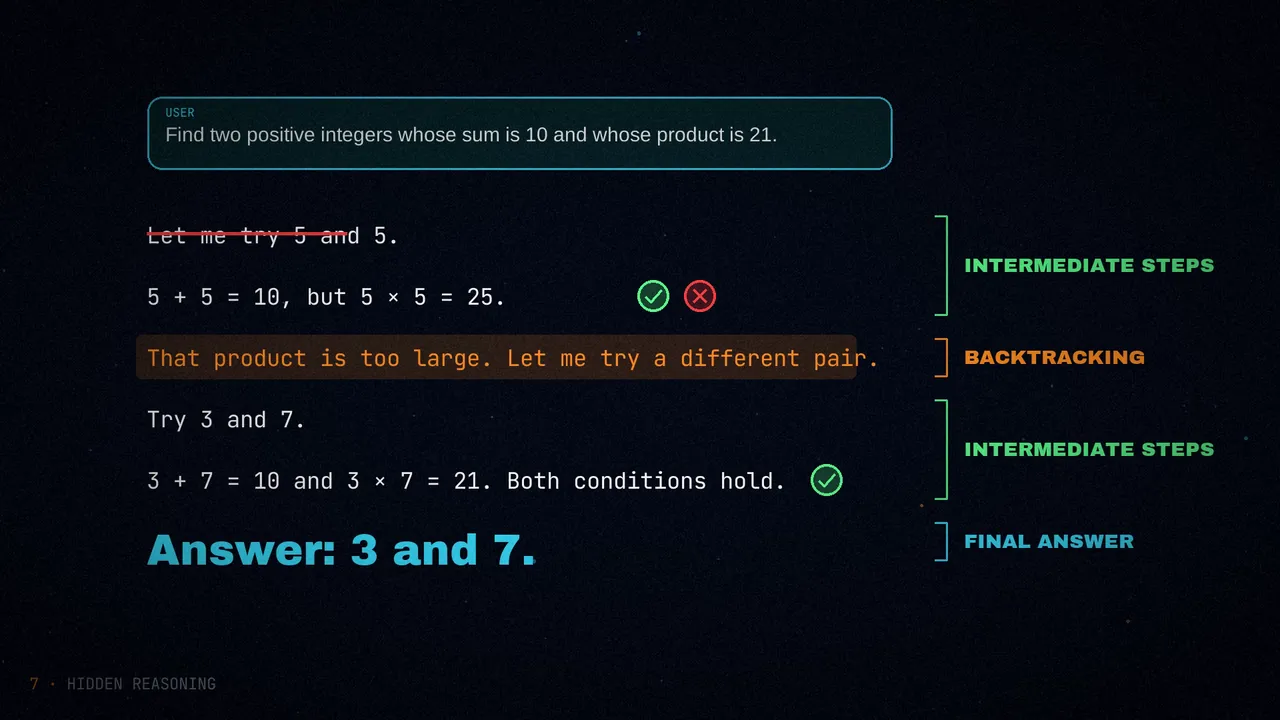
The model still generates one token at a time, with the question and what it has already written as context: those steps are a scratch pad that adds computation before answering, and the final answer can be much shorter than the reasoning before it.
The rumor's argument goes like this: reasoning tokens add computation, and so does looping, because each token passes through more blocks. A model that thinks more on the inside might need fewer thinking tokens on the outside. Is that true for Astra? In OpenAI's charts, overall it doesn't use fewer tokens than Sol across effort levels; but at a fixed accuracy, it does: it reaches the same score with fewer tokens.
Is that a problem? Not necessarily. Using fewer tokens can just mean the model is more capable: it makes fewer mistakes and backtracks less. And it's nothing new. On the Artificial Analysis index (v4.3), GPT-5.6 Luna scores 38 points with about 41,000 tokens per task, and Sol scores 39 with about 8,000: almost five times fewer. Nobody says Sol is much less interpretable than Luna. (The article's text says “80% more”; I use the numbers from its figure.)
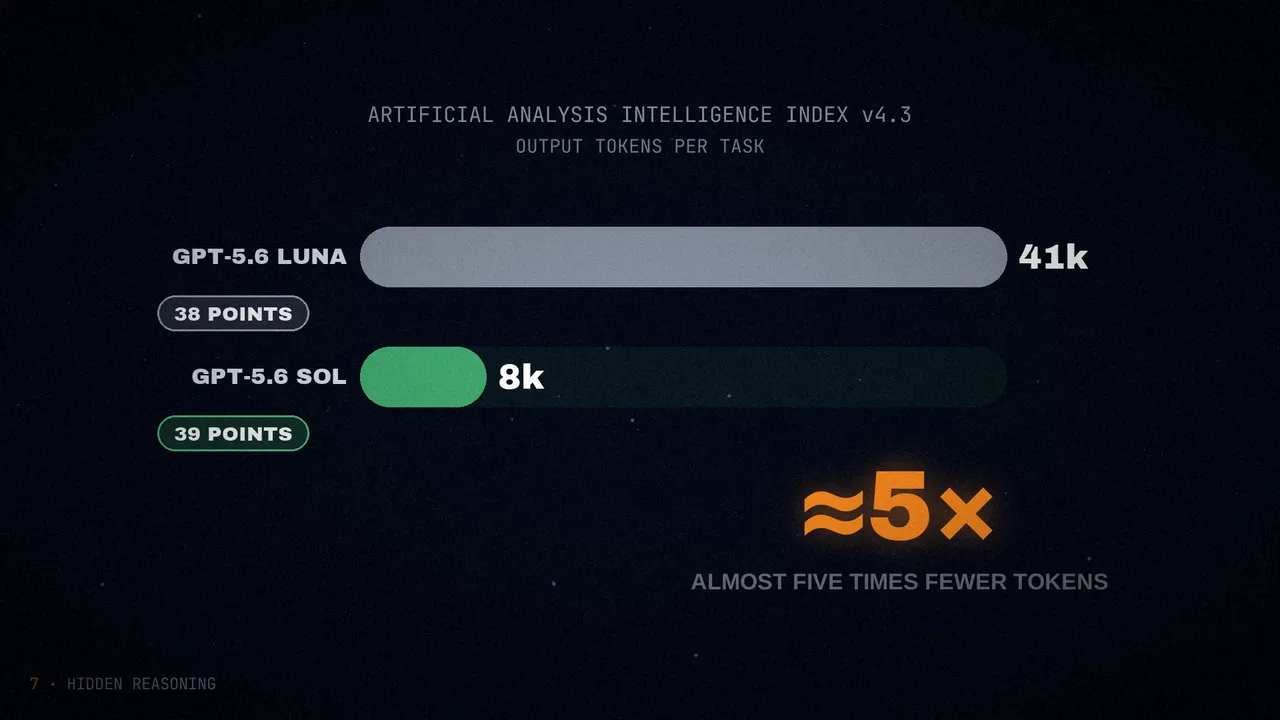
Besides, a chain of thought has never been guaranteed to faithfully describe what happens inside the model. For Raschka, the only valid concern would be looping producing fake reasoning traces more often than a regular transformer, and there's no strong evidence of that. Astra's system card does report somewhat reduced monitorability compared to Sol, mostly because its traces are shorter and less informative; but that doesn't point to looping as the cause, and it could simply come down to length, as with Luna and Sol.
A few hours later, Jakub Pachocki, OpenAI's chief scientist, clarified that he wants “to prevent a race into unmonitorability kicked off by confused reporting.” He says they have worked to preserve chain-of-thought monitoring since their first reasoning models, and admits it's fragile and trending in a negative direction, but for reasons not contingent on architecture changes. The confused reporting points to The Information: according to him, looping has nothing to do with it.
Recent research
Raschka wraps up with four papers on the topic.
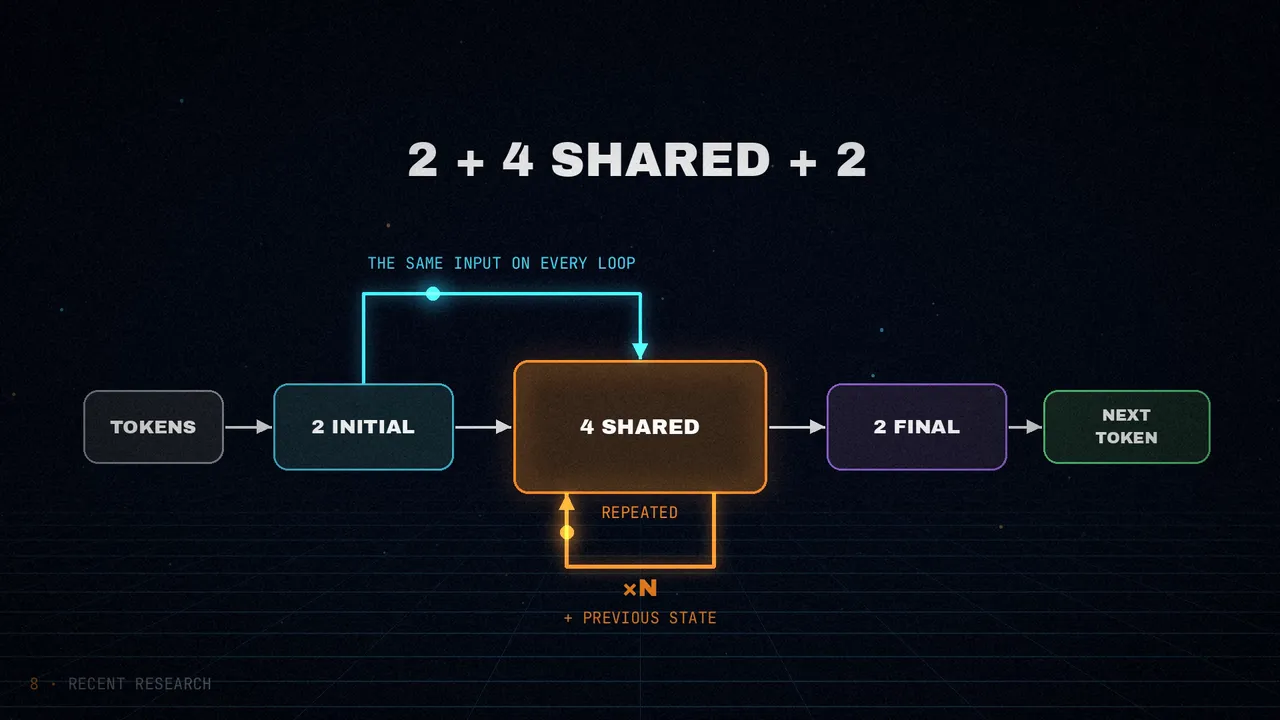
Latent reasoning with recurrent depth (Geiping et al., 2025). A 3.5B-parameter model trained on 800B tokens that repeats a stack of four shared blocks, between two initial and two final blocks. On every loop, the stack gets the original input again alongside the previous state. With 32 passes that's 132 block applications with only 8 distinct blocks. During training the loop count is sampled at random, so at inference whoever runs it picks a budget (8, 32 or 64), and each token stops when its prediction barely changes between two rounds. The benefit depends on the task: HellaSwag levels off around eight loops, while GSM8K and HumanEval keep improving. Despite the title, the model still writes its chain of thought.
Storing is not reasoning (Beyond Parameters, Zhu et al., June 2025). They measured memorization and reasoning separately. With 5M parameters the model memorizes about 3.4 bits per token, and with 20M more than twice that, but more loops barely move that number: looping computes, it doesn't store. On multi-step math problems, however, reusing the blocks does improve results without adding parameters.
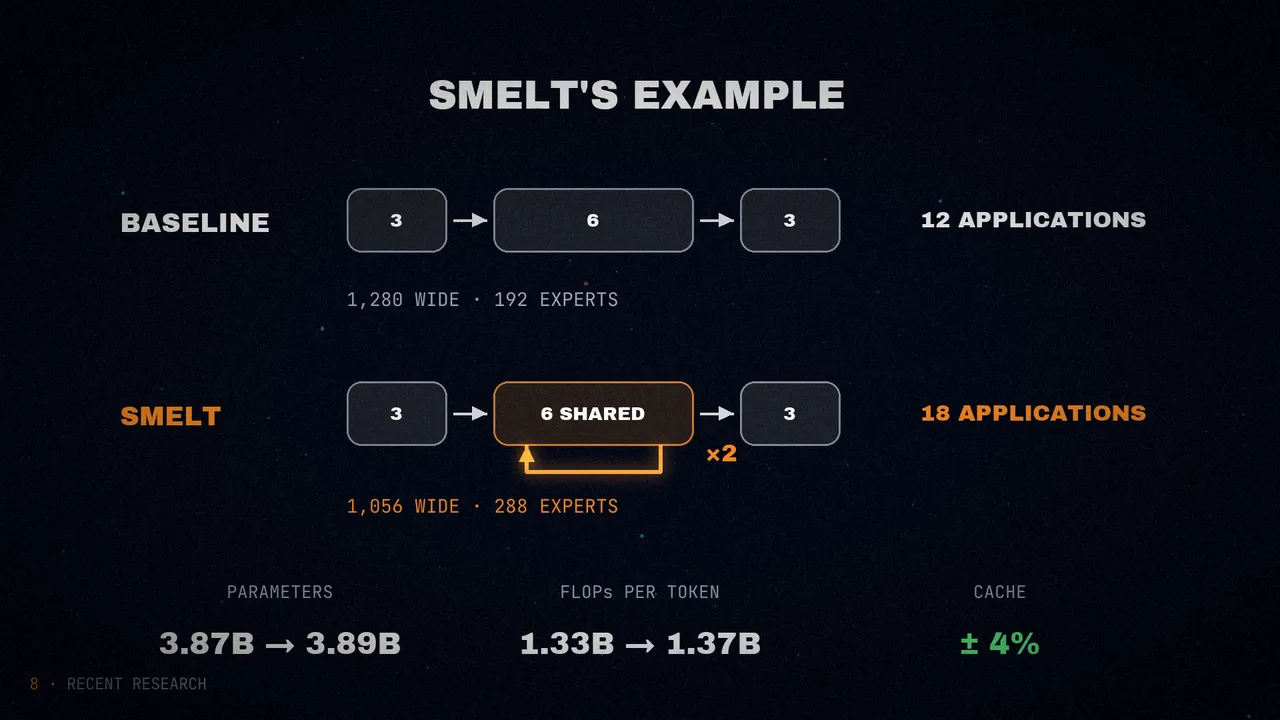
SMELT (September 2026) goes back to the cost question: what if we compare a looped and a regular transformer with the same compute per token, the same parameters and the same cache? They use a mixture of experts and apply the middle half of the blocks twice; to offset the extra compute they narrow the hidden dimension, to recover the parameters they add experts, and they adjust the attention heads to match the cache. In their example, the baseline applies 12 blocks (hidden size 1,280, 192 experts) and SMELT 18 (1,056, 288 experts), with 3.87B → 3.89B parameters, 1.33B → 1.37B FLOPs per token and the cache within 4%. Scaling up to 54B parameters, they estimate SMELT needs 6.8 to 18% less training compute for the same loss. At the same budget, looping gives a slightly better model.
Full-bandwidth transformer (August 2026). Here the recurrence runs across positions: at each step, a learned gate combines the previous token's final hidden state with the new token's embedding. With a 1B base model, this latent feedback shortened reasoning traces on MATH500 (from a median of about 500 tokens to about 460) with equal or better accuracy. But the effect disappears after instruction tuning, and they didn't test whether those shorter traces are less faithful or whether a bigger model without looping would shorten them just as much.
Summary
Astra is a very strong model, with a big leap in computer use, which Raschka expects to be the main focus for harnesses in the coming months (and he prefers open-source harnesses, so he can audit them before giving them access to his computer). It probably uses some variant of looping, which repeats layers with the same weights to think more without growing and gives slightly better models for the same compute. But there's no evidence that looping hides the reasoning: shorter chains are what you'd expect from a more capable model that makes fewer mistakes and thinks more on the inside. Like a well-prepared student in an exam, who needs less scratch paper.
Sources
- Sebastian Raschka, “GPT-6 Astra, Looped Transformers, and Hidden Reasoning”, Ahead of AI, November 2026.
- The video on my channel: Articulator EN · Articulator ES.