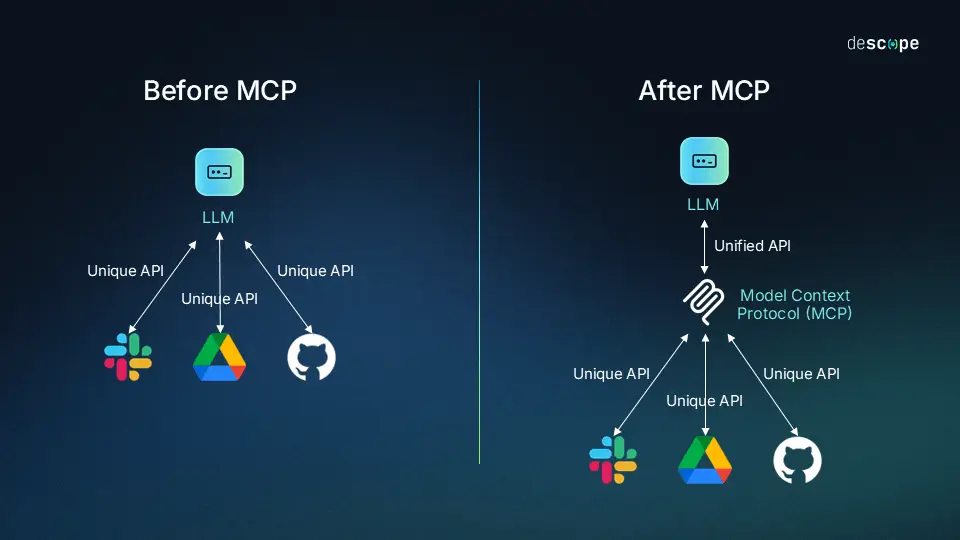
En las partes anteriores creamos un servidor MCP con tools (Parte 1) y vimos la capa de transporte, el contexto y los primeros resources (Parte 2). Ahora damos un paso más: añadimos **contexto a los resources**, creamos **resource templates** parametrizados y definimos **prompts** reutilizables.
⚠️ Este capítulo continúa el código de las partes anteriores. Asegúrate de tener el entorno y el servidor de las partes 1 y 2.
📚 **Esta entrada es parte de la serie _MCP con FastMCP_**, dividida en cuatro capítulos que se leen en orden:
> * Parte 1: Primer servidor y tools
* Parte 2: Transporte, contexto y resources
* 👉 **Parte 3: Resources avanzados y prompts**
* Parte 4: HTTP, autenticación y cliente
Añadir contexto al resource
Al igual que hicimos con las tools, podemos añadir contexto a los resources.
Servidor MCP
InputPython%%writefile gitHub_MCP_server/github_server.pyimport httpxfrom fastmcp import FastMCP, Contextfrom github import GITHUB_TOKEN, create_github_headersUSER_ID = 1234567890# Create FastMCP servermcp = FastMCP(name="GitHubMCP",instructions="This server provides tools, resources and prompts to interact with the GitHub API.",include_tags={"public"},exclude_tags={"first_issue"})sub_mcp = FastMCP(name="SubMCP",)@mcp.tool(tags={"public", "production"},exclude_args=["user_id"], # user_id has to be injected by server, not provided by LLM)async def list_repository_issues(owner: str, repo_name: str, ctx: Context, user_id: int = USER_ID) -> list[dict]:"""Lists open issues for a given GitHub repository.Args:owner: The owner of the repository (e.g., 'modelcontextprotocol')repo_name: The name of the repository (e.g., 'python-sdk')ctx: The context of the requestuser_id: The user ID (automatically injected by the server)Returns:list[dict]: A list of dictionaries, each containing information about an issue"""# Limit to first 10 issues to avoid very long responsesapi_url = f"https://api.github.com/repos/{owner}/{repo_name}/issues?state=open&per_page=10"ctx.info(f"Fetching issues from {api_url}...")async with httpx.AsyncClient() as client:try:response = await client.get(api_url, headers=create_github_headers())response.raise_for_status()issues_data = response.json()if not issues_data:ctx.info("No open issues found for this repository.")return [{"message": "No open issues found for this repository."}]issues_summary = []for issue in issues_data:# Create a more concise summarysummary = f"#{issue.get('number', 'N/A')}: {issue.get('title', 'No title')}"if issue.get('comments', 0) > 0:summary += f" ({issue.get('comments')} comments)"issues_summary.append({"number": issue.get("number"),"title": issue.get("title"),"user": issue.get("user", {}).get("login"),"url": issue.get("html_url"),"comments": issue.get("comments"),"summary": summary})ctx.info(f"Found {len(issues_summary)} open issues.")# Add context informationresult = {"total_found": len(issues_summary),"repository": f"{owner}/{repo_name}","note": "Showing first 10 open issues" if len(issues_summary) == 10 else f"Showing all {len(issues_summary)} open issues","issues": issues_summary,"requested_by_user_id": user_id}return [result]except httpx.HTTPStatusError as e:error_message = e.response.json().get("message", "No additional message from API.")if e.response.status_code == 403 and GITHUB_TOKEN:error_message += " (Rate limit with token or token lacks permissions?)"elif e.response.status_code == 403 and not GITHUB_TOKEN:error_message += " (Rate limit without token. Consider creating a .env file with GITHUB_TOKEN.)"ctx.error(f"GitHub API error: {e.response.status_code}. {error_message}")return [{"error": f"GitHub API error: {e.response.status_code}","message": error_message}]except Exception as e:ctx.error(f"An unexpected error occurred: {str(e)}")return [{"error": f"An unexpected error occurred: {str(e)}"}]@mcp.tool(tags={"private", "development"})async def list_more_repository_issues(owner: str, repo_name: str) -> list[dict]:"""Lists open issues for a given GitHub repository.Args:owner: The owner of the repository (e.g., 'modelcontextprotocol')repo_name: The name of the repository (e.g., 'python-sdk')Returns:list[dict]: A list of dictionaries, each containing information about an issue"""# Limit to first 100 issues to avoid very long responsesapi_url = f"https://api.github.com/repos/{owner}/{repo_name}/issues?state=open&per_page=100"print(f"Fetching issues from {api_url}...")async with httpx.AsyncClient() as client:try:response = await client.get(api_url, headers=create_github_headers())response.raise_for_status()issues_data = response.json()if not issues_data:print("No open issues found for this repository.")return [{"message": "No open issues found for this repository."}]issues_summary = []for issue in issues_data:# Create a more concise summarysummary = f"#{issue.get('number', 'N/A')}: {issue.get('title', 'No title')}"if issue.get('comments', 0) > 0:summary += f" ({issue.get('comments')} comments)"issues_summary.append({"number": issue.get("number"),"title": issue.get("title"),"user": issue.get("user", {}).get("login"),"url": issue.get("html_url"),"comments": issue.get("comments"),"summary": summary})print(f"Found {len(issues_summary)} open issues.")# Add context informationresult = {"total_found": len(issues_summary),"repository": f"{owner}/{repo_name}","note": "Showing first 10 open issues" if len(issues_summary) == 10 else f"Showing all {len(issues_summary)} open issues","issues": issues_summary}return [result]except httpx.HTTPStatusError as e:error_message = e.response.json().get("message", "No additional message from API.")if e.response.status_code == 403 and GITHUB_TOKEN:error_message += " (Rate limit with token or token lacks permissions?)"elif e.response.status_code == 403 and not GITHUB_TOKEN:error_message += " (Rate limit without token. Consider creating a .env file with GITHUB_TOKEN.)"print(f"GitHub API error: {e.response.status_code}. {error_message}")return [{"error": f"GitHub API error: {e.response.status_code}","message": error_message}]except Exception as e:print(f"An unexpected error occurred: {str(e)}")return [{"error": f"An unexpected error occurred: {str(e)}"}]@mcp.tool(tags={"public", "first_issue"})async def first_repository_issue(owner: str, repo_name: str) -> list[dict]:"""Gets the first issue ever created in a GitHub repository.Args:owner: The owner of the repository (e.g., 'modelcontextprotocol')repo_name: The name of the repository (e.g., 'python-sdk')Returns:list[dict]: A list containing information about the first issue created"""# Get the first issue by sorting by creation date in ascending orderapi_url = f"https://api.github.com/repos/{owner}/{repo_name}/issues?state=all&sort=created&direction=asc&per_page=1"print(f"Fetching first issue from {api_url}...")async with httpx.AsyncClient() as client:try:response = await client.get(api_url, headers=create_github_headers())response.raise_for_status()issues_data = response.json()if not issues_data:print("No issues found for this repository.")return [{"message": "No issues found for this repository."}]first_issue = issues_data[0]# Create a detailed summary of the first issuesummary = f"#{first_issue.get('number', 'N/A')}: {first_issue.get('title', 'No title')}"if first_issue.get('comments', 0) > 0:summary += f" ({first_issue.get('comments')} comments)"issue_info = {"number": first_issue.get("number"),"title": first_issue.get("title"),"user": first_issue.get("user", {}).get("login"),"url": first_issue.get("html_url"),"state": first_issue.get("state"),"comments": first_issue.get("comments"),"created_at": first_issue.get("created_at"),"updated_at": first_issue.get("updated_at"),"body": first_issue.get("body", "")[:500] + "..." if len(first_issue.get("body", "")) > 500 else first_issue.get("body", ""),"summary": summary}print(f"Found first issue: #{first_issue.get('number')} created on {first_issue.get('created_at')}")# Add context informationresult = {"repository": f"{owner}/{repo_name}","note": "This is the very first issue created in this repository","first_issue": issue_info}return [result]except httpx.HTTPStatusError as e:error_message = e.response.json().get("message", "No additional message from API.")if e.response.status_code == 403 and GITHUB_TOKEN:error_message += " (Rate limit with token or token lacks permissions?)"elif e.response.status_code == 403 and not GITHUB_TOKEN:error_message += " (Rate limit without token. Consider creating a .env file with GITHUB_TOKEN.)"print(f"GitHub API error: {e.response.status_code}. {error_message}")return [{"error": f"GitHub API error: {e.response.status_code}","message": error_message}]except Exception as e:print(f"An unexpected error occurred: {str(e)}")return [{"error": f"An unexpected error occurred: {str(e)}"}]@mcp.resource("resource://server_info", tags={"public"})def server_info(ctx: Context) -> str:"""Returns information about the server."""return {"info": "This is the MCP GitHub server development for MaximoFN blog post","requested_id": ctx.request_id}@sub_mcp.tool(tags={"public"})def hello_world() -> str:"""Returns a simple greeting."""return "Hello, world!"mcp.mount("sub_mcp", sub_mcp)if __name__ == "__main__":print("DEBUG: Starting FastMCP GitHub server...")print(f"DEBUG: Server name: {mcp.name}")# Initialize and run the servermcp.run(transport="stdio")Copied
Overwriting gitHub_MCP_server/github_server.py
Hemos añadido contexto al resource server_info para que nos devuelva la ID de la petición.
return {
  "info": "This is the MCP GitHub server development for MaximoFN blog post",
  "requested_id": ctx.request_id
}
Prueba del servidor con contexto en el resource
Ejecutamos el cliente
InputPython!cd client_MCP && source .venv/bin/activate && python client.py ../gitHub_MCP_server/github_server.pyCopied
🔗 Connecting to FastMCP server: ../gitHub_MCP_server/github_server.py✅ Client created successfully/Users/macm1/Documents/web/portafolio/posts/gitHub_MCP_server/github_server.py:258: DeprecationWarning: Mount prefixes are now optional and the first positional argument should be the server you want to mount.mcp.mount("sub_mcp", sub_mcp)[06/28/25 11:17:41] INFO Starting MCP server 'GitHubMCP' with transport 'stdio' server.py:1246🛠️ Available tools (2):==================================================📋 sub_mcp_hello_worldDescription: Returns a simple greeting.Parameters:📋 list_repository_issuesDescription: Lists open issues for a given GitHub repository.Args:owner: The owner of the repository (e.g., 'modelcontextprotocol')repo_name: The name of the repository (e.g., 'python-sdk')ctx: The context of the requestuser_id: The user ID (automatically injected by the server)Returns:list[dict]: A list of dictionaries, each containing information about an issueParameters: owner, repo_name...🔧 Claude wants to use: read_mcp_resource📝 Arguments: {'resource_uri': 'resource://server_info'}📖 Resource read successfully: resource://server_info🤖 Claude: I'll help you read the server information using the `read_mcp_resource` function. The server information is available at the resource URI "resource://server_info".According to the server information:- This is the MCP GitHub server development for MaximoFN blog post- The requested ID is "7"👤 You: q👋 Bye!🧹 Cleaning up resources...✅ Resources released
Como vemos, nos ha dado la información del servidor y el ID de la petición.
👤 You: Tell me the server info

🤔 Claude is thinking...
🔧 Claude wants to use: read_mcp_resource
📝 Arguments: {'resource_uri': 'resource://server_info'}
📖 Resource read successfully: resource://server_info

🤖 Claude: I'll help you read the server information using the `read_mcp_resource` function. The server information is available at the resource URI "resource://server_info".According to the server information:
- This is the MCP GitHub server development for MaximoFN blog post
- The requested ID is "7"
Crear un resource template
Antes hemos creado un resource que es un recurso estático, pero a lo mejor queremos obtener información, pero no siempre la misma, queremos que el LLM pueda decidir qué información quiere o necesita.
Para ello tenemos los resource templates, que nos dan información igual que un resource, pero de manera dinámica. En el momento de la petición se crea el resource y se devuelve.
Servidor MCP
Crear un resource template se hace de la misma manera que crear un resource, es decir mediante @mcp.resource(<ENDPOINT), solo que ahora el endpoint es una plantilla que se rellena en el momento de la petición.
Vamos a verlo
InputPython%%writefile gitHub_MCP_server/github_server.pyimport httpxfrom fastmcp import FastMCP, Contextfrom github import GITHUB_TOKEN, create_github_headersimport datetimeUSER_ID = 1234567890# Create FastMCP servermcp = FastMCP(name="GitHubMCP",instructions="This server provides tools, resources and prompts to interact with the GitHub API.",include_tags={"public"},exclude_tags={"first_issue"})sub_mcp = FastMCP(name="SubMCP",)@mcp.tool(tags={"public", "production"},exclude_args=["user_id"], # user_id has to be injected by server, not provided by LLM)async def list_repository_issues(owner: str, repo_name: str, ctx: Context, user_id: int = USER_ID) -> list[dict]:"""Lists open issues for a given GitHub repository.Args:owner: The owner of the repository (e.g., 'modelcontextprotocol')repo_name: The name of the repository (e.g., 'python-sdk')ctx: The context of the requestuser_id: The user ID (automatically injected by the server)Returns:list[dict]: A list of dictionaries, each containing information about an issue"""# Limit to first 10 issues to avoid very long responsesapi_url = f"https://api.github.com/repos/{owner}/{repo_name}/issues?state=open&per_page=10"ctx.info(f"Fetching issues from {api_url}...")async with httpx.AsyncClient() as client:try:response = await client.get(api_url, headers=create_github_headers())response.raise_for_status()issues_data = response.json()if not issues_data:ctx.info("No open issues found for this repository.")return [{"message": "No open issues found for this repository."}]issues_summary = []for issue in issues_data:# Create a more concise summarysummary = f"#{issue.get('number', 'N/A')}: {issue.get('title', 'No title')}"if issue.get('comments', 0) > 0:summary += f" ({issue.get('comments')} comments)"issues_summary.append({"number": issue.get("number"),"title": issue.get("title"),"user": issue.get("user", {}).get("login"),"url": issue.get("html_url"),"comments": issue.get("comments"),"summary": summary})ctx.info(f"Found {len(issues_summary)} open issues.")# Add context informationresult = {"total_found": len(issues_summary),"repository": f"{owner}/{repo_name}","note": "Showing first 10 open issues" if len(issues_summary) == 10 else f"Showing all {len(issues_summary)} open issues","issues": issues_summary,"requested_by_user_id": user_id}return [result]except httpx.HTTPStatusError as e:error_message = e.response.json().get("message", "No additional message from API.")if e.response.status_code == 403 and GITHUB_TOKEN:error_message += " (Rate limit with token or token lacks permissions?)"elif e.response.status_code == 403 and not GITHUB_TOKEN:error_message += " (Rate limit without token. Consider creating a .env file with GITHUB_TOKEN.)"ctx.error(f"GitHub API error: {e.response.status_code}. {error_message}")return [{"error": f"GitHub API error: {e.response.status_code}","message": error_message}]except Exception as e:ctx.error(f"An unexpected error occurred: {str(e)}")return [{"error": f"An unexpected error occurred: {str(e)}"}]@mcp.tool(tags={"private", "development"})async def list_more_repository_issues(owner: str, repo_name: str) -> list[dict]:"""Lists open issues for a given GitHub repository.Args:owner: The owner of the repository (e.g., 'modelcontextprotocol')repo_name: The name of the repository (e.g., 'python-sdk')Returns:list[dict]: A list of dictionaries, each containing information about an issue"""# Limit to first 100 issues to avoid very long responsesapi_url = f"https://api.github.com/repos/{owner}/{repo_name}/issues?state=open&per_page=100"print(f"Fetching issues from {api_url}...")async with httpx.AsyncClient() as client:try:response = await client.get(api_url, headers=create_github_headers())response.raise_for_status()issues_data = response.json()if not issues_data:print("No open issues found for this repository.")return [{"message": "No open issues found for this repository."}]issues_summary = []for issue in issues_data:# Create a more concise summarysummary = f"#{issue.get('number', 'N/A')}: {issue.get('title', 'No title')}"if issue.get('comments', 0) > 0:summary += f" ({issue.get('comments')} comments)"issues_summary.append({"number": issue.get("number"),"title": issue.get("title"),"user": issue.get("user", {}).get("login"),"url": issue.get("html_url"),"comments": issue.get("comments"),"summary": summary})print(f"Found {len(issues_summary)} open issues.")# Add context informationresult = {"total_found": len(issues_summary),"repository": f"{owner}/{repo_name}","note": "Showing first 10 open issues" if len(issues_summary) == 10 else f"Showing all {len(issues_summary)} open issues","issues": issues_summary}return [result]except httpx.HTTPStatusError as e:error_message = e.response.json().get("message", "No additional message from API.")if e.response.status_code == 403 and GITHUB_TOKEN:error_message += " (Rate limit with token or token lacks permissions?)"elif e.response.status_code == 403 and not GITHUB_TOKEN:error_message += " (Rate limit without token. Consider creating a .env file with GITHUB_TOKEN.)"print(f"GitHub API error: {e.response.status_code}. {error_message}")return [{"error": f"GitHub API error: {e.response.status_code}","message": error_message}]except Exception as e:print(f"An unexpected error occurred: {str(e)}")return [{"error": f"An unexpected error occurred: {str(e)}"}]@mcp.tool(tags={"public", "first_issue"})async def first_repository_issue(owner: str, repo_name: str) -> list[dict]:"""Gets the first issue ever created in a GitHub repository.Args:owner: The owner of the repository (e.g., 'modelcontextprotocol')repo_name: The name of the repository (e.g., 'python-sdk')Returns:list[dict]: A list containing information about the first issue created"""# Get the first issue by sorting by creation date in ascending orderapi_url = f"https://api.github.com/repos/{owner}/{repo_name}/issues?state=all&sort=created&direction=asc&per_page=1"print(f"Fetching first issue from {api_url}...")async with httpx.AsyncClient() as client:try:response = await client.get(api_url, headers=create_github_headers())response.raise_for_status()issues_data = response.json()if not issues_data:print("No issues found for this repository.")return [{"message": "No issues found for this repository."}]first_issue = issues_data[0]# Create a detailed summary of the first issuesummary = f"#{first_issue.get('number', 'N/A')}: {first_issue.get('title', 'No title')}"if first_issue.get('comments', 0) > 0:summary += f" ({first_issue.get('comments')} comments)"issue_info = {"number": first_issue.get("number"),"title": first_issue.get("title"),"user": first_issue.get("user", {}).get("login"),"url": first_issue.get("html_url"),"state": first_issue.get("state"),"comments": first_issue.get("comments"),"created_at": first_issue.get("created_at"),"updated_at": first_issue.get("updated_at"),"body": first_issue.get("body", "")[:500] + "..." if len(first_issue.get("body", "")) > 500 else first_issue.get("body", ""),"summary": summary}print(f"Found first issue: #{first_issue.get('number')} created on {first_issue.get('created_at')}")# Add context informationresult = {"repository": f"{owner}/{repo_name}","note": "This is the very first issue created in this repository","first_issue": issue_info}return [result]except httpx.HTTPStatusError as e:error_message = e.response.json().get("message", "No additional message from API.")if e.response.status_code == 403 and GITHUB_TOKEN:error_message += " (Rate limit with token or token lacks permissions?)"elif e.response.status_code == 403 and not GITHUB_TOKEN:error_message += " (Rate limit without token. Consider creating a .env file with GITHUB_TOKEN.)"print(f"GitHub API error: {e.response.status_code}. {error_message}")return [{"error": f"GitHub API error: {e.response.status_code}","message": error_message}]except Exception as e:print(f"An unexpected error occurred: {str(e)}")return [{"error": f"An unexpected error occurred: {str(e)}"}]@mcp.resource("resource://server_info", tags={"public"})def server_info(ctx: Context) -> str:"""Returns information about the server."""return {"info": "This is the MCP GitHub server development for MaximoFN blog post","requested_id": ctx.request_id}@mcp.resource("github://repo/{owner}/{repo_name}", tags={"public"})async def repository_info(owner: str, repo_name: str, ctx: Context) -> dict:"""Returns detailed information about a GitHub repository.Args:owner: The owner of the repository (e.g., 'modelcontextprotocol')repo_name: The name of the repository (e.g., 'python-sdk')ctx: The context of the requestReturns:dict: Repository information including name, description, stats, etc."""api_url = f"https://api.github.com/repos/{owner}/{repo_name}"ctx.info(f"Fetching repository information from {api_url}...")async with httpx.AsyncClient() as client:try:response = await client.get(api_url, headers=create_github_headers())response.raise_for_status()repo_data = response.json()# Extract relevant repository informationrepo_info = {"name": repo_data.get("name"),"full_name": repo_data.get("full_name"),"description": repo_data.get("description"),"owner": {"login": repo_data.get("owner", {}).get("login"),"type": repo_data.get("owner", {}).get("type")},"html_url": repo_data.get("html_url"),"clone_url": repo_data.get("clone_url"),"ssh_url": repo_data.get("ssh_url"),"language": repo_data.get("language"),"size": repo_data.get("size"), # Size in KB"stargazers_count": repo_data.get("stargazers_count"),"watchers_count": repo_data.get("watchers_count"),"forks_count": repo_data.get("forks_count"),"open_issues_count": repo_data.get("open_issues_count"),"default_branch": repo_data.get("default_branch"),"created_at": repo_data.get("created_at"),"updated_at": repo_data.get("updated_at"),"pushed_at": repo_data.get("pushed_at"),"is_private": repo_data.get("private"),"is_fork": repo_data.get("fork"),"is_archived": repo_data.get("archived"),"has_issues": repo_data.get("has_issues"),"has_projects": repo_data.get("has_projects"),"has_wiki": repo_data.get("has_wiki"),"license": repo_data.get("license", {}).get("name") if repo_data.get("license") else None,"topics": repo_data.get("topics", [])}ctx.info(f"Successfully retrieved information for repository {owner}/{repo_name}")return repo_infoexcept httpx.HTTPStatusError as e:error_message = e.response.json().get("message", "No additional message from API.")if e.response.status_code == 404:error_message = f"Repository {owner}/{repo_name} not found or is private."elif e.response.status_code == 403 and GITHUB_TOKEN:error_message += " (Rate limit with token or token lacks permissions?)"elif e.response.status_code == 403 and not GITHUB_TOKEN:error_message += " (Rate limit without token. Consider creating a .env file with GITHUB_TOKEN.)"ctx.error(f"GitHub API error: {e.response.status_code}. {error_message}")return {"error": f"GitHub API error: {e.response.status_code}","message": error_message,"repository": f"{owner}/{repo_name}"}except Exception as e:ctx.error(f"An unexpected error occurred: {str(e)}")return {"error": f"An unexpected error occurred: {str(e)}","repository": f"{owner}/{repo_name}"}@sub_mcp.tool(tags={"public"})def hello_world() -> str:"""Returns a simple greeting."""return "Hello, world!"mcp.mount("sub_mcp", sub_mcp)if __name__ == "__main__":print("DEBUG: Starting FastMCP GitHub server...")print(f"DEBUG: Server name: {mcp.name}")# Initialize and run the servermcp.run(transport="stdio")Copied
Overwriting gitHub_MCP_server/github_server.py
Hemos creado el resource template repository_info, que nos da la información de un repositorio que va a determinar el LLM. Se crea la plantilla y en tiempo de ejecución se rellena con los parámetros que se le pasan.
@mcp.resource("github://repo/{owner}/{repo_name}", tags={"public"})
async def repository_info(owner: str, repo_name: str, ctx: Context) -> dict:
Tanto el repositorio como el dueño del repositorio tienen que ser parámetros de la función.
Client MCP
Hacemos un pequeño cambio en el cliente para que el LLM entienda que hay recursos estáticos y dinámicos
InputPython%%writefile client_MCP/client.pyimport sysimport asynciofrom contextlib import AsyncExitStackfrom anthropic import Anthropicfrom dotenv import load_dotenvfrom fastmcp import Client# Load environment variables from .env fileload_dotenv()class FastMCPClient:"""FastMCP client that integrates with Claude to process user queriesand use tools and resources exposed by a FastMCP server."""def __init__(self):"""Initialize the FastMCP client with Anthropic and resource management."""self.exit_stack = AsyncExitStack()self.anthropic = Anthropic()self.client = Noneasync def connect_to_server(self, server_script_path: str):"""Connect to the specified FastMCP server.Args:server_script_path: Path to the server script (Python)"""print(f"🔗 Connecting to FastMCP server: {server_script_path}")# Determine the server type based on the extensionif not server_script_path.endswith('.py'):raise ValueError(f"Unsupported server type. Use .py files. Received: {server_script_path}")# Create FastMCP clientself.client = Client(server_script_path)# Note: FastMCP Client automatically infers transport from .py filesprint("✅ Client created successfully")async def list_available_tools(self):"""List available tools in the FastMCP server."""try:# Get list of tools from the server using FastMCP contextasync with self.client as client:tools = await client.list_tools()if tools:print(f" 🛠️ Available tools ({len(tools)}):")print("=" * 50)for tool in tools:print(f"📋 {tool.name}")if tool.description:print(f" Description: {tool.description}")# Show parameters if availableif hasattr(tool, 'inputSchema') and tool.inputSchema:if 'properties' in tool.inputSchema:params = list(tool.inputSchema['properties'].keys())print(f" Parameters: {', '.join(params)}")print()else:print("⚠️ No tools found in the server")except Exception as e:print(f"❌ Error listing tools: {str(e)}")async def list_available_resources(self):"""List available resources in the FastMCP server."""try:# Get list of resources from the server using FastMCP contextasync with self.client as client:resources = await client.list_resources()if resources:print(f" 📚 Available resources ({len(resources)}):")print("=" * 50)for resource in resources:print(f"📄 {resource.uri}")if resource.name:print(f" Name: {resource.name}")if resource.description:print(f" Description: {resource.description}")if resource.mimeType:print(f" MIME Type: {resource.mimeType}")print()else:print("⚠️ No resources found in the server")except Exception as e:print(f"❌ Error listing resources: {str(e)}")async def read_resource(self, resource_uri: str):"""Read a specific resource from the server.Args:resource_uri: URI of the resource to readReturns:str: Resource content"""try:async with self.client as client:result = await client.read_resource(resource_uri)return resultexcept Exception as e:print(f"❌ Error reading resource {resource_uri}: {str(e)}")return Noneasync def process_query(self, query: str) -> str:"""Process a user query, interacting with Claude and FastMCP tools and resources.Args:query: User queryReturns:str: Final processed response"""try:# Use FastMCP context for all operationsasync with self.client as client:# Get available tools and resourcestools_list = await client.list_tools()resources_list = await client.list_resources()# Prepare tools for Claude in correct formatclaude_tools = []for tool in tools_list:claude_tool = {"name": tool.name,"description": tool.description or f"Tool {tool.name}","input_schema": tool.inputSchema or {"type": "object", "properties": {}}}claude_tools.append(claude_tool)# Add a special tool for reading resources (including template resources)resource_description = "Read a resource from the MCP server. "if resources_list:# Convert URIs to strings to avoid AnyUrl object issuesresource_uris = [str(r.uri) for r in resources_list]resource_description += f"Available static resources: {', '.join(resource_uris)}. "resource_description += "Also supports template resources like github://repo/owner/repo_name for GitHub repository information."claude_tools.append({"name": "read_mcp_resource","description": resource_description,"input_schema": {"type": "object","properties": {"resource_uri": {"type": "string","description": "URI of the resource to read. Can be static (like resource://server_info) or template-based (like github://repo/facebook/react)"}},"required": ["resource_uri"]}})# Create initial message for Claudemessages = [{"role": "user","content": query}]# First call to Clauderesponse = self.anthropic.messages.create(model="claude-3-5-sonnet-20241022",max_tokens=6000,messages=messages,tools=claude_tools if claude_tools else None)# Process Claude's responseresponse_text = ""for content_block in response.content:if content_block.type == "text":response_text += content_block.textelif content_block.type == "tool_use":# Claude wants to use a tooltool_name = content_block.nametool_args = content_block.inputtool_call_id = content_block.idprint(f"🔧 Claude wants to use: {tool_name}")print(f"📝 Arguments: {tool_args}")try:if tool_name == "read_mcp_resource":# Handle resource readingresource_uri = tool_args.get("resource_uri")if resource_uri:tool_result = await client.read_resource(resource_uri)print(f"📖 Resource read successfully: {resource_uri}")# Better handling of resource resultif hasattr(tool_result, 'content'):# If it's a resource response object, extract contentif hasattr(tool_result.content, 'text'):result_content = tool_result.content.textelse:result_content = str(tool_result.content)else:# If it's already a string or simple objectresult_content = str(tool_result)else:tool_result = "Error: No resource URI provided"result_content = tool_resultelse:# Execute regular tool on the FastMCP servertool_result = await client.call_tool(tool_name, tool_args)print(f"✅ Tool executed successfully")result_content = str(tool_result)# Add tool result to the conversationmessages.append({"role": "assistant","content": response.content})# Format result for Claudeif tool_result:messages.append({"role": "user","content": [{"type": "tool_result","tool_use_id": tool_call_id,"content": f"Tool result: {result_content}"}]})else:messages.append({"role": "user","content": [{"type": "tool_result","tool_use_id": tool_call_id,"content": "Tool executed without response content"}]})# Second call to Claude with the tool resultfinal_response = self.anthropic.messages.create(model="claude-3-5-sonnet-20241022",max_tokens=6000,messages=messages,tools=claude_tools if claude_tools else None)# Extract text from the final responsefor final_content in final_response.content:if final_content.type == "text":response_text += final_content.textexcept Exception as e:error_msg = f"❌ Error executing {tool_name}: {str(e)}"print(error_msg)response_text += f" {error_msg}"return response_textexcept Exception as e:error_msg = f"❌ Error processing query: {str(e)}"print(error_msg)return error_msgasync def chat_loop(self):"""Main chat loop with user interaction."""print(" 🤖 FastMCP client started. Write 'quit', 'q', 'exit', 'salir' to exit.")print("💬 You can ask questions about GitHub repositories!")print("📚 The client can use tools and resources from the FastMCP server")print("-" * 60)while True:try:# Request user inputuser_input = input(" 👤 You: ").strip()if user_input.lower() in ['quit', 'q', 'exit', 'salir']:print("👋 Bye!")breakif not user_input:continueprint(" 🤔 Claude is thinking...")# Process queryresponse = await self.process_query(user_input)# Show responseprint(f" 🤖 Claude: {response}")except KeyboardInterrupt:print(" 👋 Disconnecting...")breakexcept Exception as e:print(f" ❌ Error in chat: {str(e)}")continueasync def cleanup(self):"""Clean up resources and close connections."""print("🧹 Cleaning up resources...")# FastMCP Client cleanup is handled automatically by context managerawait self.exit_stack.aclose()print("✅ Resources released")async def main():"""Main function that initializes and runs the FastMCP client."""# Verify command line argumentsif len(sys.argv) != 2:print("❌ Usage: python client.py <path_to_fastmcp_server>")print("📝 Example: python client.py ../MCP_github/github_server.py")sys.exit(1)server_script_path = sys.argv[1]# Create and run clientclient = FastMCPClient()try:# Connect to the serverawait client.connect_to_server(server_script_path)# List available tools and resources after connectionawait client.list_available_tools()await client.list_available_resources()# Start chat loopawait client.chat_loop()except Exception as e:print(f"❌ Fatal error: {str(e)}")finally:# Ensure resources are cleaned upawait client.cleanup()if __name__ == "__main__":# Entry point of the scriptasyncio.run(main())Copied
Overwriting client_MCP/client.py
Como vemos le decimos "description": "URI of the resource to read. Can be static (like resource://server_info) or template-based (like github://repo/facebook/react)"
claude_tools.append({
  "name": "read_mcp_resource",
  "description": "Read a resource from the MCP server. Available resources: " +
          ", ".join(resource_uris),
  "input_schema": {
    "type": "object",
    "properties": {
      "resource_uri": {
        "type": "string",
        "description": "URI of the resource to read"
      }
    },
    "required": ["resource_uri"]
  }
})
Prueba del resource template
Ejecutamos el cliente
InputPython!cd client_MCP && source .venv/bin/activate && python client.py ../gitHub_MCP_server/github_server.pyCopied
🔗 Connecting to FastMCP server: ../gitHub_MCP_server/github_server.py✅ Client created successfully🛠️ Available tools (2):==================================================📋 sub_mcp_hello_worldDescription: Returns a simple greeting.Parameters:📋 list_repository_issuesDescription: Lists open issues for a given GitHub repository.Args:owner: The owner of the repository (e.g., 'modelcontextprotocol')repo_name: The name of the repository (e.g., 'python-sdk')ctx: The context of the requestuser_id: The user ID (automatically injected by the server)Returns:list[dict]: A list of dictionaries, each containing information about an issueParameters: owner, repo_name📚 Available resources (1):==================================================📄 resource://server_info...- react- uiThe repository can be accessed via:- HTTPS: https://github.com/facebook/react- SSH: git@github.com:facebook/react.gitThis is one of the most popular repositories on GitHub, as evidenced by its high number of stars and forks, and it remains actively maintained with regular updates.👤 You: q👋 Bye!🧹 Cleaning up resources...✅ Resources released
Le pedimos la información de un repositorio, usa el resource template repository_info y nos da la información del repositorio.
👤 You: Can you read the resource github://repo/facebook/react for detailed information about the repository?

🤔 Claude is thinking...
🔧 Claude wants to use: read_mcp_resource
📝 Arguments: {'resource_uri': 'github://repo/facebook/react'}
📖 Resource read successfully: github://repo/facebook/react

🤖 Claude: I'll help you read the GitHub repository information for Facebook's React using the `read_mcp_resource` function.Based on the repository information retrieved, here are the key details about the Facebook React repository:

1. Description: The library for web and native user interfaces
2. Owner: Facebook (Organization)
3. Language: JavaScript
4. Repository Statistics:
 - Stars: 236,803
 - Forks: 48,815
 - Open Issues: 999
 - Watchers: 236,803

5. Important Dates:
 - Created: May 24, 2013
 - Last Updated: June 28, 2025
 - Last Push: June 27, 2025

6. Repository Features:
 - Public repository (not private)
 - Not a fork
 - Not archived
 - Has issues enabled
 - Projects disabled
 - Wiki disabled

7. License: MIT License

8. Topics/Tags:
 - declarative
 - frontend
 - javascript
 - library
 - react
 - ui

The repository can be accessed via:
- HTTPS: https://github.com/facebook/react
- SSH: git@github.com:facebook/react.git

This is one of the most popular repositories on GitHub, as evidenced by its high number of stars and forks, and it remains actively maintained with regular updates.
Crear un prompt
Otra de las herramientas que nos ofrece MCP es pedirle al LLM que nos cree un prompt para usarlo en una petición.
Servidor MCP
Creamos un prompt en nuestro servidor, para ello usamos el decorador @mcp.prompt y le pasamos el nombre del prompt, la descripción y la etiqueta public, porque habíamos definido nuestro servidor haciendo que solo incluyera las tools, los resources y los prompts con la etiqueta public.
@mcp.prompt(
  name="generate_issues_prompt",
  description="Generates a structured prompt for asking about GitHub repository issues. Use this when users want to formulate questions about repository issues, or need help creating prompts for issue analysis.",
  tags={"public"}
)InputPython%%writefile gitHub_MCP_server/github_server.pyimport httpxfrom fastmcp import FastMCP, Contextfrom github import GITHUB_TOKEN, create_github_headersimport datetimeUSER_ID = 1234567890# Create FastMCP servermcp = FastMCP(name="GitHubMCP",instructions="This server provides tools, resources and prompts to interact with the GitHub API.",include_tags={"public"},exclude_tags={"first_issue"})sub_mcp = FastMCP(name="SubMCP",)@mcp.tool(tags={"public", "production"},exclude_args=["user_id"], # user_id has to be injected by server, not provided by LLM)async def list_repository_issues(owner: str, repo_name: str, ctx: Context, user_id: int = USER_ID) -> list[dict]:"""Lists open issues for a given GitHub repository.Args:owner: The owner of the repository (e.g., 'modelcontextprotocol')repo_name: The name of the repository (e.g., 'python-sdk')ctx: The context of the requestuser_id: The user ID (automatically injected by the server)Returns:list[dict]: A list of dictionaries, each containing information about an issue"""# Limit to first 10 issues to avoid very long responsesapi_url = f"https://api.github.com/repos/{owner}/{repo_name}/issues?state=open&per_page=10"ctx.info(f"Fetching issues from {api_url}...")async with httpx.AsyncClient() as client:try:response = await client.get(api_url, headers=create_github_headers())response.raise_for_status()issues_data = response.json()if not issues_data:ctx.info("No open issues found for this repository.")return [{"message": "No open issues found for this repository."}]issues_summary = []for issue in issues_data:# Create a more concise summarysummary = f"#{issue.get('number', 'N/A')}: {issue.get('title', 'No title')}"if issue.get('comments', 0) > 0:summary += f" ({issue.get('comments')} comments)"issues_summary.append({"number": issue.get("number"),"title": issue.get("title"),"user": issue.get("user", {}).get("login"),"url": issue.get("html_url"),"comments": issue.get("comments"),"summary": summary})ctx.info(f"Found {len(issues_summary)} open issues.")# Add context informationresult = {"total_found": len(issues_summary),"repository": f"{owner}/{repo_name}","note": "Showing first 10 open issues" if len(issues_summary) == 10 else f"Showing all {len(issues_summary)} open issues","issues": issues_summary,"requested_by_user_id": user_id}return [result]except httpx.HTTPStatusError as e:error_message = e.response.json().get("message", "No additional message from API.")if e.response.status_code == 403 and GITHUB_TOKEN:error_message += " (Rate limit with token or token lacks permissions?)"elif e.response.status_code == 403 and not GITHUB_TOKEN:error_message += " (Rate limit without token. Consider creating a .env file with GITHUB_TOKEN.)"ctx.error(f"GitHub API error: {e.response.status_code}. {error_message}")return [{"error": f"GitHub API error: {e.response.status_code}","message": error_message}]except Exception as e:ctx.error(f"An unexpected error occurred: {str(e)}")return [{"error": f"An unexpected error occurred: {str(e)}"}]@mcp.tool(tags={"private", "development"})async def list_more_repository_issues(owner: str, repo_name: str) -> list[dict]:"""Lists open issues for a given GitHub repository.Args:owner: The owner of the repository (e.g., 'modelcontextprotocol')repo_name: The name of the repository (e.g., 'python-sdk')Returns:list[dict]: A list of dictionaries, each containing information about an issue"""# Limit to first 100 issues to avoid very long responsesapi_url = f"https://api.github.com/repos/{owner}/{repo_name}/issues?state=open&per_page=100"print(f"Fetching issues from {api_url}...")async with httpx.AsyncClient() as client:try:response = await client.get(api_url, headers=create_github_headers())response.raise_for_status()issues_data = response.json()if not issues_data:print("No open issues found for this repository.")return [{"message": "No open issues found for this repository."}]issues_summary = []for issue in issues_data:# Create a more concise summarysummary = f"#{issue.get('number', 'N/A')}: {issue.get('title', 'No title')}"if issue.get('comments', 0) > 0:summary += f" ({issue.get('comments')} comments)"issues_summary.append({"number": issue.get("number"),"title": issue.get("title"),"user": issue.get("user", {}).get("login"),"url": issue.get("html_url"),"comments": issue.get("comments"),"summary": summary})print(f"Found {len(issues_summary)} open issues.")# Add context informationresult = {"total_found": len(issues_summary),"repository": f"{owner}/{repo_name}","note": "Showing first 10 open issues" if len(issues_summary) == 10 else f"Showing all {len(issues_summary)} open issues","issues": issues_summary}return [result]except httpx.HTTPStatusError as e:error_message = e.response.json().get("message", "No additional message from API.")if e.response.status_code == 403 and GITHUB_TOKEN:error_message += " (Rate limit with token or token lacks permissions?)"elif e.response.status_code == 403 and not GITHUB_TOKEN:error_message += " (Rate limit without token. Consider creating a .env file with GITHUB_TOKEN.)"print(f"GitHub API error: {e.response.status_code}. {error_message}")return [{"error": f"GitHub API error: {e.response.status_code}","message": error_message}]except Exception as e:print(f"An unexpected error occurred: {str(e)}")return [{"error": f"An unexpected error occurred: {str(e)}"}]@mcp.tool(tags={"public", "first_issue"})async def first_repository_issue(owner: str, repo_name: str) -> list[dict]:"""Gets the first issue ever created in a GitHub repository.Args:owner: The owner of the repository (e.g., 'modelcontextprotocol')repo_name: The name of the repository (e.g., 'python-sdk')Returns:list[dict]: A list containing information about the first issue created"""# Get the first issue by sorting by creation date in ascending orderapi_url = f"https://api.github.com/repos/{owner}/{repo_name}/issues?state=all&sort=created&direction=asc&per_page=1"print(f"Fetching first issue from {api_url}...")async with httpx.AsyncClient() as client:try:response = await client.get(api_url, headers=create_github_headers())response.raise_for_status()issues_data = response.json()if not issues_data:print("No issues found for this repository.")return [{"message": "No issues found for this repository."}]first_issue = issues_data[0]# Create a detailed summary of the first issuesummary = f"#{first_issue.get('number', 'N/A')}: {first_issue.get('title', 'No title')}"if first_issue.get('comments', 0) > 0:summary += f" ({first_issue.get('comments')} comments)"issue_info = {"number": first_issue.get("number"),"title": first_issue.get("title"),"user": first_issue.get("user", {}).get("login"),"url": first_issue.get("html_url"),"state": first_issue.get("state"),"comments": first_issue.get("comments"),"created_at": first_issue.get("created_at"),"updated_at": first_issue.get("updated_at"),"body": first_issue.get("body", "")[:500] + "..." if len(first_issue.get("body", "")) > 500 else first_issue.get("body", ""),"summary": summary}print(f"Found first issue: #{first_issue.get('number')} created on {first_issue.get('created_at')}")# Add context informationresult = {"repository": f"{owner}/{repo_name}","note": "This is the very first issue created in this repository","first_issue": issue_info}return [result]except httpx.HTTPStatusError as e:error_message = e.response.json().get("message", "No additional message from API.")if e.response.status_code == 403 and GITHUB_TOKEN:error_message += " (Rate limit with token or token lacks permissions?)"elif e.response.status_code == 403 and not GITHUB_TOKEN:error_message += " (Rate limit without token. Consider creating a .env file with GITHUB_TOKEN.)"print(f"GitHub API error: {e.response.status_code}. {error_message}")return [{"error": f"GitHub API error: {e.response.status_code}","message": error_message}]except Exception as e:print(f"An unexpected error occurred: {str(e)}")return [{"error": f"An unexpected error occurred: {str(e)}"}]@mcp.resource("resource://server_info", tags={"public"})def server_info(ctx: Context) -> str:"""Returns information about the server."""return {"info": "This is the MCP GitHub server development for MaximoFN blog post","requested_id": ctx.request_id}# Use: ¿Puedes leer el resource github://repo/facebook/react para obtener información detallada del repositorio?@mcp.resource("github://repo/{owner}/{repo_name}", tags={"public"})async def repository_info(owner: str, repo_name: str, ctx: Context) -> dict:"""Returns detailed information about a GitHub repository.Args:owner: The owner of the repository (e.g., 'modelcontextprotocol')repo_name: The name of the repository (e.g., 'python-sdk')ctx: The context of the requestReturns:dict: Repository information including name, description, stats, etc."""api_url = f"https://api.github.com/repos/{owner}/{repo_name}"ctx.info(f"Fetching repository information from {api_url}...")async with httpx.AsyncClient() as client:try:response = await client.get(api_url, headers=create_github_headers())response.raise_for_status()repo_data = response.json()# Extract relevant repository informationrepo_info = {"name": repo_data.get("name"),"full_name": repo_data.get("full_name"),"description": repo_data.get("description"),"owner": {"login": repo_data.get("owner", {}).get("login"),"type": repo_data.get("owner", {}).get("type")},"html_url": repo_data.get("html_url"),"clone_url": repo_data.get("clone_url"),"ssh_url": repo_data.get("ssh_url"),"language": repo_data.get("language"),"size": repo_data.get("size"), # Size in KB"stargazers_count": repo_data.get("stargazers_count"),"watchers_count": repo_data.get("watchers_count"),"forks_count": repo_data.get("forks_count"),"open_issues_count": repo_data.get("open_issues_count"),"default_branch": repo_data.get("default_branch"),"created_at": repo_data.get("created_at"),"updated_at": repo_data.get("updated_at"),"pushed_at": repo_data.get("pushed_at"),"is_private": repo_data.get("private"),"is_fork": repo_data.get("fork"),"is_archived": repo_data.get("archived"),"has_issues": repo_data.get("has_issues"),"has_projects": repo_data.get("has_projects"),"has_wiki": repo_data.get("has_wiki"),"license": repo_data.get("license", {}).get("name") if repo_data.get("license") else None,"topics": repo_data.get("topics", [])}ctx.info(f"Successfully retrieved information for repository {owner}/{repo_name}")return repo_infoexcept httpx.HTTPStatusError as e:error_message = e.response.json().get("message", "No additional message from API.")if e.response.status_code == 404:error_message = f"Repository {owner}/{repo_name} not found or is private."elif e.response.status_code == 403 and GITHUB_TOKEN:error_message += " (Rate limit with token or token lacks permissions?)"elif e.response.status_code == 403 and not GITHUB_TOKEN:error_message += " (Rate limit without token. Consider creating a .env file with GITHUB_TOKEN.)"ctx.error(f"GitHub API error: {e.response.status_code}. {error_message}")return {"error": f"GitHub API error: {e.response.status_code}","message": error_message,"repository": f"{owner}/{repo_name}"}except Exception as e:ctx.error(f"An unexpected error occurred: {str(e)}")return {"error": f"An unexpected error occurred: {str(e)}","repository": f"{owner}/{repo_name}"}@mcp.prompt(name="generate_issues_prompt",description="Generates a structured prompt for asking about GitHub repository issues. Use this when users want to formulate questions about repository issues, or need help creating prompts for issue analysis.",tags={"public"})def generate_issues_prompt(owner: str, repo_name: str) -> str:"""Generates a structured prompt for asking about GitHub repository issues.This prompt template helps users formulate clear questions about repository issuesand can be used as a starting point for issue analysis or research.Args:owner: Repository owner (e.g., 'huggingface', 'microsoft')repo_name: Repository name (e.g., 'transformers', 'vscode')Returns:A formatted prompt asking about repository issues"""return f"""Please provide information about the open issues in the repository {owner}/{repo_name}.I'm interested in:- Current open issues and their status- Recent issue trends and patterns- Common issue categories or topics- Any critical or high-priority issuesRepository: {owner}/{repo_name}"""@sub_mcp.tool(tags={"public"})def hello_world() -> str:"""Returns a simple greeting."""return "Hello, world!"mcp.mount("sub_mcp", sub_mcp)if __name__ == "__main__":print("DEBUG: Starting FastMCP GitHub server...")print(f"DEBUG: Server name: {mcp.name}")# Initialize and run the servermcp.run(transport="stdio")Copied
Overwriting gitHub_MCP_server/github_server.py
Cliente MCP
Modificamos nuestro cliente para poder usar el prompt que hemos creado en nuestro servidor.
InputPython%%writefile client_MCP/client.pyimport sysimport asynciofrom contextlib import AsyncExitStackfrom anthropic import Anthropicfrom dotenv import load_dotenvfrom fastmcp import Client# Load environment variables from .env fileload_dotenv()class FastMCPClient:"""FastMCP client that integrates with Claude to process user queriesand use tools and resources exposed by a FastMCP server."""def __init__(self):"""Initialize the FastMCP client with Anthropic and resource management."""self.exit_stack = AsyncExitStack()self.anthropic = Anthropic()self.client = Noneasync def connect_to_server(self, server_script_path: str):"""Connect to the specified FastMCP server.Args:server_script_path: Path to the server script (Python)"""print(f"🔗 Connecting to FastMCP server: {server_script_path}")# Determine the server type based on the extensionif not server_script_path.endswith('.py'):raise ValueError(f"Unsupported server type. Use .py files. Received: {server_script_path}")# Create FastMCP clientself.client = Client(server_script_path)# Note: FastMCP Client automatically infers transport from .py filesprint("✅ Client created successfully")async def list_available_tools(self):"""List available tools in the FastMCP server."""try:# Get list of tools from the server using FastMCP contextasync with self.client as client:tools = await client.list_tools()if tools:print(f" 🛠️ Available tools ({len(tools)}):")print("=" * 50)for tool in tools:print(f"📋 {tool.name}")if tool.description:print(f" Description: {tool.description}")# Show parameters if availableif hasattr(tool, 'inputSchema') and tool.inputSchema:if 'properties' in tool.inputSchema:params = list(tool.inputSchema['properties'].keys())print(f" Parameters: {', '.join(params)}")print()else:print("⚠️ No tools found in the server")except Exception as e:print(f"❌ Error listing tools: {str(e)}")async def list_available_resources(self):"""List available resources in the FastMCP server."""try:# Get list of resources from the server using FastMCP contextasync with self.client as client:resources = await client.list_resources()if resources:print(f" 📚 Available resources ({len(resources)}):")print("=" * 50)for resource in resources:print(f"📄 {resource.uri}")if resource.name:print(f" Name: {resource.name}")if resource.description:print(f" Description: {resource.description}")if resource.mimeType:print(f" MIME Type: {resource.mimeType}")print()else:print("⚠️ No resources found in the server")except Exception as e:print(f"❌ Error listing resources: {str(e)}")async def list_available_prompts(self):"""List available prompts in the FastMCP server."""try:# Get list of prompts from the server using FastMCP contextasync with self.client as client:prompts = await client.list_prompts()if prompts:print(f" 💭 Available prompts ({len(prompts)}):")print("=" * 50)for prompt in prompts:print(f"🎯 {prompt.name}")if prompt.description:print(f" Description: {prompt.description}")# Show parameters if availableif hasattr(prompt, 'arguments') and prompt.arguments:params = []for arg in prompt.arguments:param_info = f"{arg.name}: {arg.description or 'No description'}"if arg.required:param_info += " (required)"params.append(param_info)print(f" Parameters: {', '.join(params)}")print()else:print("⚠️ No prompts found in the server")except Exception as e:print(f"❌ Error listing prompts: {str(e)}")async def read_resource(self, resource_uri: str):"""Read a specific resource from the server.Args:resource_uri: URI of the resource to readReturns:str: Resource content"""try:async with self.client as client:result = await client.read_resource(resource_uri)return resultexcept Exception as e:print(f"❌ Error reading resource {resource_uri}: {str(e)}")return Noneasync def get_prompt(self, prompt_name: str, prompt_args: dict = None):"""Get/call a specific prompt from the server.Args:prompt_name: Name of the prompt to callprompt_args: Arguments for the prompt (if any)Returns:str: Generated prompt content"""try:async with self.client as client:if prompt_args:result = await client.get_prompt(prompt_name, prompt_args)else:result = await client.get_prompt(prompt_name)# Extract the prompt text from the responseif hasattr(result, 'messages') and result.messages:# FastMCP returns prompts as message objectsreturn ' '.join([msg.content.text for msg in result.messages if hasattr(msg.content, 'text')])elif hasattr(result, 'content'):return str(result.content)else:return str(result)except Exception as e:print(f"❌ Error getting prompt {prompt_name}: {str(e)}")return Noneasync def process_query(self, query: str) -> str:"""Process a user query, interacting with Claude and FastMCP tools and resources.Args:query: User queryReturns:str: Final processed response"""try:# Use FastMCP context for all operationsasync with self.client as client:# Get available tools, resources, and promptstools_list = await client.list_tools()resources_list = await client.list_resources()prompts_list = await client.list_prompts()# Prepare tools for Claude in correct formatclaude_tools = []for tool in tools_list:claude_tool = {"name": tool.name,"description": tool.description or f"Tool {tool.name}","input_schema": tool.inputSchema or {"type": "object", "properties": {}}}claude_tools.append(claude_tool)# Add a special tool for reading resources (including template resources)resource_description = "Read a resource from the MCP server. "if resources_list:# Convert URIs to strings to avoid AnyUrl object issuesresource_uris = [str(r.uri) for r in resources_list]resource_description += f"Available static resources: {', '.join(resource_uris)}. "resource_description += "Also supports template resources like github://repo/owner/repo_name for GitHub repository information."claude_tools.append({"name": "read_mcp_resource","description": resource_description,"input_schema": {"type": "object","properties": {"resource_uri": {"type": "string","description": "URI of the resource to read. Can be static (like resource://server_info) or template-based (like github://repo/facebook/react)"}},"required": ["resource_uri"]}})# Add a special tool for using promptsprompt_description = "Generate specialized prompts from the MCP server. Use this when users want to: "prompt_description += "- Create well-structured questions about repositories "prompt_description += "- Get help formulating prompts for specific tasks "prompt_description += "- Generate template questions for analysis "if prompts_list:prompt_names = [p.name for p in prompts_list]prompt_description += f" Available prompts: {', '.join(prompt_names)} "prompt_description += "- generate_issues_prompt: Creates structured questions about GitHub repository issues"prompt_description += " IMPORTANT: Use prompts when users explicitly ask for help creating questions or prompts, or when they want to formulate better questions about repositories."claude_tools.append({"name": "use_mcp_prompt","description": prompt_description,"input_schema": {"type": "object","properties": {"prompt_name": {"type": "string","description": "Name of the prompt to use. Available: 'generate_issues_prompt'"},"prompt_args": {"type": "object","description": "Arguments for the prompt. For generate_issues_prompt: {'owner': 'repo-owner', 'repo_name': 'repo-name'}","properties": {"owner": {"type": "string","description": "Repository owner (e.g., 'huggingface', 'microsoft')"},"repo_name": {"type": "string","description": "Repository name (e.g., 'transformers', 'vscode')"}}}},"required": ["prompt_name"]}})# Create initial message for Claudemessages = [{"role": "user","content": query}]# First call to Clauderesponse = self.anthropic.messages.create(model="claude-3-5-sonnet-20241022",max_tokens=6000,messages=messages,tools=claude_tools if claude_tools else None)# Process Claude's responseresponse_text = ""for content_block in response.content:if content_block.type == "text":response_text += content_block.textelif content_block.type == "tool_use":# Claude wants to use a tooltool_name = content_block.nametool_args = content_block.inputtool_call_id = content_block.idprint(f"🔧 Claude wants to use: {tool_name}")print(f"📝 Arguments: {tool_args}")try:if tool_name == "read_mcp_resource":# Handle resource readingresource_uri = tool_args.get("resource_uri")if resource_uri:tool_result = await client.read_resource(resource_uri)print(f"📖 Resource read successfully: {resource_uri}")# Better handling of resource resultif hasattr(tool_result, 'content'):# If it's a resource response object, extract contentif hasattr(tool_result.content, 'text'):result_content = tool_result.content.textelse:result_content = str(tool_result.content)else:# If it's already a string or simple objectresult_content = str(tool_result)else:tool_result = "Error: No resource URI provided"result_content = tool_resultelif tool_name == "use_mcp_prompt":# Handle prompt usageprompt_name = tool_args.get("prompt_name")prompt_args = tool_args.get("prompt_args", {})if prompt_name:tool_result = await self.get_prompt(prompt_name, prompt_args)print(f"💭 Prompt '{prompt_name}' generated successfully")result_content = str(tool_result) if tool_result else "Error generating prompt"else:tool_result = "Error: No prompt name provided"result_content = tool_resultelse:# Execute regular tool on the FastMCP servertool_result = await client.call_tool(tool_name, tool_args)print(f"✅ Tool executed successfully")result_content = str(tool_result)# Add tool result to the conversationmessages.append({"role": "assistant","content": response.content})# Format result for Claudeif tool_result:messages.append({"role": "user","content": [{"type": "tool_result","tool_use_id": tool_call_id,"content": f"Tool result: {result_content}"}]})else:messages.append({"role": "user","content": [{"type": "tool_result","tool_use_id": tool_call_id,"content": "Tool executed without response content"}]})# Second call to Claude with the tool resultfinal_response = self.anthropic.messages.create(model="claude-3-5-sonnet-20241022",max_tokens=6000,messages=messages,tools=claude_tools if claude_tools else None)# Extract text from the final responsefor final_content in final_response.content:if final_content.type == "text":response_text += final_content.textexcept Exception as e:error_msg = f"❌ Error executing {tool_name}: {str(e)}"print(error_msg)response_text += f" {error_msg}"return response_textexcept Exception as e:error_msg = f"❌ Error processing query: {str(e)}"print(error_msg)return error_msgasync def chat_loop(self):"""Main chat loop with user interaction."""print(" 🤖 FastMCP client started. Write 'quit', 'q', 'exit', 'salir' to exit.")print("💬 You can ask questions about GitHub repositories!")print("📚 The client can use tools, resources, and prompts from the FastMCP server")print()print("💭 PROMPT Examples:")print(" • 'Generate a prompt for asking about issues in facebook/react'")print(" • 'Help me create a good question about microsoft/vscode issues'")print(" • 'I need a structured prompt for analyzing tensorflow/tensorflow'")print()print("🔧 DIRECT Examples:")print(" • 'Show me the issues in huggingface/transformers'")print(" • 'Get repository info for github://repo/google/chrome'")print("-" * 60)while True:try:# Request user inputuser_input = input(" 👤 You: ").strip()if user_input.lower() in ['quit', 'q', 'exit', 'salir']:print("👋 Bye!")breakif not user_input:continueprint(" 🤔 Claude is thinking...")# Process queryresponse = await self.process_query(user_input)# Show responseprint(f" 🤖 Claude: {response}")except KeyboardInterrupt:print(" 👋 Disconnecting...")breakexcept Exception as e:print(f" ❌ Error in chat: {str(e)}")continueasync def cleanup(self):"""Clean up resources and close connections."""print("🧹 Cleaning up resources...")# FastMCP Client cleanup is handled automatically by context managerawait self.exit_stack.aclose()print("✅ Resources released")async def main():"""Main function that initializes and runs the FastMCP client."""# Verify command line argumentsif len(sys.argv) != 2:print("❌ Usage: python client.py <path_to_fastmcp_server>")print("📝 Example: python client.py ../MCP_github/github_server.py")sys.exit(1)server_script_path = sys.argv[1]# Create and run clientclient = FastMCPClient()try:# Connect to the serverawait client.connect_to_server(server_script_path)# List available tools, resources, and prompts after connectionawait client.list_available_tools()await client.list_available_resources()await client.list_available_prompts()# Start chat loopawait client.chat_loop()except Exception as e:print(f"❌ Fatal error: {str(e)}")finally:# Ensure resources are cleaned upawait client.cleanup()if __name__ == "__main__":# Entry point of the scriptasyncio.run(main())Copied
Overwriting client_MCP/client.py
Hemos creado las funciones list_available_prompts y get_prompt para listar los prompts disponibles y obtener un prompt específico.
Prueba del prompt
Ejecutamos el cliente
InputPython!cd client_MCP && source .venv/bin/activate && python client.py ../gitHub_MCP_server/github_server.pyCopied
🔗 Connecting to FastMCP server: ../gitHub_MCP_server/github_server.py✅ Client created successfully🛠️ Available tools (2):==================================================📋 sub_mcp_hello_worldDescription: Returns a simple greeting.Parameters:📋 list_repository_issuesDescription: Lists open issues for a given GitHub repository.Args:owner: The owner of the repository (e.g., 'modelcontextprotocol')repo_name: The name of the repository (e.g., 'python-sdk')ctx: The context of the requestuser_id: The user ID (automatically injected by the server)Returns:list[dict]: A list of dictionaries, each containing information about an issueParameters: owner, repo_name📚 Available resources (1):==================================================📄 resource://server_info...💭 Prompt 'generate_issues_prompt' generated successfully🤖 Claude: I'll help you generate a structured prompt for viewing issues from the Hugging Face Transformers repository using the `use_mcp_prompt` function with the `generate_issues_prompt` prompt type. I have all the required information from your request:- owner: `huggingface'- repo_name: 'transformers'I've generated a structured prompt that you can use to analyze issues in the Hugging Face Transformers repository. This prompt is designed to help you get comprehensive information about the repository's issues, including their current status, trends, categories, and priorities.Would you like me to actually fetch the current issues from the repository using this prompt? If so, I can use the `list_repository_issues` function to get that information for you.👤 You: q👋 Bye!🧹 Cleaning up resources...✅ Resources released
Vemos que nos da una lista de los prompts disponibles.
💭 Available prompts (1):
==================================================
🎯 generate_issues_prompt
 Description: Generates a structured prompt for asking about GitHub repository issues. Use this when users want to formulate questions about repository issues, or need help creating prompts for issue analysis.
 Parameters: owner: No description (required), repo_name: No description (required)


🤖 FastMCP client started. Write 'quit', 'q', 'exit', 'salir' to exit.
💬 You can ask questions about GitHub repositories!
📚 The client can use tools, resources, and prompts from the FastMCP server

💭 PROMPT Examples:
 • 'Generate a prompt for asking about issues in facebook/react'
 • 'Help me create a good question about microsoft/vscode issues'
 • 'I need a structured prompt for analyzing tensorflow/tensorflow'

🔧 DIRECT Examples:
 • 'Show me the issues in huggingface/transformers'
 • 'Get repository info for github://repo/google/chrome'
Y que cuando le pedimos un prompt nos da el prompt generado.
👤 You: Can you create a prompt to view issues from the Hugging Face Transformers repository?

🤔 Claude is thinking...
🔧 Claude wants to use: use_mcp_prompt
📝 Arguments: {'prompt_name': 'generate_issues_prompt', 'prompt_args': {'owner': 'huggingface', 'repo_name': 'transformers'}}
💭 Prompt 'generate_issues_prompt' generated successfully

🤖 Claude: I'll help you generate a structured prompt for viewing issues from the Hugging Face Transformers repository using the `use_mcp_prompt` function with the `generate_issues_prompt` prompt type. I have all the required information from your request:
- owner: "huggingface"
- repo_name: "transformers"I've generated a structured prompt that you can use to analyze issues in the Hugging Face Transformers repository. This prompt is designed to help you get comprehensive information about the repository's issues, including their current status, trends, categories, and priorities.

Would you like me to actually fetch the current issues from the repository using this prompt? If so, I can use the `list_repository_issues` function to get that information for you.
---
➡️ **Continúa en la Parte 4: HTTP, autenticación y cliente MCP**.