
What a swing state is
The article opens with questions that sound technical. Which cloud hosts public-sector systems? Which chips power national compute plans? Which open models get adapted to Spanish, Portuguese and Indigenous languages? Which safety evaluations are mandatory to sell to the government? Which data centers get approved, and with how much water and energy? For Guerrero, all of them are strategic decisions.
Each power arrives with its offer. The United States wants to export the full technology stack. China is building its own around its “AI Plus” initiative. Europe exports regulation, frontier labs export access to their models, and cloud companies export dependency unless governments negotiate otherwise. The author's answer is not to pick a flag but to pick the rules of the ecosystem.
The central sentence is this: Latin America's leverage is not neutrality, it is conditional alignment. That means accepting capital, infrastructure, models and partnerships from any side, but only when they strengthen six things: interoperability, auditability, local capacity, democratic control, environmental responsibility and AI safety.
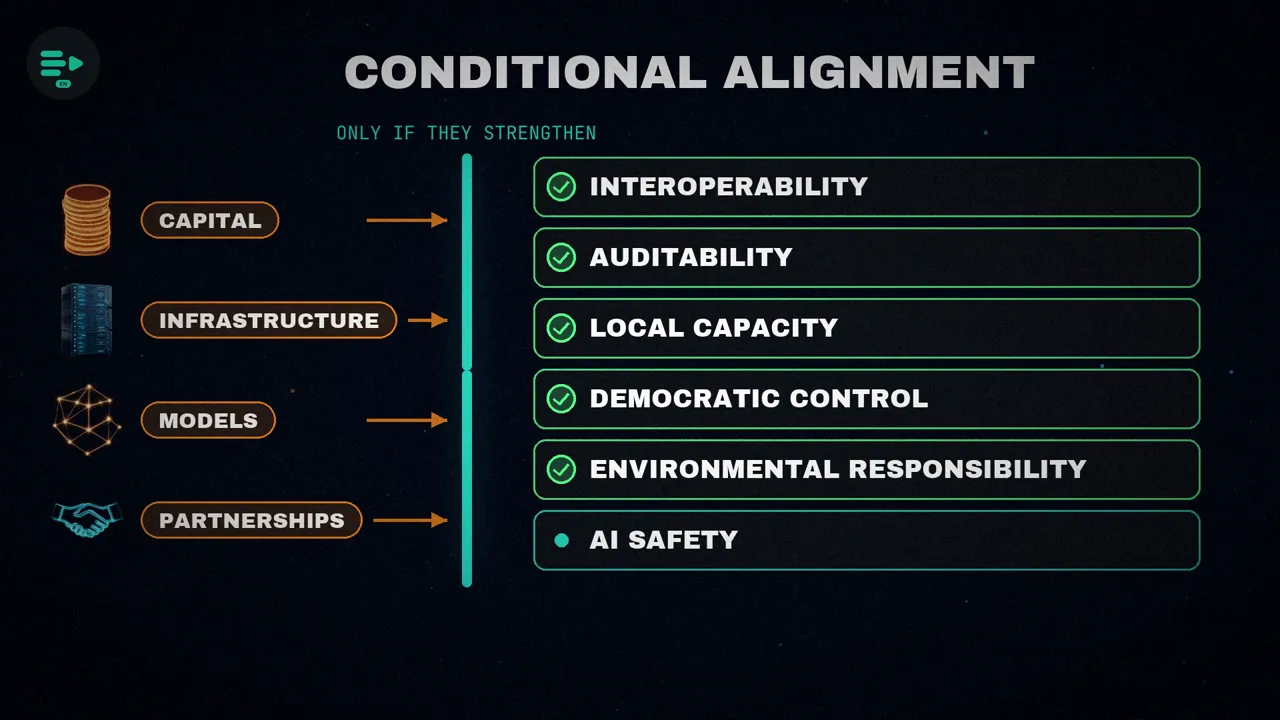
A “swing state” is not a country sitting and waiting between Washington and Beijing. It is a country whose procurement, infrastructure, data, talent and safety norms can tip where each ecosystem spreads. Latin American governments do not control frontier labs, but they do control the conditions under which this technology enters their schools, hospitals, courts, tax agencies, banks and critical infrastructure.
The author's five judgments
Guerrero sums up his position in five ideas:
- Latin America is not peripheral, it is disorganized. It is only sidelined if it negotiates country by country. It has scale, languages, energy, minerals and public-sector demand. What is missing is coordination.
- The contest is between ecosystems, not models. The question is which one leaves governments with leverage over chips, cloud, standards and safety institutions.
- Procurement is foreign policy. Every public AI contract decides whose cloud, model, chips, safety tests, data rules and update cadence.
- Safety is not a rich-country luxury. Malicious use, malfunctions and systemic risks show up wherever deployment happens at scale.
- The region can build a fourth position, alongside the United States, China and the European Union: open to investment, serious about safety, pragmatic about open source and strict when buying.
A market, not yet a power
The data comes mostly from the ILIA 2025 index, by ECLAC and CENIA. Latin America and the Caribbean hold between 15 and 20% of global downloads of generative-AI mobile apps. The figure comes from Sensor Tower and covers mobile apps only: not cloud, not enterprise tools.
The same index shows the gaps:
- Compute: roughly 90% of the region's supercomputing capacity is in Brazil.
- Talent: Brazil and Mexico account for about 68% of researchers.
- Research: five countries produce around 90% of publications.
- Execution: most national strategies have no budget, no implementation mechanisms and no evaluation systems.
That is the article's central paradox: Latin America is adopting AI faster than it is shaping it.
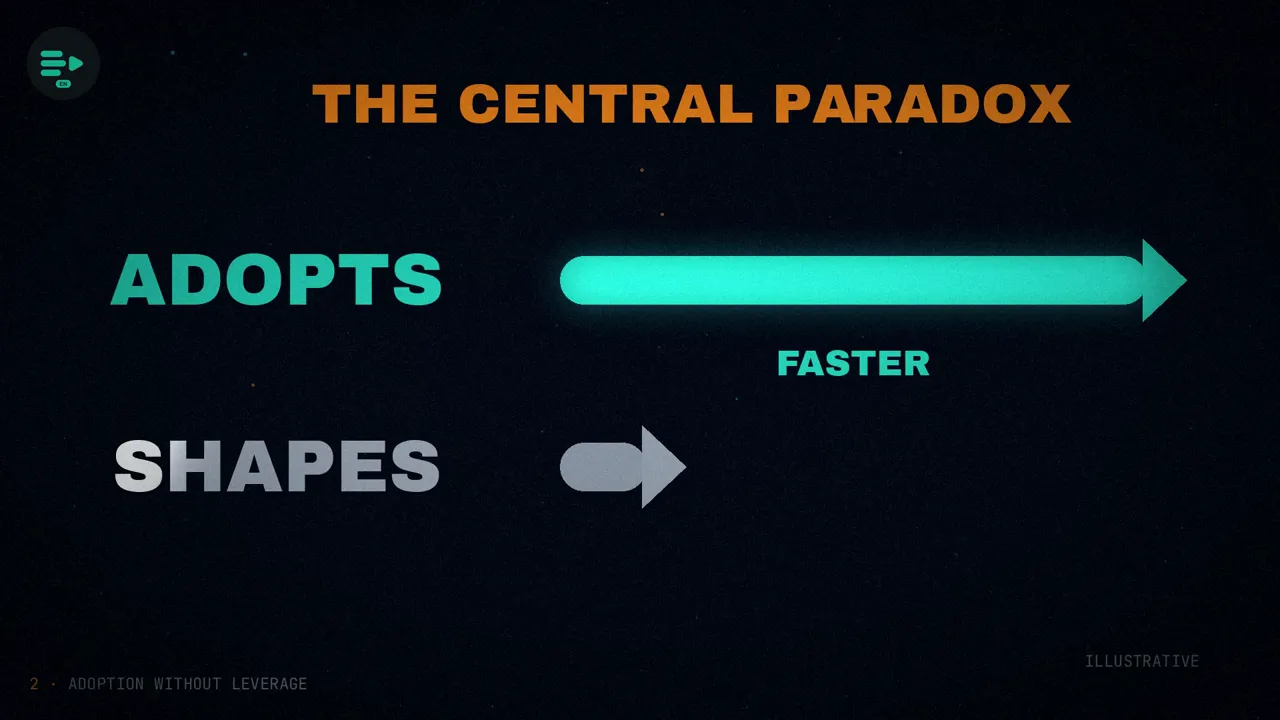
How much value is at stake? The World Economic Forum and McKinsey estimate that broader adoption could raise productivity growth by 1.9 to 2.3% a year and generate 1.1 to 1.7 trillion dollars annually. That is modelled potential, not gains that already exist. In their regional survey of about 129 senior respondents, only 23% saw any positive impact on operating profit, and just 6% saw an improvement above 5%. It is a survey, not a census of firms.
For the author, that gap is not explained by a lack of enthusiasm but by institutions. Productivity does not show up because a ministry buys a chatbot. It shows up when organizations redesign workflows, train the people who operate the systems, connect their data, manage risk and measure impact. His summary: a weak state buys tools; a strategic state shapes markets.
The US offer
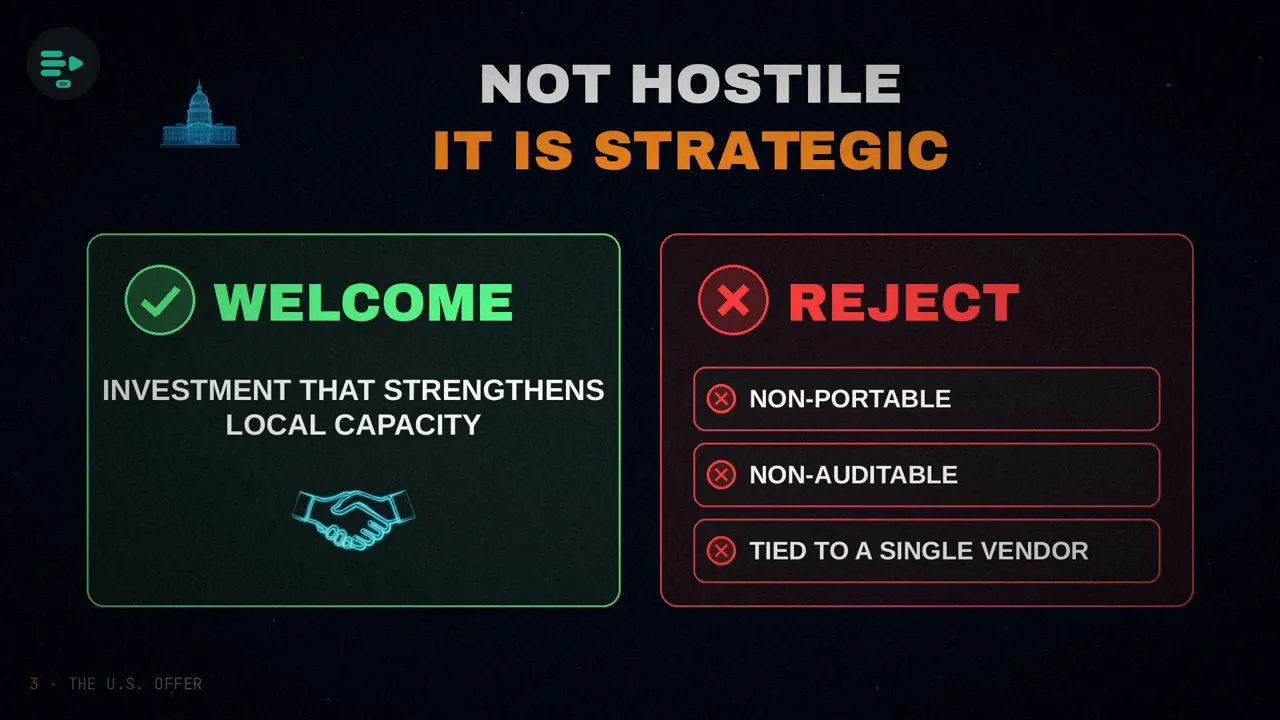
Washington has made its strategy explicit. Its action plan calls for driving global adoption of American systems, hardware and standards, exporting that technology to allies and partners, countering Chinese influence in governance bodies and strengthening export controls on compute.
A July 2025 executive order directs the promotion of full-stack packages abroad: chips, servers, storage, cloud, networking, data pipelines, models, cybersecurity and applications for education, health, agriculture or transport. Guerrero puts it this way: this is not just exporting technology, it is exporting institutions.
A country that adopts the package gets useful infrastructure, cloud access, security tools and productivity gains. And it may inherit dependency on vendors, chips, licensing terms, standards and US export-control politics. That last part is the author's inference, not something the official documents say, and it is not automatic: it depends on the conditions under which the package is accepted.
The Chinese offer
Beijing has been explicit too. In August 2025 its State Council published the guidelines to accelerate the “AI Plus” initiative across science, industry, consumption, welfare, governance and global cooperation. It sets targets: new-generation intelligent terminals and agents above 70% penetration by 2027 and above 90% by 2030. Those are goals, not results.
Its global governance action plan describes AI as an international public good and talks about digital infrastructure, open cooperation, safety, equity and respect for national sovereignty. For the Global South that is a powerful message: infrastructure, financing, open models and a narrative that criticizes the monopoly of a few countries and companies.
But that offer is strategic too. Whoever accepts Chinese infrastructure gains access and affordable prices and, again according to the author's inference, may inherit dependencies in telecommunications, cloud, surveillance architectures, data governance and industrial standards, while also being exposed to US export controls.
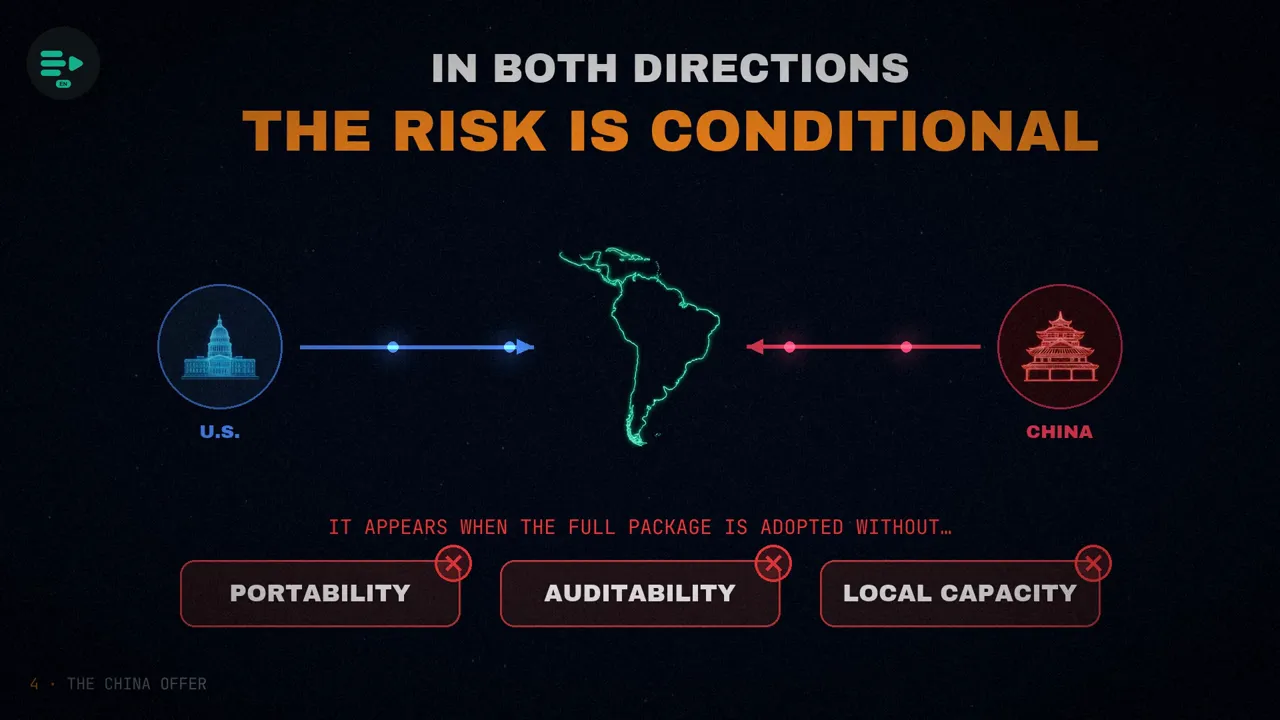
So the answer is not rejection either, but conditionality: getting Washington and Beijing to compete on meeting the region's rules for interoperability, safety testing, public-interest access, environmental reporting and local technical transfer.
The third force: a corpus
The most important infrastructure for Latin America may not be a giant data center but a corpus. Latam-GPT is an early signal. It was launched by Chile's National Center for Artificial Intelligence (CENIA), with support from more than 30 institutions across eight countries. It is an open-source language model trained on the region's cultures and data. Its first release focuses on Spanish and Portuguese; Indigenous languages are planned for later phases.
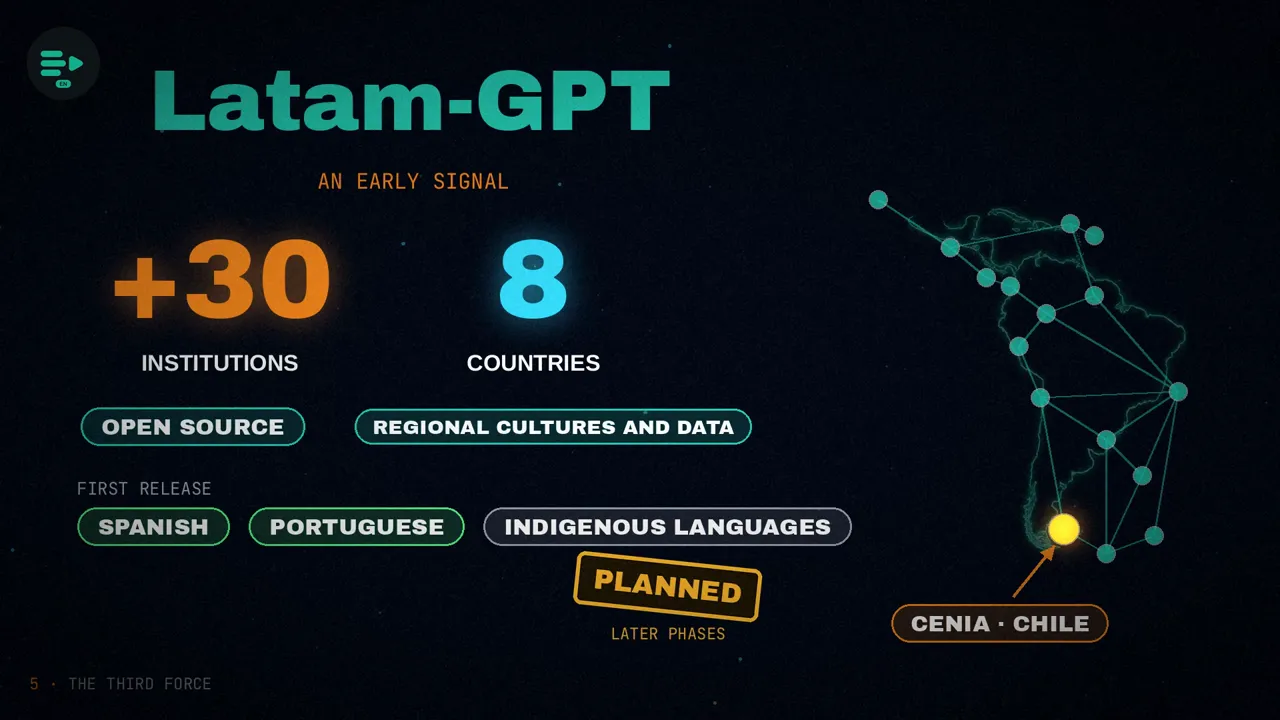
The lesson is not that it will compete with the big frontier models; it probably will not. The lesson is that regional infrastructure creates leverage. Whoever understands how models are built is better placed to regulate them. Whoever develops their own datasets evaluates foreign systems better. And a public sector able to use small open models depends less on opaque services.
Besides, a school, a court or a health system that can test models in Spanish, Portuguese, Quechua, Guarani, Aymara or Rapa Nui catches failures that English-centered benchmarks miss. Guerrero says it in one sentence: cultural infrastructure is safety infrastructure.
Data centers and minerals
AI is turning data centers into strategic assets, and the region keeps attracting more. According to the law firm White & Case, Brazil accounts for more than 40% of announced investment. The consultancy CBRE lists São Paulo, Santiago, Bogotá and Querétaro as the four largest markets, with São Paulo in the lead at about 493 MW in early 2025.
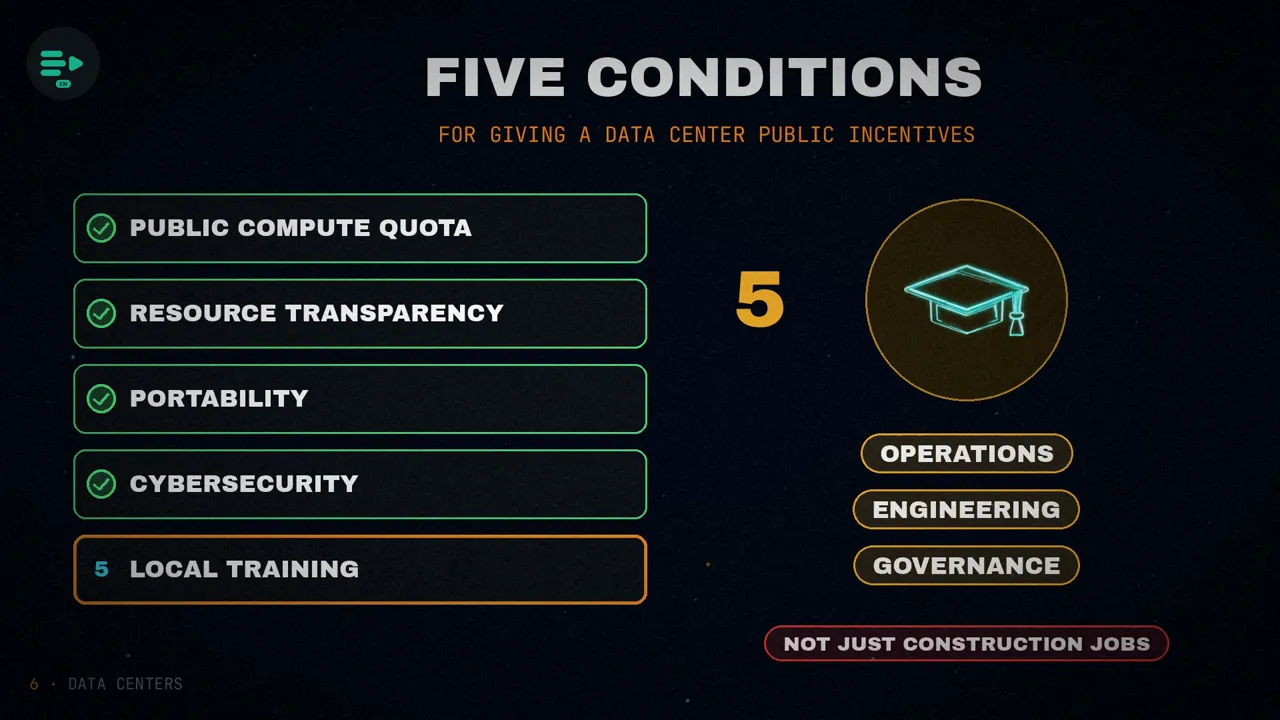
But a data center is not sovereign just because it sits on your territory. It can be extractive infrastructure: a country can host it and have no compute for its universities, its startups or its safety testing, and supply the electricity and the water while foreign firms capture most of the strategic value. That is why the article proposes five conditions for public incentives:
- A compute quota for universities, startups, the public sector and safety evaluation.
- Transparency: audited, public reporting of energy, water and emissions.
- Portability: government workloads must be able to move between providers.
- Cybersecurity, with mandatory reporting of incidents and vulnerabilities.
- Local training in operations, engineering and governance, not just construction jobs.
The same goes for critical minerals. According to the OECD, Latin America supplies roughly 35% of the world's lithium and 40% of its copper. That wealth only becomes leverage if it is tied to responsible supply chains, traceability, industrial upgrading and digital strategy. The region, the author says, should not export minerals, import cloud and call that digital transformation.
Safety is decided where AI is deployed
Most of the safety debate looks at frontier labs: model weights, evaluation protocols, catastrophic scenarios. For Guerrero that focus is necessary but incomplete. A model that performs well in English can fail at legal reasoning in Spanish, at public services in Indigenous languages, at local medical triage, at agricultural advice or when deciding who receives a social benefit.
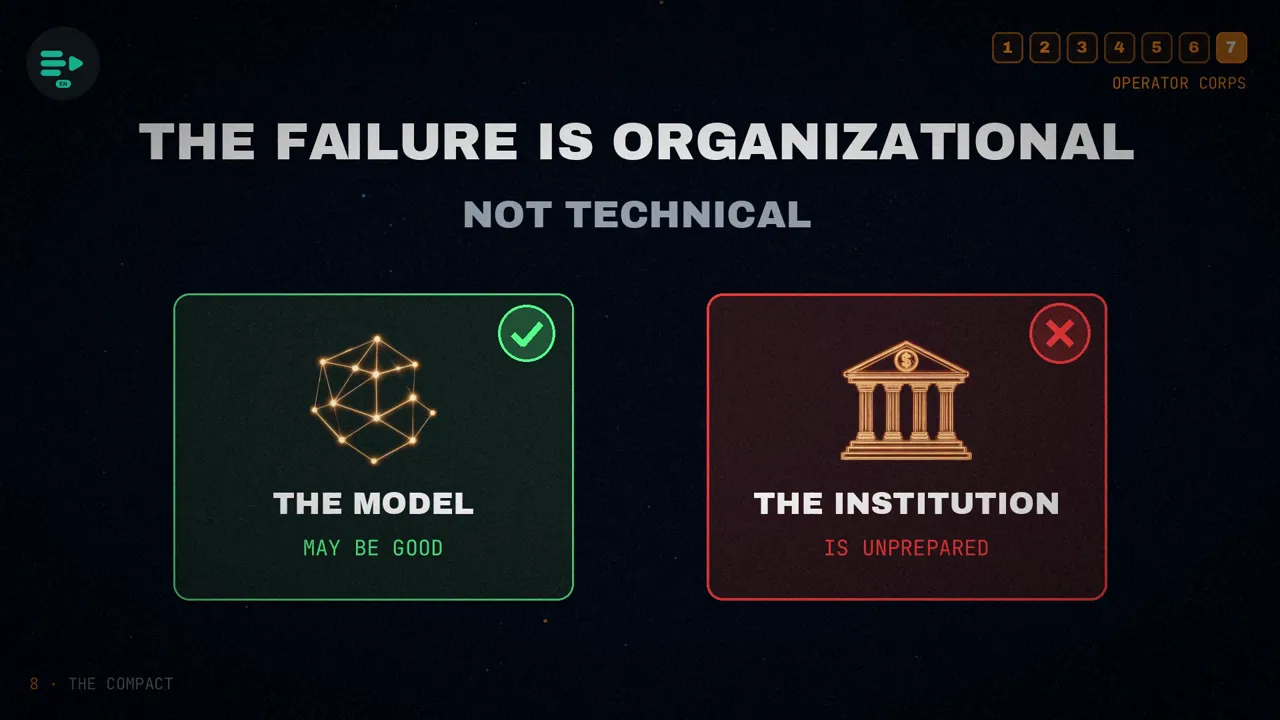
And the failure can be institutional, not the model's:
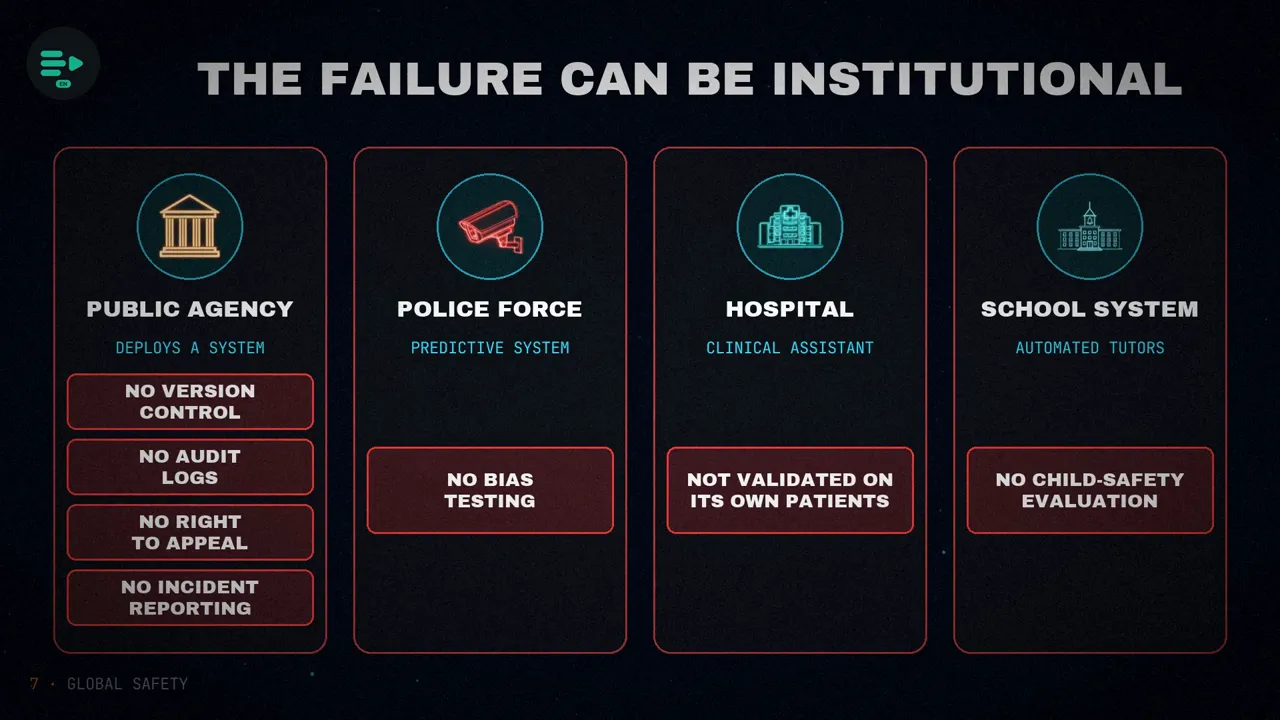
The 2026 International AI Safety Report, led by Yoshua Bengio with more than 100 contributors, lists risks of malicious use, malfunctions, systemic effects, cyber capabilities, biological and chemical misuse, and open-weight models whose safeguards can be removed. Those are global categories. Latin America does not yet have a comparable regional incident registry, and building one is part of the proposal.
According to a Brookings analysis the author cites, regional governance is still at an early stage and many bills are vague. The opportunity he sees is not competing with the labs but becoming the first regional testbed where deployment safety is institutionalized.
The compact: seven parts
The article's proposal is a Latin American AI Swing States Compact: a voluntary but operational agreement among governments, universities, development banks, labs, civil society and companies. It is the author's proposal, not something that exists. Each pillar needs four things: who leads it, who funds it, what it delivers in year one, and what its risk is.
| Part | What it proposes |
|---|---|
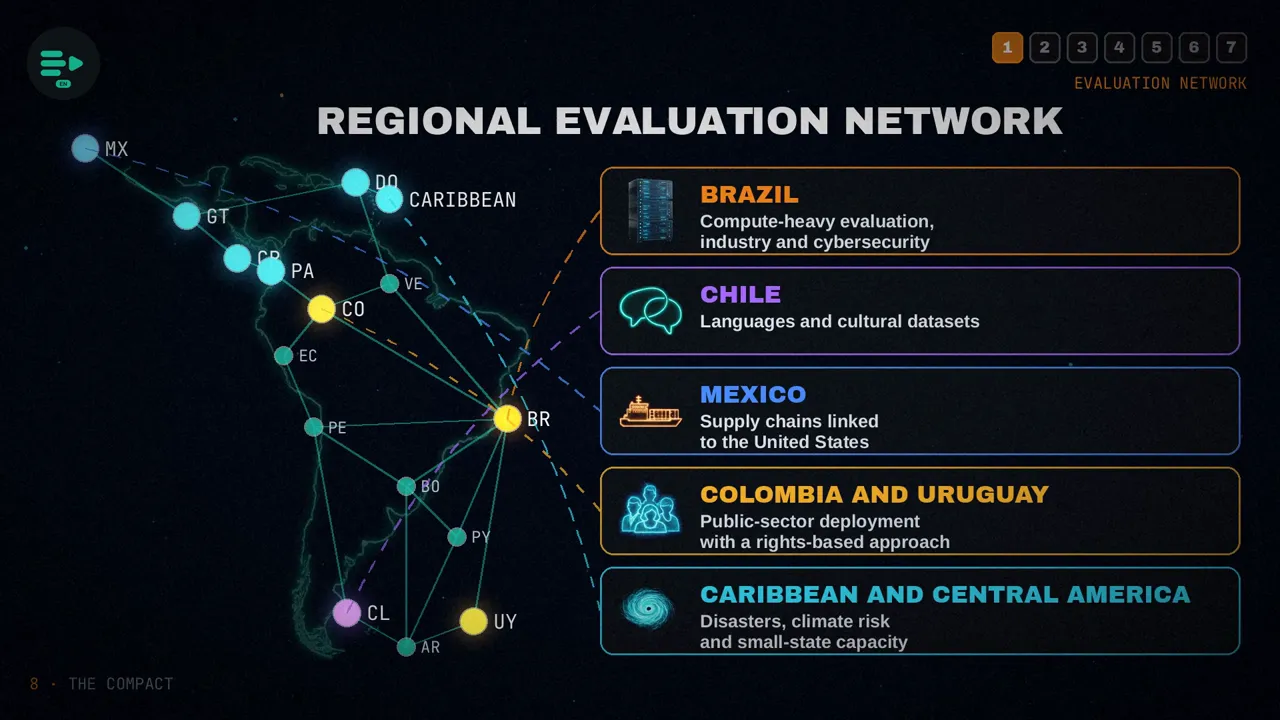
| 1. Regional evaluation and safety network | Specialized nodes instead of one central institute: Brazil (compute-heavy evaluation, industry and cybersecurity), Chile (languages and cultural datasets), Mexico (supply chains linked to the United States), Colombia and Uruguay (public-sector deployment with a rights-based approach), and the Caribbean and Central America (disasters, climate risk and small states). It would publish an annual safety report. |
| 2. Public procurement standard | Requirements for any system above a risk threshold (list below). |
| 3. Commons of models and datasets | Treat Latam-GPT as a beginning: public-domain corpora, licensed educational material, cultural datasets and specific benchmarks for health, education, justice, agriculture and climate. Not to replace global models, but to hold them accountable. |
| 4. Compute with conditions | If public incentives, tax benefits, concessional loans or public land stand behind a data center, it must reserve capacity for public-interest uses. |
| 5. Two-door diplomacy | One door for investment from the United States, Europe and allies; another for partnerships with China and the Global South. Both lead into the same room: Latin American rules. |
| 6. Safety tied to adoption | Apply AI well where needs are urgent (health, education, administration, climate, justice) and turn strategies into budgets, procurement rules and evaluation labs. |
| 7. Operator corps | Train thousands of professionals a year: civil servants, teachers, doctors, judges and engineers who turn technical capability into results. |
The public procurement standard is, according to the article, the fastest way to shape a market. Any agency buying a system above the risk threshold should require: a system or model card, a performance evaluation in the local language, a human-rights impact assessment, audit logs accessible to oversight bodies, incident reporting within a set period, version control and rollback, rules on data use and retention (and on whether it is used for training), exit clauses to switch providers, interoperability with other clouds, the energy and water footprint, and human authority over high-impact decisions.
This is not anti-innovation, it is pro-competition: bad procurement locks governments into opaque systems; good procurement forces vendors to compete on reliability, transparency, portability and safety.
The two doors come down to six tests for any foreign offer:
- Interoperability: can the government switch providers without rebuilding everything?
- Auditability: can regulators inspect logs, updates and failures?
- Contestability: can a citizen appeal a decision that affects their rights?
- Local capacity: does the contract train local engineers and evaluators?
- Sustainability: are energy, water and emissions measured?
- Safety: are there red-team tests, incident reporting and rollback?
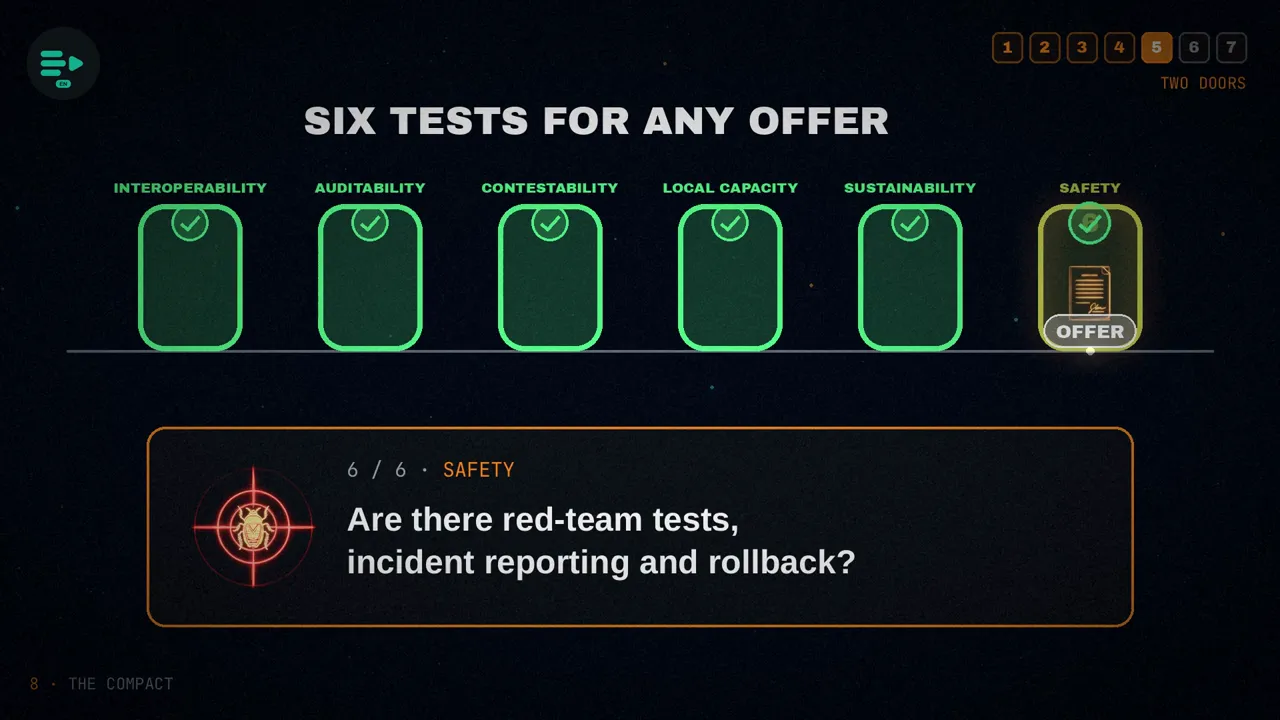
If a US vendor passes them, buy American. If a Chinese vendor passes them, buy Chinese. And the same if it is European, Brazilian, Chilean, Mexican, Indian, Japanese or open source. The strategic goal is not neutrality, it is leverage.
On adoption, the article points to real moves. Brazil proposes a plan of around 4 billion dollars and roughly 54 measures (a plan, not money already spent). Chile updated its national policy and introduced a risk-based bill after applying UNESCO's methodology. Colombia approved its policy (CONPES 4144) in February 2025. But they only count if they become working systems. The author's line: a strategy without execution is a PDF; a procurement rule changes the market.
Every country, a role
The region is very uneven: the ILIA index itself distinguishes pioneers, adopters and explorers. So the compact does not require everyone to move at the same pace. Interoperable rules among the first movers, plus on-ramps for the rest, are enough.
Scale, research, industrial policy, weight in data centers and an ambitious national plan.
An updated policy, CENIA and Latam-GPT.
Shaped by proximity to the United States, Chinese supply chains, manufacturing and trade policy.
If its policy turns into procurement rules, citizen participation and measurable results.
They can lead in digital government, education and agile deployment, as long as they do not stay passive buyers.
Not a footnote: climate risk, disasters, tourism dependence, language diversity and cyber vulnerability.
The mistake to avoid
The big mistake, Guerrero says, would be treating this policy as a race to attract vendors. That is negotiating from weakness: governments offer tax incentives, fast-track permits, data access, public contracts and political legitimacy, and in return get cloud credits, pilot projects, memoranda of understanding and impressive launch events. And then the dependency begins.
The alternative is to design the ecosystem and ask every vendor, lab or partner government: when the contract ends, will we be more capable? Can our universities evaluate it, our regulators inspect it, our startups build on it, our citizens contest it and our public agencies walk away from it? Do our languages and cultures fit? Can our energy and water sustain it? Do our safety institutions learn from it? If the answer is no, the deal is not strategic.
How to read the numbers
The figures in this post are the ones the article cites, and they come with caveats:
- Some are estimates and targets. The economic value is potential modelled by the WEF and McKinsey; China's percentages are goals for 2027 and 2030; Brazil's plan is not money already spent.
- Some are the author's inferences. That adopting a power's package may bring dependency is not in the official documents: Guerrero infers it, and frames it as a conditional risk.
- The compact is a proposal. It does not exist, and the year-one deliverables are a sketch.
- Adoption data is partial. The 15-20% covers mobile apps only, and the 23% and 6% come from a survey of about 129 executives.
Summing up
The region's future is not decided only in Silicon Valley, Washington, Beijing, Brussels or Shenzhen. It is decided in procurement offices, data-protection agencies, university labs, development banks and the permits of each data center. The compact comes down to six non-negotiables:
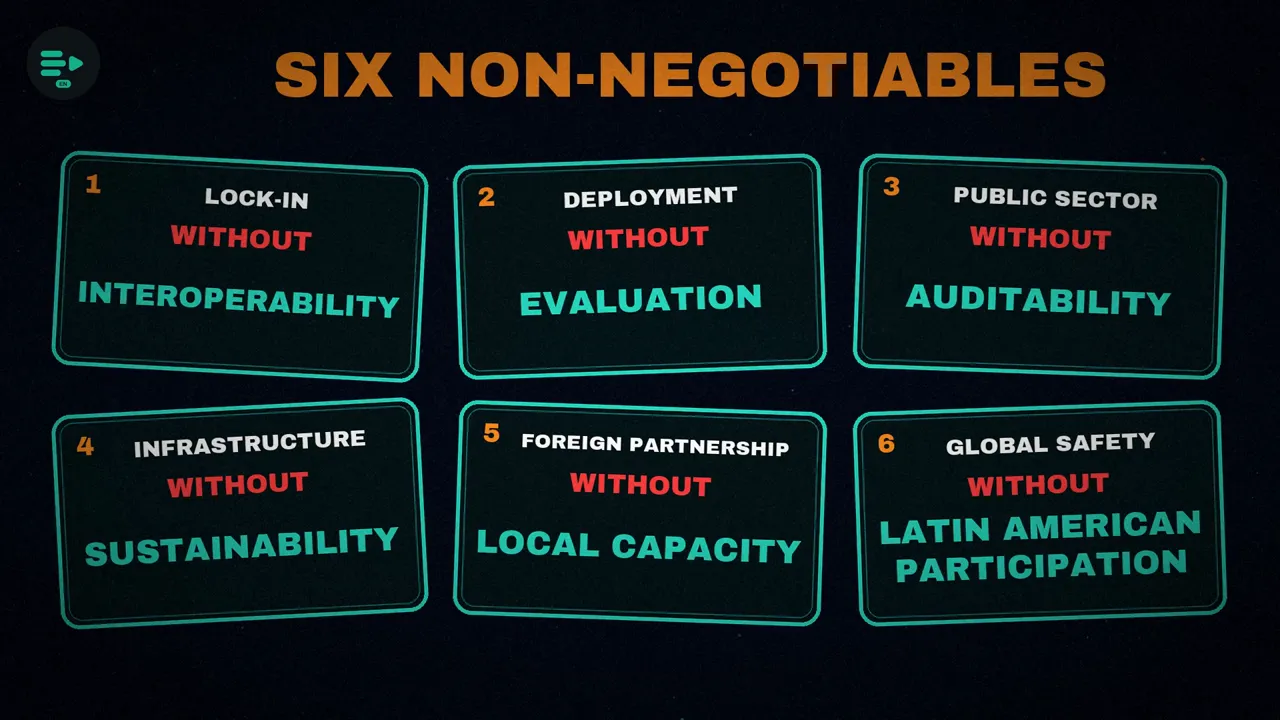
The question is not whether to align with the United States or with China, but what conditions any ecosystem must meet to operate in our societies.
Do you think the region can negotiate as a bloc?
Sources
- “AI Swing States: How Latin America Will Shape US-China Competition and Global AI Safety”, by Miguel Guerrero (May 2026).
- The video, on my channels: English and Spanish.