Aviso: Este post foi traduzido para o português usando um modelo de tradução automática. Por favor, me avise se encontrar algum erro.
O tokenizador BPE (Byte Pair Encoding - codificação de pares de bytes) é um algoritmo de compressão de dados que é usado para criar um vocabulário de subpalavras a partir de um corpus de texto. Este algoritmo se baseia na frequência dos pares de bytes no texto. Ele se popularizou porque foi utilizado como tokenizador por LLMs como GPT, GPT-2, RoBERTa, BART e DeBERTa
Algoritmo de treinamento
Suponhamos que temos um corpus de texto que contém apenas as seguintes palavras hug, pug, pun, bun e hugs, o primeiro passo consiste em criar um vocabulário com todos os caracteres presentes no corpus, no nosso caso será b, g, h, n, p, s, u
InputPythoncorpus_words = ["hug", "pug", "pun", "bun", "hugs"]# Concatenate all the words in the corpusinitial_corpus_tokens = ""for word in corpus_words:initial_corpus_tokens += word# Convert the concatenated string to a set of tokens to get unique tokensinitial_corpus_tokens = set(initial_corpus_tokens)print(f"Corpus words: {corpus_words}")print(f"Initial corpus tokens: {initial_corpus_tokens}")print(f"Number of initial corpus tokens: {len(initial_corpus_tokens)}")Copied
Corpus words: ['hug', 'pug', 'pun', 'bun', 'hugs']Initial corpus tokens: {'p', 'n', 'u', 's', 'h', 'g', 'b'}Number of initial corpus tokens: 7
Agora suponhamos que este é o nosso corpus de frases, é um corpus inventado, não faz sentido.
InputPythoncorpus = ["hug hug hug pun pun bun hugs","hug hug pug pug pun pun hugs","hug hug pug pug pun pun pun pun hugs","pug pun pun pun bun hugs","hug hug hug pun bun bun hugs",]Copied
Vamos a contar o número de vezes que cada palavra aparece no corpus, para verificar que o que havíamos colocado anteriormente está correto.
InputPythonnum_hug = 0num_pug = 0num_pun = 0num_bun = 0num_hugs = 0for sentence in corpus:words = sentence.split(" ")for word in words:if word == "hug":num_hug += 1elif word == "pug":num_pug += 1elif word == "pun":num_pun += 1elif word == "bun":num_bun += 1elif word == "hugs":num_hugs += 1print(f"Number of hug: {num_hug}")print(f"Number of pug: {num_pug}")print(f"Number of pun: {num_pun}")print(f"Number of bun: {num_bun}")print(f"Number of hugs: {num_hugs}")Copied
Number of hug: 10Number of pug: 5Number of pun: 12Number of bun: 4Number of hugs: 5
Tudo o que havíamos contado está bem, podemos continuar.
Vamos a criar um dicionário com os tokens de cada palavra e o número de vezes que ela aparece no corpus
InputPythondict_tokens_by_word_appearance = {"hug":{"count": num_hug,"tokens": [character for character in "hug"],},"pug":{"count": num_pug,"tokens": [character for character in "pug"],},"pun":{"count": num_pun,"tokens": [character for character in "pun"],},"bun":{"count": num_bun,"tokens": [character for character in "bun"],},"hugs":{"count": num_hugs,"tokens": [character for character in "hugs"],},}dict_tokens_by_word_appearanceCopied
{'hug': {'count': 10, 'tokens': ['h', 'u', 'g']},'pug': {'count': 5, 'tokens': ['p', 'u', 'g']},'pun': {'count': 12, 'tokens': ['p', 'u', 'n']},'bun': {'count': 4, 'tokens': ['b', 'u', 'n']},'hugs': {'count': 5, 'tokens': ['h', 'u', 'g', 's']}}
Agora vamos a procurar o par de tokens consecutivos que mais vezes aparece no dicionário
InputPythondict_keys = dict_tokens_by_word_appearance.keys()list_consecutive_tokens = []for i, key in enumerate(dict_keys):# Get the tokens of the wordnumber_of_toneks_of_word = len(dict_tokens_by_word_appearance[key]["tokens"])# Get consecituve tokensfor j in range(number_of_toneks_of_word-1):# Get consecutive tokensconsecutive_tokens = dict_tokens_by_word_appearance[key]["tokens"][j] + dict_tokens_by_word_appearance[key]["tokens"][j+1]# Append the consecutive tokens to the list the number of times the word appearsfor _ in range(dict_tokens_by_word_appearance[key]["count"]):list_consecutive_tokens.append(consecutive_tokens)# Print the list of consecutive tokensprint(f"List of consecutive tokens: {list_consecutive_tokens}")# Get consecutive tokens with maximum frequencydict_consecutive_tokens = {}for token in list_consecutive_tokens:# Check if the token is already in the dictionaryif token in dict_consecutive_tokens:# Increment the count of the tokendict_consecutive_tokens[token] += 1# If the token is not in the dictionaryelse:# Add the token to the dictionarydict_consecutive_tokens[token] = 1# Print the dictionary of consecutive tokensprint(f"Dictionary of consecutive tokens: {dict_consecutive_tokens}")# Get the consecutive token with maximum frequencymax_consecutive_token = Nonewhile True:# Get the token with maximum frequencyconsecutive_token = max(dict_consecutive_tokens, key=dict_consecutive_tokens.get)# Check if the token is already in the list of tokensif consecutive_token in initial_corpus_tokens:# Remove token from the dictionarydict_consecutive_tokens.pop(consecutive_token)# If the token is not in the list of tokenselse:# Assign the token to the max_consecutive_tokenmax_consecutive_token = consecutive_tokenbreak# Print the consecutive token with maximum frequencyprint(f"Consecutive token with maximum frequency: {max_consecutive_token}")Copied
List of consecutive tokens: ['hu', 'hu', 'hu', 'hu', 'hu', 'hu', 'hu', 'hu', 'hu', 'hu', 'ug', 'ug', 'ug', 'ug', 'ug', 'ug', 'ug', 'ug', 'ug', 'ug', 'pu', 'pu', 'pu', 'pu', 'pu', 'ug', 'ug', 'ug', 'ug', 'ug', 'pu', 'pu', 'pu', 'pu', 'pu', 'pu', 'pu', 'pu', 'pu', 'pu', 'pu', 'pu', 'un', 'un', 'un', 'un', 'un', 'un', 'un', 'un', 'un', 'un', 'un', 'un', 'bu', 'bu', 'bu', 'bu', 'un', 'un', 'un', 'un', 'hu', 'hu', 'hu', 'hu', 'hu', 'ug', 'ug', 'ug', 'ug', 'ug', 'gs', 'gs', 'gs', 'gs', 'gs']Dictionary of consecutive tokens: {'hu': 15, 'ug': 20, 'pu': 17, 'un': 16, 'bu': 4, 'gs': 5}Consecutive token with maximum frequency: ug
Obtivemos o par de tokens que mais vezes aparece. Vamos encapsular isso em uma função, pois vamos utilizá-la mais vezes.
InputPythondef get_consecutive_tokens_with_max_frequency(dict_tokens_by_word_appearance, list_corpus_tokens):dict_keys = dict_tokens_by_word_appearance.keys()list_consecutive_tokens = []for i, key in enumerate(dict_keys):# Get the tokens of the wordnumber_of_toneks_of_word = len(dict_tokens_by_word_appearance[key]["tokens"])# Get consecituve tokensfor j in range(number_of_toneks_of_word-1):# Get consecutive tokensconsecutive_tokens = dict_tokens_by_word_appearance[key]["tokens"][j] + dict_tokens_by_word_appearance[key]["tokens"][j+1]# Append the consecutive tokens to the listfor _ in range(dict_tokens_by_word_appearance[key]["count"]):list_consecutive_tokens.append(consecutive_tokens)# Get consecutive tokens with maximum frequencydict_consecutive_tokens = {}for token in list_consecutive_tokens:# Check if the token is already in the dictionaryif token in dict_consecutive_tokens:# Increment the count of the tokendict_consecutive_tokens[token] += 1# If the token is not in the dictionaryelse:# Add the token to the dictionarydict_consecutive_tokens[token] = 1# Get the consecutive token with maximum frequencymax_consecutive_token = Nonewhile True:# Get the token with maximum frequencyconsecutive_token = max(dict_consecutive_tokens, key=dict_consecutive_tokens.get)# Check if the token is already in the list of tokensif consecutive_token in list_corpus_tokens:# Remove token from the dictionarydict_consecutive_tokens.pop(consecutive_token)# If the token is not in the list of tokenselse:# Assign the token to the max_consecutive_tokenmax_consecutive_token = consecutive_tokenbreakreturn max_consecutive_tokenCopied
Verificamos que obtemos o mesmo que antes
InputPythonmax_consecutive_token = get_consecutive_tokens_with_max_frequency(dict_tokens_by_word_appearance, initial_corpus_tokens)print(f"Consecutive token with maximum frequency: {max_consecutive_token}")Copied
Consecutive token with maximum frequency: ug
Vemos que sim.
Agora nosso corpus de tokens pode ser modificado adicionando o token ug
InputPython# new_corpus_tokens = initial_corpus_tokens + max_consecutive_tokennew_corpus_tokens = initial_corpus_tokens.copy()new_corpus_tokens.add(max_consecutive_token)print(f"Initial corpus tokens: {initial_corpus_tokens}")print(f"New corpus tokens: {new_corpus_tokens}")Copied
Initial corpus tokens: {'p', 'n', 'u', 's', 'h', 'g', 'b'}New corpus tokens: {'p', 'n', 'ug', 'g', 'b', 'u', 's', 'h'}
Colocamos isso também em uma função
InputPythondef get_new_corpus_tokens(max_consecutive_token, initial_corpus_tokens):new_corpus_tokens = initial_corpus_tokens.copy()new_corpus_tokens.add(max_consecutive_token)return new_corpus_tokensCopied
Voltaremos a verificar que obtemos o mesmo resultado de antes
InputPythonnew_corpus_tokens = get_new_corpus_tokens(max_consecutive_token, initial_corpus_tokens)print(f"Initial corpus tokens: {initial_corpus_tokens}")print(f"New corpus tokens: {new_corpus_tokens}")Copied
Initial corpus tokens: {'p', 'n', 'u', 's', 'h', 'g', 'b'}New corpus tokens: {'p', 'n', 'ug', 'g', 'b', 'u', 's', 'h'}
Vemos que sim.
Agora vamos a modificar o dicionário no qual aparecem as palavras, os tokens e o número de vezes que aparecem com o novo token
InputPythonimport copydict_keys = dict_tokens_by_word_appearance.keys()dict_tokens_by_word_appearance_tmp = copy.deepcopy(dict_tokens_by_word_appearance)for key in dict_keys:# Check if the new token is in the wordif max_consecutive_token in key:print(f"Token {max_consecutive_token} is in the word {key}")# Add the new token to the word tokensdict_tokens_by_word_appearance_tmp[key]["tokens"].append(max_consecutive_token)print(f"New tokens of the word {key}: {dict_tokens_by_word_appearance_tmp[key]['tokens']}")print(f"Initial tokens by word appearance: {dict_tokens_by_word_appearance}")print(f"New tokens by word appearance: ")dict_tokens_by_word_appearance_tmpCopied
Token ug is in the word hugNew tokens of the word hug: ['h', 'u', 'g', 'ug']Token ug is in the word pugNew tokens of the word pug: ['p', 'u', 'g', 'ug']Token ug is in the word hugsNew tokens of the word hugs: ['h', 'u', 'g', 's', 'ug']Initial tokens by word appearance: {'hug': {'count': 10, 'tokens': ['h', 'u', 'g']}, 'pug': {'count': 5, 'tokens': ['p', 'u', 'g']}, 'pun': {'count': 12, 'tokens': ['p', 'u', 'n']}, 'bun': {'count': 4, 'tokens': ['b', 'u', 'n']}, 'hugs': {'count': 5, 'tokens': ['h', 'u', 'g', 's']}}New tokens by word appearance:
{'hug': {'count': 10, 'tokens': ['h', 'u', 'g', 'ug']},'pug': {'count': 5, 'tokens': ['p', 'u', 'g', 'ug']},'pun': {'count': 12, 'tokens': ['p', 'u', 'n']},'bun': {'count': 4, 'tokens': ['b', 'u', 'n']},'hugs': {'count': 5, 'tokens': ['h', 'u', 'g', 's', 'ug']}}
Colocamos isso em uma função
InputPythondef update_tokens_by_word_appearance(dict_tokens_by_word_appearance, max_consecutive_token):dict_tokens_by_word_appearance_tmp = copy.deepcopy(dict_tokens_by_word_appearance)dict_keys = dict_tokens_by_word_appearance_tmp.keys()for key in dict_keys:# Check if the new token is in the wordif max_consecutive_token in key:# Add the new token to the word tokensdict_tokens_by_word_appearance_tmp[key]["tokens"].append(max_consecutive_token)return dict_tokens_by_word_appearance_tmpCopied
Verificamos que está correto.
InputPythondict_tokens_by_word_appearance = update_tokens_by_word_appearance(dict_tokens_by_word_appearance, max_consecutive_token)print(f"New tokens by word appearance: ")dict_tokens_by_word_appearanceCopied
New tokens by word appearance:
{'hug': {'count': 10, 'tokens': ['h', 'u', 'g', 'ug']},'pug': {'count': 5, 'tokens': ['p', 'u', 'g', 'ug']},'pun': {'count': 12, 'tokens': ['p', 'u', 'n']},'bun': {'count': 4, 'tokens': ['b', 'u', 'n']},'hugs': {'count': 5, 'tokens': ['h', 'u', 'g', 's', 'ug']}}
Em resumo, na primeira iteração passamos de um corpus de tokens s, g, h, u, n, p, b para o novo corpus de tokens h, u, n, p, s, g, b, ug
Agora realizamos uma segunda iteração, obtemos o par de tokens consecutivos que mais vezes aparecem no dicionário
InputPythonmax_consecutive_token = get_consecutive_tokens_with_max_frequency(dict_tokens_by_word_appearance, new_corpus_tokens)print(f"Consecutive token with maximum frequency: {max_consecutive_token}")Copied
Consecutive token with maximum frequency: pu
Obtemos o novo corpus de tokens
InputPythoncorpus_tokens = get_new_corpus_tokens(max_consecutive_token, new_corpus_tokens)print(f"Initial corpus tokens: {new_corpus_tokens}")print(f"New corpus tokens: {corpus_tokens}")Copied
Initial corpus tokens: {'p', 'n', 'ug', 'g', 'b', 'u', 's', 'h'}New corpus tokens: {'p', 'n', 'pu', 'u', 's', 'h', 'ug', 'g', 'b'}
E obtém-se o novo dicionário no qual aparecem as palavras, os tokens e o número de vezes que aparecem.
InputPythondict_tokens_by_word_appearance = update_tokens_by_word_appearance(dict_tokens_by_word_appearance, max_consecutive_token)print(f"New tokens by word appearance: ")dict_tokens_by_word_appearanceCopied
New tokens by word appearance:
{'hug': {'count': 10, 'tokens': ['h', 'u', 'g', 'ug']},'pug': {'count': 5, 'tokens': ['p', 'u', 'g', 'ug', 'pu']},'pun': {'count': 12, 'tokens': ['p', 'u', 'n', 'pu']},'bun': {'count': 4, 'tokens': ['b', 'u', 'n']},'hugs': {'count': 5, 'tokens': ['h', 'u', 'g', 's', 'ug']}}
Agora podemos continuar até ter um corpus de tokens com o tamanho desejado, vamos criar um corpus de 15 tokens.
InputPythonlen_corpus_tokens = 15while len(corpus_tokens) < len_corpus_tokens:max_consecutive_token = get_consecutive_tokens_with_max_frequency(dict_tokens_by_word_appearance, corpus_tokens)print(f"Consecutive token with maximum frequency: {max_consecutive_token}")# If there are no more consecutive tokens break the loopif max_consecutive_token is None:breakcorpus_tokens = get_new_corpus_tokens(max_consecutive_token, corpus_tokens)print(f"New corpus tokens: {corpus_tokens}")dict_tokens_by_word_appearance = update_tokens_by_word_appearance(dict_tokens_by_word_appearance, max_consecutive_token)print(f"New tokens by word appearance: {dict_tokens_by_word_appearance} ")Copied
Consecutive token with maximum frequency: unNew corpus tokens: {'p', 'n', 'pu', 'un', 'u', 's', 'h', 'ug', 'g', 'b'}New tokens by word appearance: {'hug': {'count': 10, 'tokens': ['h', 'u', 'g', 'ug']}, 'pug': {'count': 5, 'tokens': ['p', 'u', 'g', 'ug', 'pu']}, 'pun': {'count': 12, 'tokens': ['p', 'u', 'n', 'pu', 'un']}, 'bun': {'count': 4, 'tokens': ['b', 'u', 'n', 'un']}, 'hugs': {'count': 5, 'tokens': ['h', 'u', 'g', 's', 'ug']}}Consecutive token with maximum frequency: huNew corpus tokens: {'p', 'hu', 'n', 'pu', 'un', 'u', 's', 'h', 'ug', 'g', 'b'}New tokens by word appearance: {'hug': {'count': 10, 'tokens': ['h', 'u', 'g', 'ug', 'hu']}, 'pug': {'count': 5, 'tokens': ['p', 'u', 'g', 'ug', 'pu']}, 'pun': {'count': 12, 'tokens': ['p', 'u', 'n', 'pu', 'un']}, 'bun': {'count': 4, 'tokens': ['b', 'u', 'n', 'un']}, 'hugs': {'count': 5, 'tokens': ['h', 'u', 'g', 's', 'ug', 'hu']}}Consecutive token with maximum frequency: gugNew corpus tokens: {'p', 'hu', 'n', 'pu', 'un', 'gug', 'u', 's', 'h', 'ug', 'g', 'b'}New tokens by word appearance: {'hug': {'count': 10, 'tokens': ['h', 'u', 'g', 'ug', 'hu']}, 'pug': {'count': 5, 'tokens': ['p', 'u', 'g', 'ug', 'pu']}, 'pun': {'count': 12, 'tokens': ['p', 'u', 'n', 'pu', 'un']}, 'bun': {'count': 4, 'tokens': ['b', 'u', 'n', 'un']}, 'hugs': {'count': 5, 'tokens': ['h', 'u', 'g', 's', 'ug', 'hu']}}Consecutive token with maximum frequency: ughuNew corpus tokens: {'p', 'hu', 'n', 'pu', 'un', 'gug', 'u', 's', 'h', 'ughu', 'ug', 'g', 'b'}New tokens by word appearance: {'hug': {'count': 10, 'tokens': ['h', 'u', 'g', 'ug', 'hu']}, 'pug': {'count': 5, 'tokens': ['p', 'u', 'g', 'ug', 'pu']}, 'pun': {'count': 12, 'tokens': ['p', 'u', 'n', 'pu', 'un']}, 'bun': {'count': 4, 'tokens': ['b', 'u', 'n', 'un']}, 'hugs': {'count': 5, 'tokens': ['h', 'u', 'g', 's', 'ug', 'hu']}}Consecutive token with maximum frequency: npuNew corpus tokens: {'p', 'hu', 'n', 'npu', 'pu', 'un', 'gug', 'u', 's', 'h', 'ughu', 'ug', 'g', 'b'}New tokens by word appearance: {'hug': {'count': 10, 'tokens': ['h', 'u', 'g', 'ug', 'hu']}, 'pug': {'count': 5, 'tokens': ['p', 'u', 'g', 'ug', 'pu']}, 'pun': {'count': 12, 'tokens': ['p', 'u', 'n', 'pu', 'un']}, 'bun': {'count': 4, 'tokens': ['b', 'u', 'n', 'un']}, 'hugs': {'count': 5, 'tokens': ['h', 'u', 'g', 's', 'ug', 'hu']}}Consecutive token with maximum frequency: puunNew corpus tokens: {'p', 'hu', 'n', 'npu', 'pu', 'un', 'gug', 'puun', 'u', 's', 'h', 'ughu', 'ug', 'g', 'b'}New tokens by word appearance: {'hug': {'count': 10, 'tokens': ['h', 'u', 'g', 'ug', 'hu']}, 'pug': {'count': 5, 'tokens': ['p', 'u', 'g', 'ug', 'pu']}, 'pun': {'count': 12, 'tokens': ['p', 'u', 'n', 'pu', 'un']}, 'bun': {'count': 4, 'tokens': ['b', 'u', 'n', 'un']}, 'hugs': {'count': 5, 'tokens': ['h', 'u', 'g', 's', 'ug', 'hu']}}
Agora que vimos como é treinado o tokenizador BPE, vamos treiná-lo do zero para consolidar os conhecimentos.
InputPythoncorpus_words = ["hug", "pug", "pun", "bun", "hugs"]# Concatenate all the words in the corpusinitial_corpus_tokens = ""for word in corpus_words:initial_corpus_tokens += word# Convert the concatenated string to a set of tokens to get unique tokenscorpus_tokens = set(initial_corpus_tokens)print(f"Corpus words: {corpus_words}")print(f"Initial corpus tokens: {corpus_tokens}")print(f"Number of initial corpus tokens: {len(corpus_tokens)}")Copied
Corpus words: ['hug', 'pug', 'pun', 'bun', 'hugs']Initial corpus tokens: {'p', 'n', 'u', 's', 'h', 'g', 'b'}Number of initial corpus tokens: 7
InputPythoncorpus = ["hug hug hug pun pun bun hugs","hug hug pug pug pun pun hugs","hug hug pug pug pun pun pun pun hugs","pug pun pun pun bun hugs","hug hug hug pun bun bun hugs",]num_hug = 0num_pug = 0num_pun = 0num_bun = 0num_hugs = 0for sentence in corpus:words = sentence.split(" ")for word in words:if word == "hug":num_hug += 1elif word == "pug":num_pug += 1elif word == "pun":num_pun += 1elif word == "bun":num_bun += 1elif word == "hugs":num_hugs += 1dict_tokens_by_word_appearance = {"hug":{"count": num_hug,"tokens": [character for character in "hug"],},"pug":{"count": num_pug,"tokens": [character for character in "pug"],},"pun":{"count": num_pun,"tokens": [character for character in "pun"],},"bun":{"count": num_bun,"tokens": [character for character in "bun"],},"hugs":{"count": num_hugs,"tokens": [character for character in "hugs"],},}dict_tokens_by_word_appearanceCopied
{'hug': {'count': 10, 'tokens': ['h', 'u', 'g']},'pug': {'count': 5, 'tokens': ['p', 'u', 'g']},'pun': {'count': 12, 'tokens': ['p', 'u', 'n']},'bun': {'count': 4, 'tokens': ['b', 'u', 'n']},'hugs': {'count': 5, 'tokens': ['h', 'u', 'g', 's']}}
Treinamos desde zero até obter um corpus de 15 tokens
InputPythonlen_corpus_tokens = 15print(f"Initial corpus tokens: ({len(corpus_tokens)}) {corpus_tokens}")while len(corpus_tokens) < len_corpus_tokens:max_consecutive_token = get_consecutive_tokens_with_max_frequency(dict_tokens_by_word_appearance, corpus_tokens)# If there are no more consecutive tokens break the loopif max_consecutive_token is None:breakcorpus_tokens = get_new_corpus_tokens(max_consecutive_token, corpus_tokens)dict_tokens_by_word_appearance = update_tokens_by_word_appearance(dict_tokens_by_word_appearance, max_consecutive_token)print(f"New corpus tokens: ({len(corpus_tokens)}) {corpus_tokens}")Copied
Initial corpus tokens: (7) {'p', 'n', 'u', 's', 'h', 'g', 'b'}New corpus tokens: (15) {'p', 'hu', 'n', 'npu', 'pu', 'un', 'gug', 'puun', 'u', 's', 'h', 'ughu', 'ug', 'g', 'b'}
Tokenização
Se quisermos tokenizar agora, primeiro teríamos que criar um vocabulário, ou seja, atribuir a cada token um ID.
InputPythonvocab = {}for i, token in enumerate(corpus_tokens):vocab[token] = iprint(f"Vocabulary: ")vocabCopied
Vocabulary:
{'p': 0,'hu': 1,'sug': 2,'npu': 3,'ugpu': 4,'gug': 5,'u': 6,'ug': 7,'ughu': 8,'n': 9,'pu': 10,'un': 11,'puun': 12,'s': 13,'h': 14,'gs': 15,'g': 16,'b': 17}
Colocamos isso em uma função
InputPythondef get_vocabulary(corpus_tokens):vocab = {}for i, token in enumerate(corpus_tokens):vocab[token] = ireturn vocabCopied
Verificamos que está correto.
InputPythonvocab = get_vocabulary(corpus_tokens)print(f"Vocabulary: ")vocabCopied
Vocabulary:
{'p': 0,'hu': 1,'sug': 2,'npu': 3,'ugpu': 4,'gug': 5,'u': 6,'ug': 7,'ughu': 8,'n': 9,'pu': 10,'un': 11,'puun': 12,'s': 13,'h': 14,'gs': 15,'g': 16,'b': 17}
Se quisermos tokenizar a palavra bug, podemos fazer
InputPythonword = 'bug'# Get the maximum length of tokensmax_len = max(len(token) for token in vocab)print(f"Maximum length of tokens: {max_len}")# Create a empty list of tokenstokens = []while len(word) > 0:# Flag to check if the token is foundfound = False# Iterate over the maximum length of tokens from max_len to 0for i in range(max_len, 0, -1):# Get the prefix of the wordprefix = word[:i]print(f"Prefix: {prefix}")# Check if the prefix is in the vocabularyif prefix in vocab:print(f"prefix {prefix} is in the vocabulary")tokens.append(prefix)word = word[i:]found = Truebreak# if not found:# tokens.append('<UNK>')# word = word[1:]print(f"Tokens: {tokens}")Copied
Maximum length of tokens: 4Prefix: bugPrefix: bugPrefix: buPrefix: bprefix b is in the vocabularyPrefix: ugprefix ug is in the vocabularyTokens: ['b', 'ug']
Mas se quisermos tokenizar a palavra mug, não poderíamos, pois o caractere m não está no vocabulário. Para isso, a tokenizamos com o token <UNK>.
InputPythonword = 'mug'# Get the maximum length of tokensmax_len = max(len(token) for token in vocab)print(f"Maximum length of tokens: {max_len}")# Create a empty list of tokenstokens = []while len(word) > 0:# Flag to check if the token is foundfound = False# Iterate over the maximum length of tokens from max_len to 0for i in range(max_len, 0, -1):# Get the prefix of the wordprefix = word[:i]print(f"Prefix: {prefix}")# Check if the prefix is in the vocabularyif prefix in vocab:print(f"prefix {prefix} is in the vocabulary")tokens.append(prefix)word = word[i:]found = Truebreakif not found:tokens.append('<UNK>')word = word[1:]print(f"Tokens: {tokens}")Copied
Maximum length of tokens: 4Prefix: mugPrefix: mugPrefix: muPrefix: mPrefix: ugprefix ug is in the vocabularyTokens: ['<UNK>', 'ug']
Colocamos isso em uma função
InputPythondef tokenize_word(word, vocab):# Get the maximum length of tokensmax_len = max(len(token) for token in vocab)# Create a empty list of tokenstokens = []while len(word) > 0:# Flag to check if the token is foundfound = False# Iterate over the maximum length of tokens from max_len to 0for i in range(max_len, 0, -1):# Get the prefix of the wordprefix = word[:i]# Check if the prefix is in the vocabularyif prefix in vocab:tokens.append(prefix)word = word[i:]found = Truebreakif not found:tokens.append('<UNK>')word = word[1:]return tokensCopied
Verificamos que está correto.
InputPythonprint(f"Tokenization of the word 'bug': {tokenize_word('bug', vocab)}")print(f"Tokenization of the word 'mug': {tokenize_word('mug', vocab)}")Copied
Tokenization of the word 'bug': ['b', 'ug']Tokenization of the word 'mug': ['<UNK>', 'ug']
Visualizador de tokens
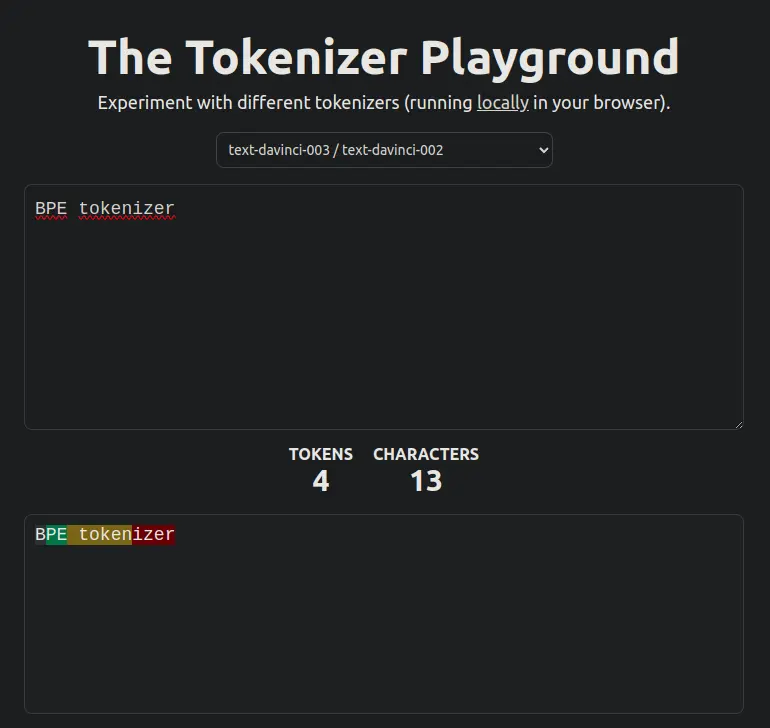
Agora que sabemos como funciona um tokenizador BPE, vamos ver através do visualizador the-tokenizer-playground como ficariam os tokens de qualquer frase.